Disclosure: Tires Review Zone is reader-supported. As an Amazon Associate I earn from qualifying purchases, at no extra cost to you. Learn more.

Buying tires for a BMW is a little different from buying tires for most cars. Many BMWs come with run-flat tires and no spare, many use staggered sizes (wider tires at the rear), and BMW approves specific tires that carry a star (★) marking on the sidewall. This guide explains what those details mean, whether you need to stick with them, and how to choose the right replacement tires for your BMW.
Tires Review Zone is independent and not affiliated with BMW. Always check your owner’s manual and door-jamb placard for your exact sizes and ratings.
Key takeaways
- Star-marked (★) tires are versions developed and approved for BMW vehicles. They are recommended, but not the only safe option.
- If your BMW has run-flat tires and no spare, switching to regular tires means carrying a sealant kit or spare.
- Staggered setups cannot usually be rotated front to back, so rear tires often wear out first.
- Always match the size, load index and speed rating on your placard, and replace tires in axle pairs at minimum.
What does the star (★) on BMW tires mean?
A star symbol on the sidewall shows the tire was developed with and approved by BMW for its vehicles. Tire makers tune these versions for the specific weight, suspension and handling of BMW models, so a star-marked tire may differ slightly from the regular version of the same tire.
Do you have to buy star-marked tires? No. Any tire in the correct size, load index and speed rating is legal and can be safe. Star-marked tires are the best way to keep the handling and ride BMW intended, and some owners prefer them on newer cars still under warranty. If you choose a non-star tire, pick a reputable model in the same category (for example, ultra-high-performance all-season or max-performance summer).
BMW says the star marking means the tire has been tailored and tested for a specific model; you can read how it describes the process on BMW’s wheels and tyres page. Tire makers publish their own star-marked ranges too, such as Michelin’s BMW line-up.
BMW tire sidewall markings decoded
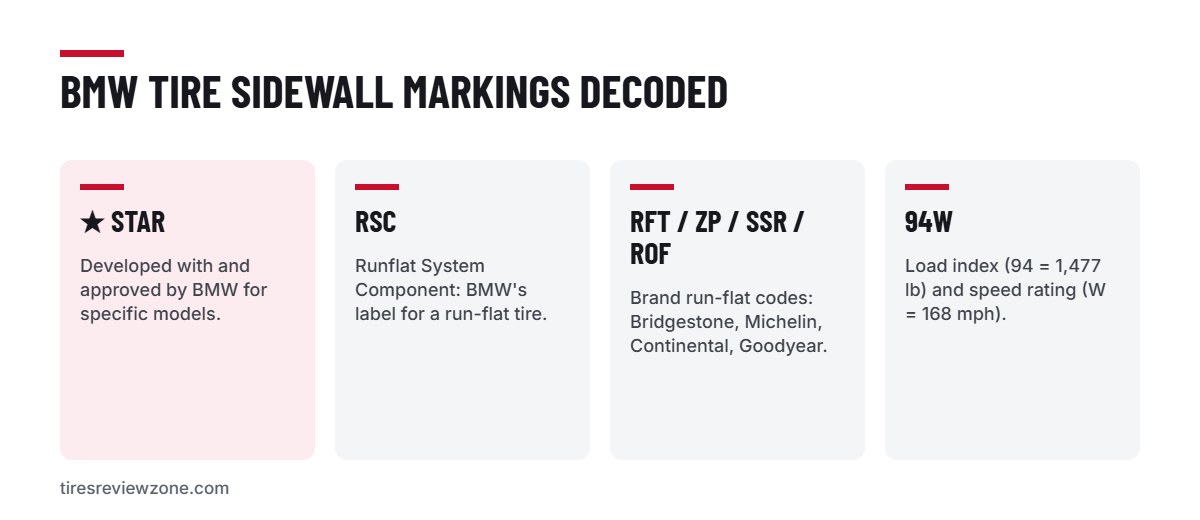
A BMW tire can carry several codes at once, and they mean different things. The star is about approval, while run-flat construction has its own marking:
- ★ (star): BMW-approved version of the tire for certain models.
- RSC: Runflat System Component, BMW’s name for a run-flat tire.
- Brand run-flat codes: Bridgestone uses RFT, Michelin ZP (Zero Pressure), Continental SSR (Self-Supporting Runflat) and Goodyear ROF (RunOnFlat). A tire can be a run-flat without being star-marked, and the other way round.
- Load index and speed rating: the number and letter after the size, such as 94W. Our tire speed rating guide explains the letters.
Run-flat tires on BMWs
Many BMW models come with run-flat tires (often marked RSC, for Runflat System Component). These have stiffened sidewalls that let you keep driving for a limited distance at reduced speed after a puncture, so many of these cars have no spare tire.
| Run-flat tires | Regular tires | |
|---|---|---|
| After a puncture | Drive on, at limited speed and distance, to a shop | Stop and use a spare or sealant kit |
| Ride comfort | Firmer | Usually softer and quieter |
| Price | Usually higher | Usually lower, more choices |
| Repairability | Often limited; depends on tire maker and whether driven flat | Standard tread repairs possible |
How far can you drive on a BMW run-flat tire?
Most run-flats are designed to keep going for up to about 50 miles at up to 50 mph after losing air. Bridgestone’s run-flat guide quotes those limits for its tires. The real range depends on the tire, the load in the car and the outside temperature, so check the figure in your BMW owner’s manual and treat it as a maximum, not a target. Once a run-flat has been driven without air, many tire makers will not allow it to be repaired.
If you switch to regular tires, buy a tire inflator and sealant kit or a compact spare, because the car has nowhere to carry a full-size spare. Your TPMS will still warn you of low pressure. For a deeper look at the technology, see how run-flat tires work and our run-flat tire guides.
Choosing run-flat tires for a BMW
If you want to keep run-flats, look for a tire marked both RSC and ★ in your exact size. That keeps the factory ride and handling and avoids surprises with the car’s suspension settings. If no star-marked run-flat suits your budget, a non-star run-flat in the same category (ultra-high-performance all-season, or max-performance summer) is the next best choice. Touring run-flats such as Bridgestone DriveGuard are built for cars that never came with run-flats, so they usually trade some sharpness for comfort.
Staggered tire sizes
Many rear-wheel-drive BMWs use wider tires on the rear than the front. That improves traction and handling, but because the sizes differ, you usually cannot rotate tires front to back. Expect to replace rear tires more often than fronts. When you do, replace both tires on the axle together and keep the same model front and rear for balanced handling.
Why staggered sizes still match
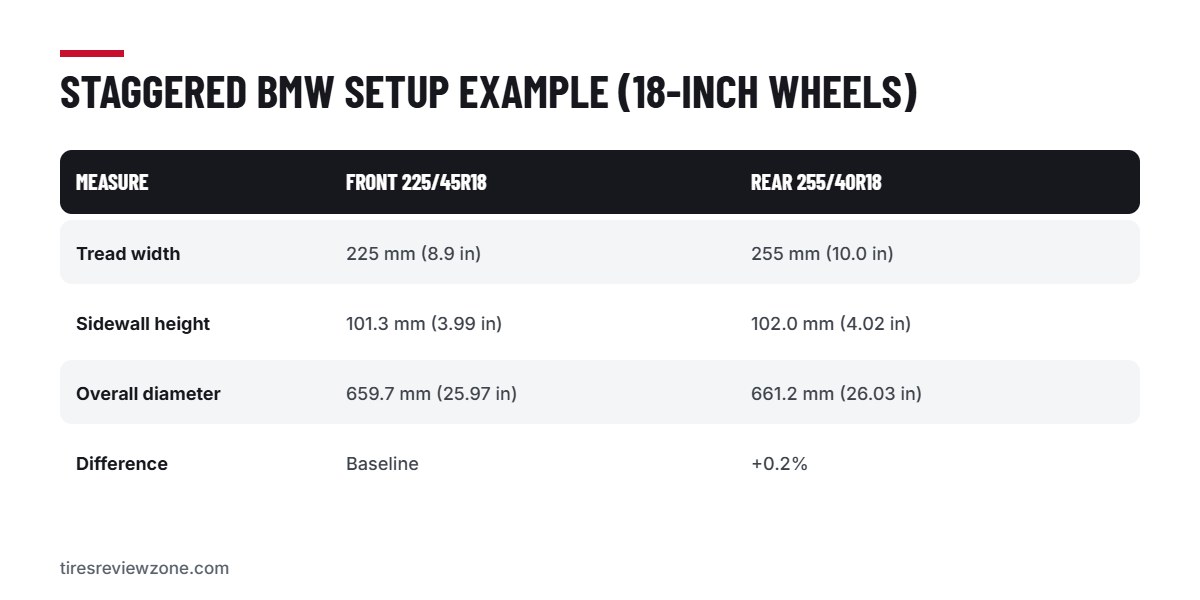
Staggered sizes look very different, but the overall diameters are matched. In the example above, the front tire is narrower with a taller profile (45), while the rear is wider with a lower profile (40). The result is an overall diameter difference of only about 0.2%, so the speedometer, ABS and stability control see all four wheels turning at nearly the same speed.
That matching matters even more on xDrive models, where the front and rear axles are linked. Always replace staggered tires with the exact sizes on your placard, and do not mix brands or tread depths across axles. If you are thinking about a different size, run it through our tire size calculator first.
How to choose replacement tires for your BMW
- Find your sizes on the door-jamb placard. Note whether front and rear differ.
- Decide run-flat or not. Weigh convenience after a puncture against comfort and cost.
- Pick a category that suits your climate: ultra-high-performance all-season for year-round use in mild winters, max-performance summer tires for warm climates with a winter set for cold months, or winter tires where snow is common.
- Match or exceed the load index and speed rating. Many BMWs require high speed ratings such as V, W or Y.
- Prefer star-marked versions if you want the factory-tuned feel, especially on newer models.
- Book an alignment when fitting new tires. BMWs are sensitive to alignment, and uneven inner-edge wear is a common complaint.
Where to buy BMW tires
- BMW dealers stock star-marked tires and know your car, but are usually the most expensive.
- Independent tire shops can order star-marked or alternative tires and often charge less for installation.
- Online retailers offer wide choice and let you filter by star marking. Read our guide to buying tires online before you order.
Whichever you choose, get a full installed price, including mounting, balancing, TPMS service and disposal.
Frequently asked questions
Do BMWs need special tires?
They need tires in the right size with the right load index and speed rating. BMW recommends star-marked tires, but other quality tires that meet the specs can be used.
Can I replace BMW run-flats with regular tires?
Yes, many owners do for a softer ride and lower cost. Carry a sealant and inflator kit or a compact spare, since most run-flat BMWs have no spare.
Should I replace all four tires on my BMW?
On staggered setups, replace tires in axle pairs at minimum. On all-wheel-drive (xDrive) models, check the owner’s manual, as large differences in tread depth between axles are not recommended.
Why do my BMW’s tires wear on the inside edge?
Often because of camber settings or worn suspension parts. An alignment check and regular pressure checks help.