

Disclosure: Tires Review Zone is reader-supported. As an Amazon Associate I earn from qualifying purchases, at no extra cost to you. Learn more.
When the tire pressure warning light comes on, most of the time a tire really is low. But sometimes the problem is that the tire pressure sensor is bad. A failing TPMS sensor can leave a light glowing on a perfect set of tires, show a wrong reading or stop reporting altogether. This guide shows you how to tell the difference, how to test a sensor and how to replace one without overpaying.
Key takeaways: a solid TPMS light means a tire is low, while a light that flashes for about a minute at start-up and then stays on points to a system fault, most often a dead sensor. Most direct sensors have sealed batteries, so the whole sensor is replaced when the battery dies. Always check all four tires with a gauge first; our guide to how tire pressure sensors work explains the two kinds of system.
Low tire vs bad sensor: read the light
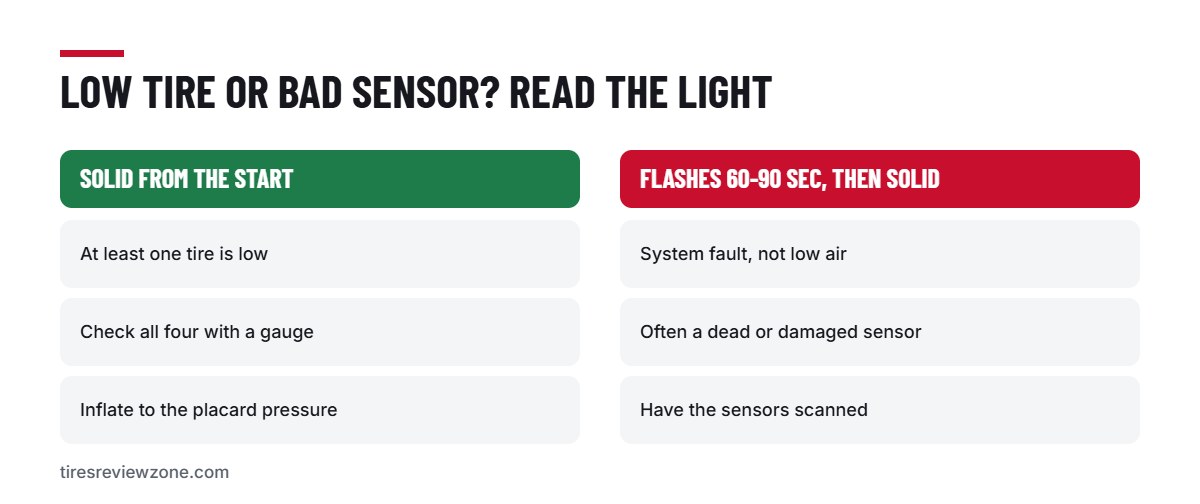
Direct TPMS uses a battery-powered sensor inside each wheel. The way the warning light behaves is the first clue:
- Solid light from the start: at least one tire is low. Check all four with a gauge.
- Light flashes for about 60 to 90 seconds at start-up, then stays on: the system has a fault, most often a dead or damaged sensor, or a sensor the car cannot see.
- Light goes off after you inflate the tires and drive a few minutes: it was pressure, not the sensor.
If you are not sure which system your car uses, see how tire pressure sensors work.
Signs a tire pressure sensor is bad
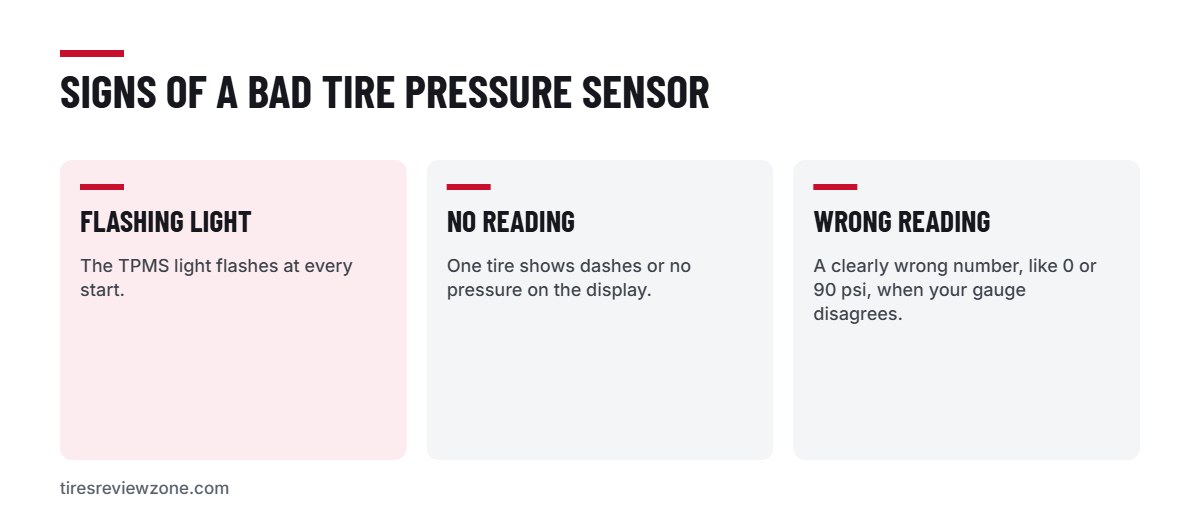
- Flashing TPMS light at every start.
- One tire shows no reading or dashes on the pressure display.
- A reading that is clearly wrong, such as 0 psi or 90 psi on a tire your gauge says is at 35 psi.
- The light stays on after you inflate all tires to the placard pressure and drive for 10 to 20 minutes.
- The sensors are old. Sensor batteries usually last about 5 to 10 years, and they often fail one after another.
- Recent tire work. A sensor can be broken or its valve stem cracked during a tire change.
- Corrosion on the valve stem, especially on aluminum stems in salted winter regions.
How to test a TPMS sensor
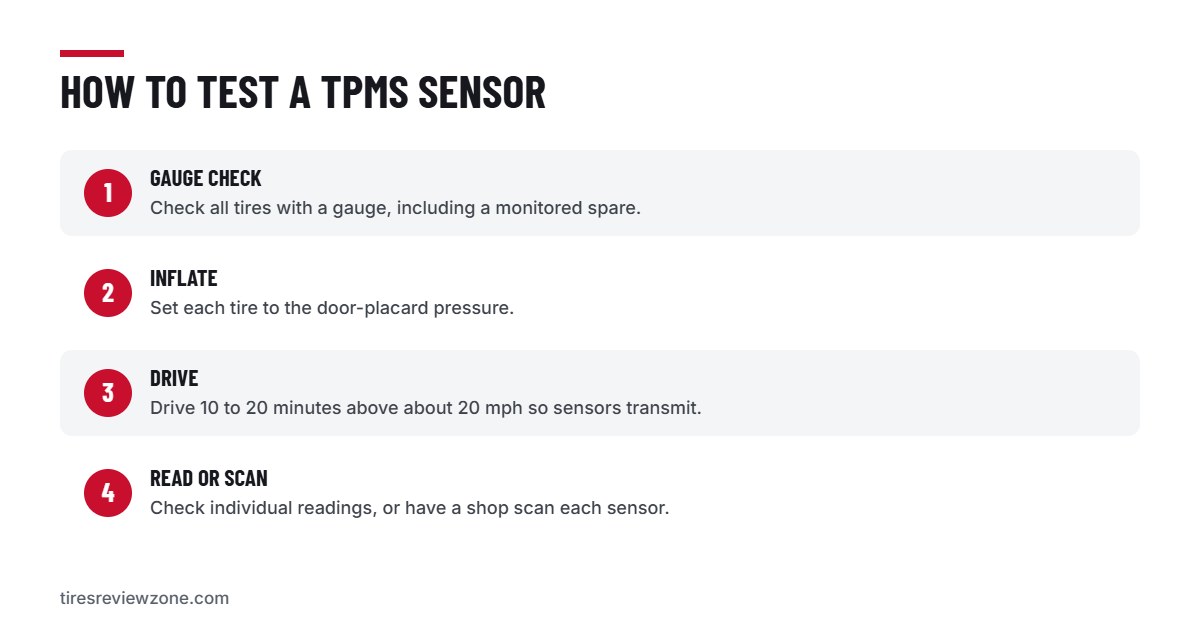
- Check pressure with a gauge on all tires, including the spare if it is monitored. Inflate to the door-placard pressure.
- Drive 10 to 20 minutes above about 20 mph so the sensors wake up and transmit.
- Read individual pressures on the dash if your vehicle shows them. A missing or frozen value points to that wheel.
- Use a TPMS tool. An inexpensive TPMS activation or scan tool can wake each sensor and read its ID, pressure and battery status. Many tire shops do this check for free or a small fee.
- Check after a rotation. If the car now shows the warning on a different corner, the sensor positions may need relearning rather than replacing.
Why sensors fail
- Dead battery: the battery is sealed inside the sensor and cannot be replaced on most units.
- Physical damage: from tire changes, potholes or a loose wheel weight.
- Corrosion: road salt attacks the valve stem and nut.
- Tire sealant: some repair sealants can clog the sensor port.
- Wrong frequency or programming after fitting an aftermarket sensor.
Cost-effective ways to replace tire pressure sensors
Replacing sensors one at a time at a dealer is the most expensive route. You can cut the cost several ways:
- Choose a quality aftermarket or programmable sensor. Universal programmable sensors are cloned or programmed to match your vehicle and often cost much less than dealer parts.
- Replace sensors when you buy new tires. The tires are already off the wheels, so you save on mounting labor. If the sensors are seven or more years old, replacing all four at once often makes sense.
- Ask about a TPMS service kit. If the sensor works but the stem leaks, a new seal, nut and valve core costs far less than a new sensor.
- Compare tire shops. Independent tire shops often charge less than dealers for sensor programming and relearning.
- Do the relearn yourself if your vehicle allows a manual or drive-around relearn; your owner’s manual explains the steps.
Typical costs vary by vehicle, but a single aftermarket sensor plus installation and programming usually costs noticeably less than a dealer original part. Ask for a written quote that includes the relearn.
Can you drive with a bad TPMS sensor?
Yes, the car will drive normally, but you lose your early warning for low pressure, and in some places a lit TPMS light can fail a safety inspection. Until it is fixed, check pressure with a reliable gauge at least weekly.
For tire safety basics and recalls, see NHTSA’s tire pages, the USTMA’s tire care essentials and USTMA tire recalls.
Frequently asked questions
How do I know if my tire pressure sensor is bad?
A TPMS light that flashes for about a minute at start-up and then stays on, a missing or wrong reading for one tire, or a light that stays on after all tires are correctly inflated are the main signs.
Can a TPMS sensor battery be replaced?
On most sensors, no. The battery is sealed inside, so the whole sensor is replaced when the battery dies.
How long do tire pressure sensors last?
Most TPMS sensors last about 5 to 10 years, depending mainly on battery life and driving.
Is it safe to drive with a bad tire pressure sensor?
The car drives normally, but you lose low-pressure warnings. Check your tires with a gauge regularly until the sensor is replaced.
What is the cheapest way to replace TPMS sensors?
Use quality programmable aftermarket sensors and replace them when you buy new tires to save on labor.
Will a bad TPMS sensor fail a safety inspection?
In some US states and Canadian provinces, a lit TPMS warning light can fail a safety inspection. If your inspection is due, fix the sensor first.
Do sensors need to be relearned after replacement?
Most cars need a relearn so the TPMS module knows the new sensor’s ID. Some do it automatically after a short drive; others need a scan tool or a procedure from the owner’s manual.
Can I replace just one TPMS sensor?
Yes. You only need to replace the faulty sensor, but sensors fitted at the same time often fail around the same age, so many owners replace all four when tires are changed.