

Disclosure: Tires Review Zone is reader-supported. As an Amazon Associate I earn from qualifying purchases, at no extra cost to you. Learn more.
Goodyear has made performance tires for decades, and its Eagle name has been on some of the most exciting cars ever built. Today the Eagle family covers everything from track-ready summer tires to sporty all-season tires for daily drivers. The range has also changed recently, with new models replacing several long-running favourites.
This guide explains the current Goodyear performance tire lineup, what each tire is designed for, how the newer models compare with the ones they replace, and how to choose the right Goodyear performance tire for your car and climate.
The Goodyear Eagle Performance Lineup
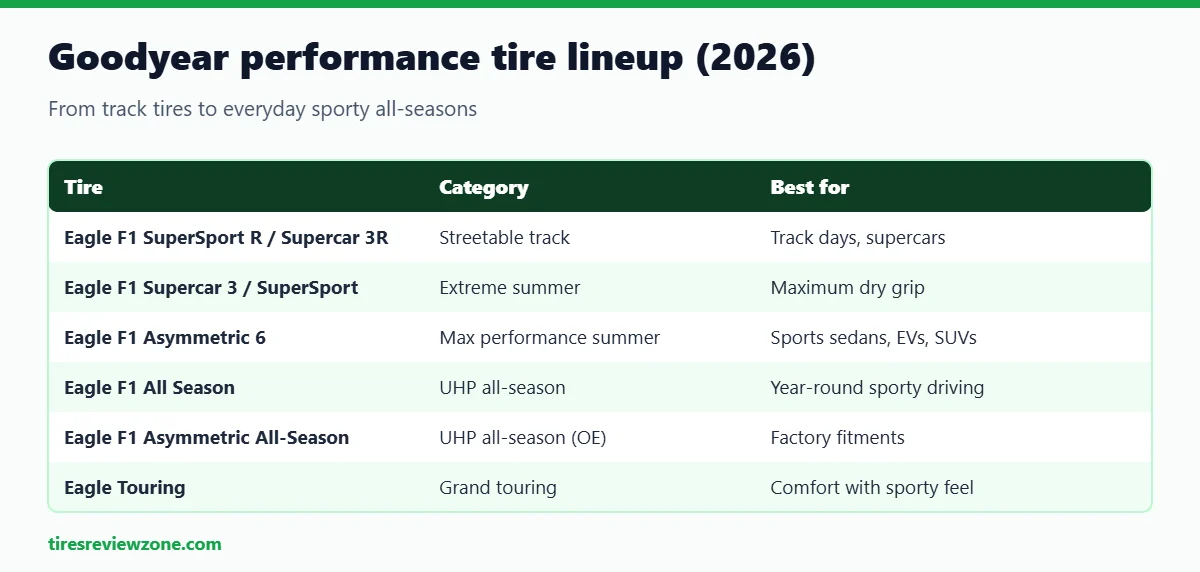
Tire Rack’s Goodyear Eagle lineup guide describes the Eagle F1 badge as Goodyear’s highest level of performance, but notes that it covers several very different tires. Here is how the range breaks down:
Streetable track and competition tires
The Eagle F1 SuperSport R and Eagle F1 Supercar 3R sit at the top. They are designed for drivers who use their cars on track days and want near-race grip while staying street legal. They wear quickly and are best in warm, dry conditions.
Extreme performance summer tires
Tires such as the Eagle F1 SuperSport and Eagle F1 Supercar 3 focus on outright grip and rapid steering response for high-performance cars, with slightly more road-friendly manners than the R versions.
Max performance summer: Eagle F1 Asymmetric 6
The Eagle F1 Asymmetric 6 is the heart of the lineup. It is a premium ultra-high-performance summer tire that launched in the US and Canada in May 2025. Goodyear offers it in more than 100 sizes from 17 to 23 inches, with nearly 90% of sizes 18 inches or larger, and backs it with a 30,000-mile treadwear warranty. It fits cars such as the BMW 3 Series and M3, Audi A4 and S4, Mercedes C-Class, Porsche Macan and Tesla Model S. In Europe it won Auto Bild’s 2023 summer tire test.
UHP all-season: Eagle F1 All Season
The Eagle F1 All Season is Goodyear’s newest ultra-high-performance all-season tire, launched in October 2025 for sports cars, performance sedans and premium crossovers. It is designed for grip in dry, wet and light snow conditions. You can read the announcement in Goodyear’s Eagle F1 All Season press release.
Eagle F1 Asymmetric All-Season and Eagle Touring
The Eagle F1 Asymmetric All-Season is common as original equipment on sporty cars. The Eagle Touring is a grand touring tire that adds sporty handling to a comfortable, quiet ride.
What Replaced the Eagle Exhilarate?
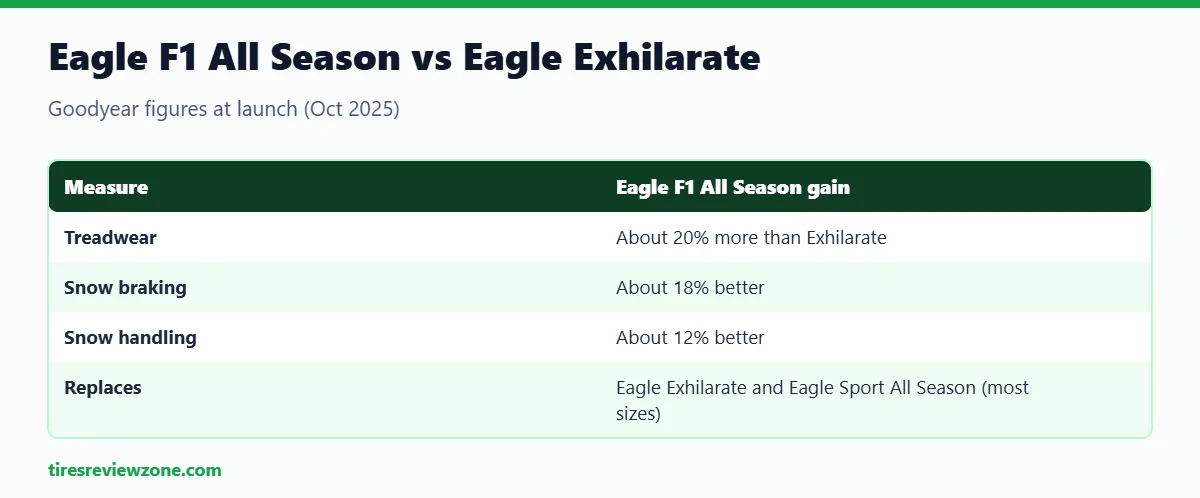
According to Modern Tire Dealer’s report on the Eagle F1 All Season launch, the new tire replaces the Eagle Exhilarate and the Eagle Sport All Season, although Goodyear is keeping some original equipment fitments. Goodyear says the Eagle F1 All Season offers about 20% more treadwear, 18% better snow braking and 12% better snow handling than the Exhilarate. It also fits 117 vehicles that use staggered tire sizes, with different widths front and rear.
If you are replacing worn Eagle Exhilarate or Eagle Sport All Season tires, the Eagle F1 All Season is Goodyear’s intended successor.
Summer vs All-Season Performance Tires
The biggest decision is whether you need summer or all-season performance tires:
- Summer tires such as the Eagle F1 Asymmetric 6 give the best grip and braking in warm weather, both dry and wet. They should not be used in snow or freezing temperatures, where the rubber hardens and grip falls sharply.
- All-season performance tires such as the Eagle F1 All Season trade some warm-weather grip for the ability to handle cool temperatures and light snow. They suit drivers who want one set of tires all year in a moderate climate.
Our guide to summer vs all-season tires explains the cold-weather limits in more detail, and our guide to touring vs performance tires explains how performance tires compare with comfort-focused touring tires.
How Goodyear Compares With Rivals
Goodyear’s main rivals in performance tires include Michelin, Bridgestone, Continental and Pirelli. In ultra-high-performance all-season testing, Goodyear’s newest tires have been competitive with the best. For a wider comparison, see our list of the best ultra high performance all-season tires, which covers the Eagle F1 All Season alongside its main rivals, and our best summer tires guide.
How to Choose the Right Goodyear Performance Tire
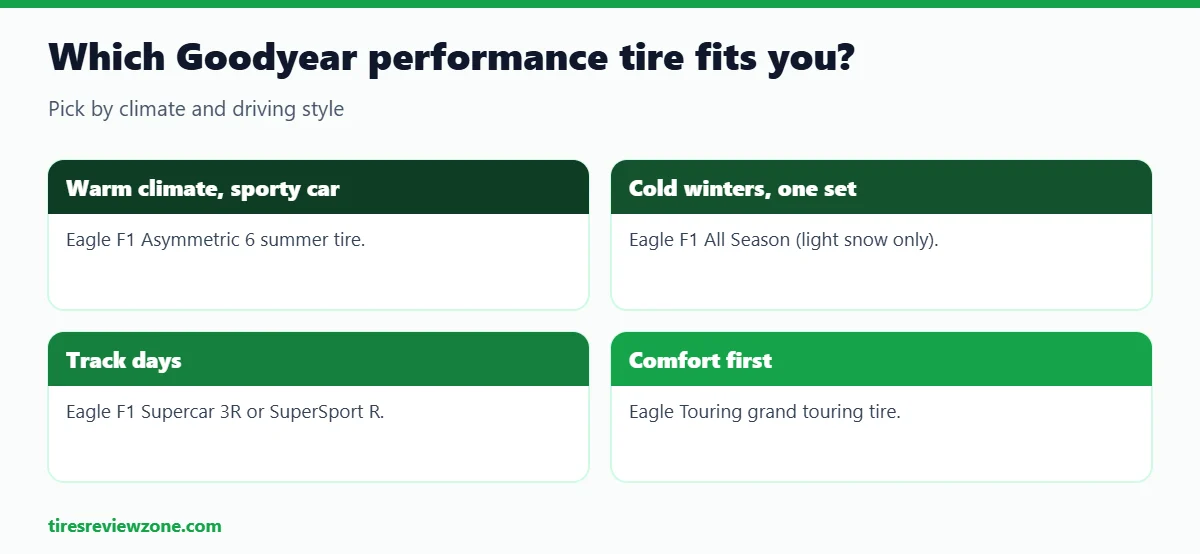
- Warm climate and a sporty car: the Eagle F1 Asymmetric 6 gives the best balance of grip and comfort.
- Cold winters but only one set of tires: the Eagle F1 All Season, keeping in mind it is for light snow only. In harsh winters, add dedicated winter tires.
- Regular track days: the Eagle F1 Supercar 3R or SuperSport R.
- Comfort first with some sportiness: the Eagle Touring.
Always match the size, load index and speed rating on your door placard. Performance cars often specify high speed ratings, and our tire speed rating chart explains each letter.
Understanding Goodyear Tire Technologies
Goodyear uses several named technologies across the Eagle range. Knowing what they do makes the spec sheets easier to read:
- Asymmetric tread: the outer shoulder uses large, stiff blocks for cornering grip, while the inner side uses more grooves and sipes to clear water. This is why the Asymmetric tires must be mounted with the “outside” marking facing out.
- Dry Stability Plus: used in the Eagle F1 Asymmetric 6, it helps the tread adapt to the road surface for steady grip and stability when braking and cornering.
- Low rolling resistance compounds: Goodyear says the Asymmetric 6 is EV-ready, with low rolling resistance for better range and lower cabin noise, which suits heavy, quiet electric cars.
- Staggered fitments: many sports cars use wider rear tires than front tires. The Eagle F1 All Season was designed to cover a large number of these staggered setups.
Price and Value
Goodyear’s performance tires sit in the premium price bracket, alongside Michelin and Continental. Track-focused models such as the Supercar 3R cost the most and wear the fastest. The Eagle F1 All Season usually offers the best value for daily drivers, because it lasts longer and avoids the cost of a second set for winter in moderate climates. Look out for Goodyear rebates in spring and autumn, which can reduce the price of a set noticeably.
Caring for Performance Tires
- Check pressures often; performance tires are sensitive to small changes.
- Rotate where your vehicle allows it. Staggered setups with different front and rear sizes can usually only be swapped side to side, or not at all.
- Store summer tires indoors in winter, away from heat sources and sunlight.
- Expect faster wear than touring tires, especially with spirited driving.
Frequently Asked Questions
What is the best Goodyear performance tire?
For most sports sedans in warm climates, the Eagle F1 Asymmetric 6. For year-round use, the Eagle F1 All Season.
Is the Goodyear Eagle Exhilarate discontinued?
Goodyear is replacing it with the Eagle F1 All Season, while keeping a few original equipment fitments.
How long do Goodyear performance tires last?
The Eagle F1 Asymmetric 6 carries a 30,000-mile treadwear warranty. Track-focused tires wear much faster.
Can I drive Goodyear summer tires in winter?
No. Summer tires should not be used in snow or freezing temperatures.
Final Thoughts
Goodyear’s Eagle range now covers every kind of performance driving, from track days to sporty year-round commuting. The Eagle F1 Asymmetric 6 leads for warm-weather grip, the new Eagle F1 All Season replaces the Exhilarate as the year-round choice, and the Supercar and SuperSport R models serve dedicated enthusiasts. Pick by climate first, then by how hard you drive, and keep the speed rating your car needs.