

Disclosure: Tires Review Zone is reader-supported. As an Amazon Associate I earn from qualifying purchases, at no extra cost to you. Learn more.
Run-flat tires let you keep driving after a puncture instead of stopping at the roadside to change a wheel. They are fitted as standard on many BMW, MINI and Mercedes-Benz models, and on other cars that have no spare tire. They are also more expensive, ride more firmly and come with rules many owners never hear about until they get a flat. This guide covers everything in one place: how run-flats work, how far you can drive on one, whether a punctured run-flat can be repaired, and what your options are when it is time to replace them.
Key takeaways: run-flat tires have reinforced sidewalls that let you drive up to about 50 miles at 50 mph after a puncture. Whether one can be repaired depends on the brand and how far it was driven flat; many must be replaced. You can switch to regular tires if you fit all four and carry a spare or repair kit.
How run-flat tires work
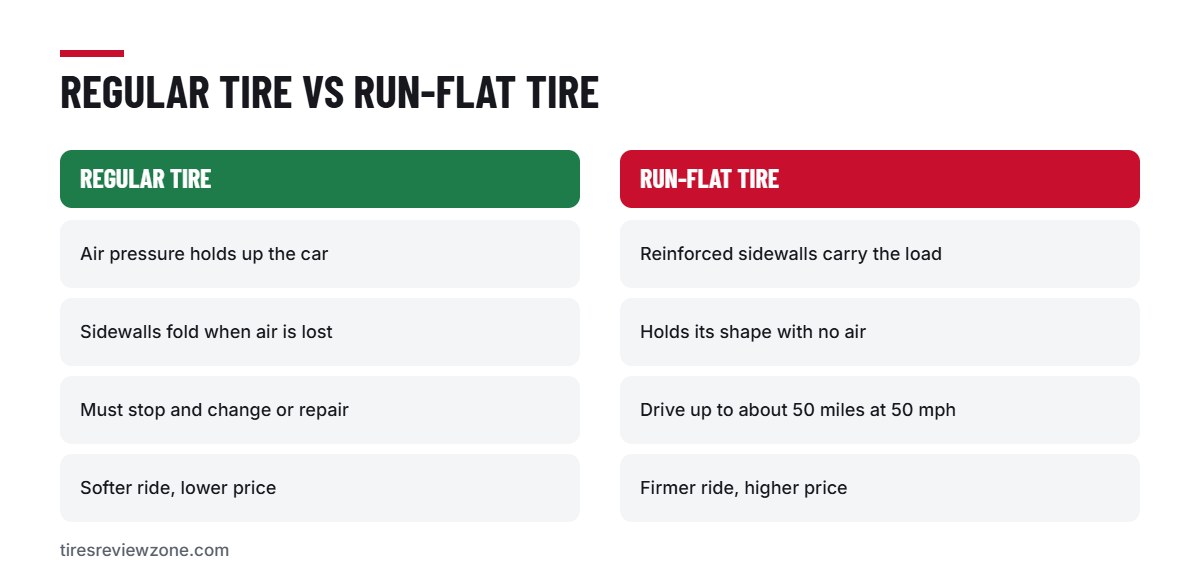
A normal tire relies on air pressure to hold up the car. When the air escapes, the sidewalls fold and the wheel rim sinks onto the road. A run-flat is built so that it can carry the car’s weight for a limited time even with no air inside. There are two main designs:
- Self-supporting run-flats are by far the most common. They have thick, reinforced sidewalls made of heat-resistant rubber that hold the tire’s shape when the pressure is gone. Brands give them names such as Bridgestone RFT and DriveGuard, Michelin ZP (Zero Pressure), Goodyear ROF and Continental SSR.
- Support-ring systems use a hard ring fitted inside the tire on a special wheel. If the tire deflates, the ring carries the load. They are mostly found on armored and military vehicles.
Because a run-flat may look almost normal even with no air in it, cars fitted with them need a tire pressure monitoring system. Motor1 notes that Bridgestone requires TPMS for its run-flat applications; without it, you might not know you have a puncture at all.
How far and how fast can you drive on a run-flat?
The usual rule is up to 50 miles at up to 50 mph after a complete loss of pressure. Bridgestone, for example, rates its DriveGuard Plus for up to 50 miles at up to 50 mph after a puncture. Some tires and vehicles have different limits, so check your owner’s manual.
Those numbers are maximums, not targets. Driving slower does not extend the distance, and heavy loads, hot weather and hard cornering all reduce what the tire can safely do. The best approach is to drive gently to the nearest tire shop rather than finishing your trip. If you are on a busy highway, our guide on what to do if you get a flat tire on the highway covers getting off the road safely.
What to do when a run-flat loses pressure
- Take the warning seriously. If the TPMS light comes on, assume a tire is losing air even if the car feels normal. On a cold morning the light can also mean the tires are simply low; our guide on why the tire pressure light comes on in the cold explains the difference.
- Slow down to 50 mph or less and avoid hard braking, sharp turns and heavy loads.
- Check the pressures on the dashboard display or with a gauge at the next safe stop.
- Note the distance you drive from the moment the warning appeared. The shop will ask, and it decides whether a repair is possible.
- Drive to the nearest tire shop, not to your destination, and tell them the tire is a run-flat so they use the right equipment.
Can run-flat tires be repaired?
Sometimes. The answer depends on the tire maker, the location and size of the damage, and above all how far and how fast the tire was driven with no air. Driving on a deflated run-flat heats and weakens the sidewall from the inside, damage that is not always visible. That is why any repair has to follow a full inspection with the tire removed from the wheel.
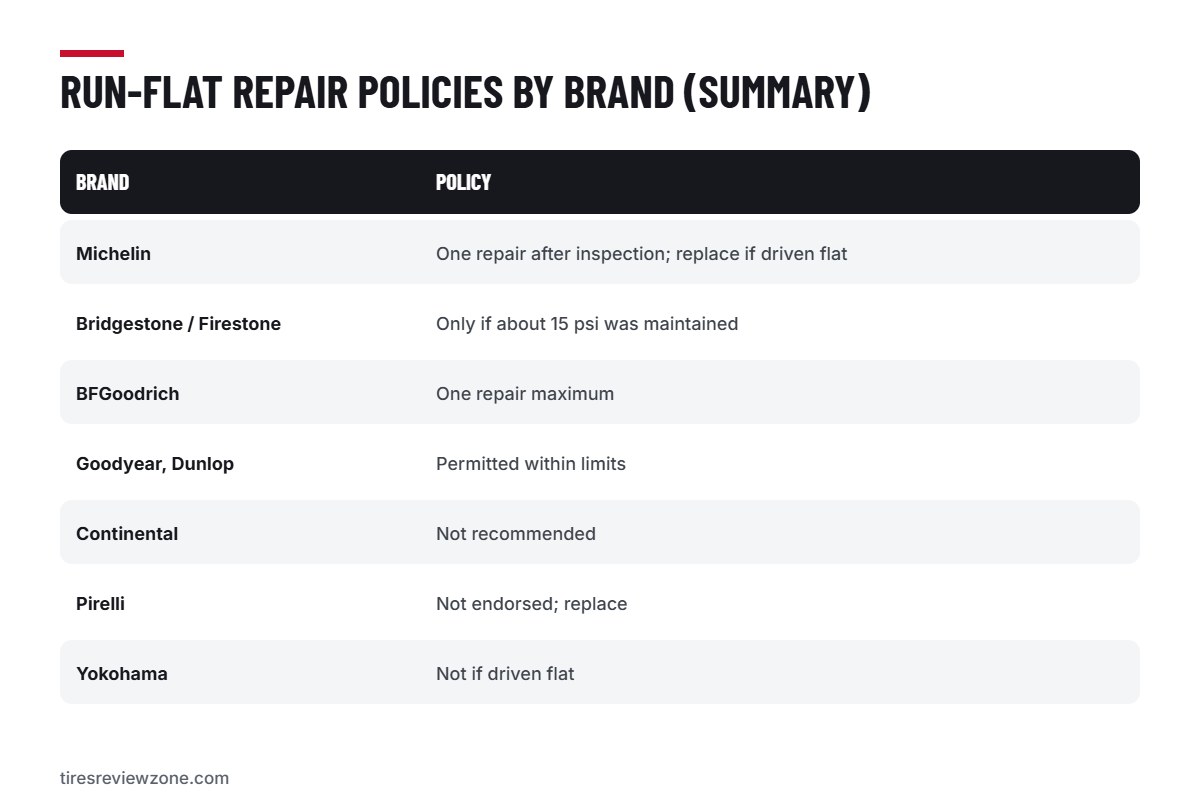
Tire makers’ policies differ. Tire Rack keeps a summary of manufacturer run-flat repair policies; at the time of writing, the general picture looks like this:
| Brand | Repair policy (summary) |
|---|---|
| Michelin | One repair permitted after inspection; a tire driven flat must be replaced |
| Bridgestone / Firestone | Repair permitted only if the tire kept at least about 15 psi |
| BFGoodrich | One repair maximum |
| Goodyear and Dunlop | Repair permitted within limits |
| Continental | Repair not recommended |
| Pirelli | Repair not endorsed; replace |
| Yokohama | Not to be repaired if driven flat |
Policies change, and some vehicle makers forbid repairs to their original-equipment run-flats regardless of the tire maker’s rules, so check your owner’s manual and the tire maker’s current policy. As a rule of thumb:
- Possibly repairable: a small puncture (about 1/4 inch or less) in the center tread area, found before the tire lost all its pressure.
- Must be replaced: any sidewall or shoulder damage, a tire driven a long way or at speed while flat, a tire that has been repaired before, or any tire the maker says should not be repaired.
Replacing run-flat tires
Like-for-like replacement
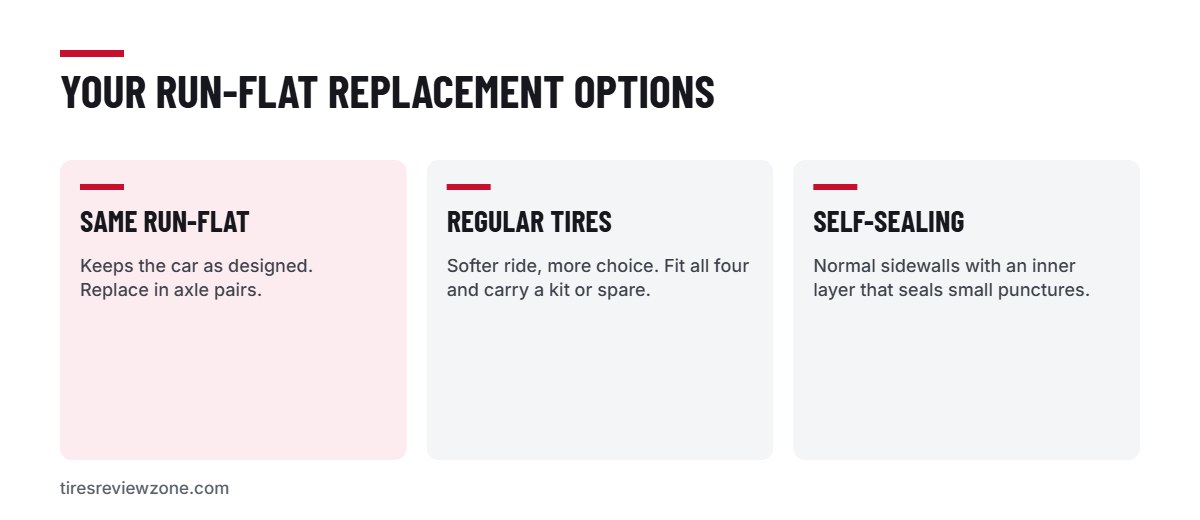
The simplest option is to fit the same run-flat model, or another run-flat in the same size, load index and speed rating. Replace tires in pairs on the same axle so they wear and behave the same, and on all-wheel-drive cars keep tread depths closely matched. Run-flats have very stiff sidewalls, so choose a shop with experience and the right mounting equipment; poor fitting can damage the bead or the TPMS sensor.
Switching to regular tires
Many owners swap run-flats for conventional tires to get a softer ride, more choice and lower prices. This is usually possible, but think it through first:
- You will have no spare. Cars built for run-flats often have no spare wheel or jack. Carry a sealant and compressor kit, or buy a compact spare that fits the car. Our guide to using a tire repair kit explains how kits work.
- Handling may change. The suspension was tuned for stiff run-flat sidewalls, so regular tires can feel softer and less precise. Many drivers prefer the ride; a few dislike the change.
- Fit all four. Do not mix run-flats and regular tires on the same car.
- Check the manual and warranty. A few vehicle makers recommend against the switch.
When to replace them
Run-flats wear out like any other tire. Replace them at the legal tread limit or sooner for wet-road safety, if they show cracks or bulges, after any run-flat use the maker says requires replacement, or when they reach the age limit your tire or vehicle maker recommends.
Run-flat tires: pros and cons
| Pros | Cons |
|---|---|
| Keep driving after a puncture, so no roadside wheel change | Firmer, sometimes noisier ride |
| More stable if a tire suddenly loses air at speed | Usually more expensive to buy |
| No spare needed, saving weight and trunk space | Repairs often not allowed; you may have to replace instead |
| Safer than stopping on a dangerous road | Fewer models and sizes to choose from |
If you prefer conventional tires but want some protection from punctures, self-sealing tires are an alternative: they have a layer inside that seals small tread punctures as they happen, while keeping a normal sidewall.
Frequently asked questions
How do I know if my car has run-flat tires?
Look on the sidewall for a marking such as RFT, ZP, ROF, SSR, RSC or a run-flat symbol. Cars with run-flats also usually have no spare tire.
Can I drive on a run-flat tire without TPMS?
You should not rely on run-flats without TPMS. A deflated run-flat can look almost normal, so without a warning you may drive too far or too fast on it.
Can I put regular tires on a car that came with run-flats?
Usually yes, if you fit all four and carry a spare or repair kit. Check your owner’s manual first.
Do run-flat tires wear out faster?
Not necessarily. Tread life depends on the tire model, but run-flats are often original-equipment tires on performance cars, which tend to wear faster.
Can you plug a run-flat tire?
A plug alone is not a proper permanent repair for any tire. Where a run-flat repair is allowed, it must be a plug-patch from the inside after a full inspection.