
Disclosure: Tires Review Zone is reader-supported. As an Amazon Associate I earn from qualifying purchases, at no extra cost to you. Learn more.
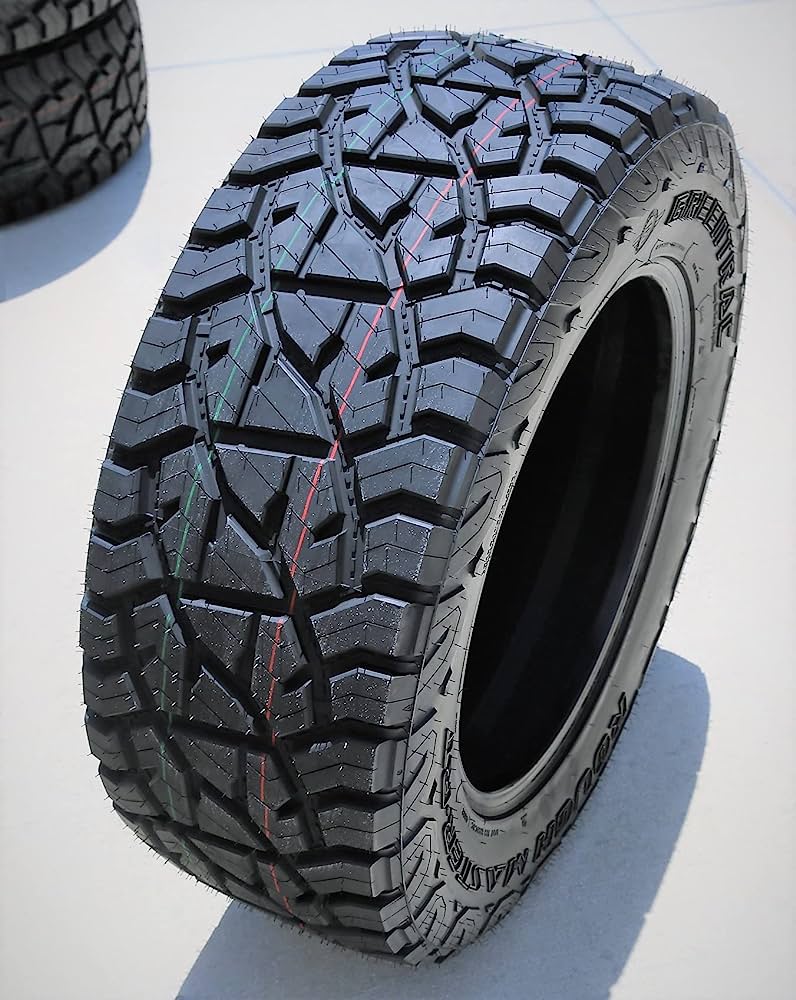
All-terrain (A/T) tires are the most popular upgrade for pickups and SUVs because they do a bit of everything: a reasonably quiet ride on the highway, plus extra grip on gravel, dirt, mud, snow and sand. This buyer’s guide explains what makes a light-truck (LT) all-terrain tire different, how to read load ranges, and how to pick the right A/T for the way you actually use your truck.
Looking for specific models? See our list of the best all-terrain light truck tires.
Key takeaways
- All-terrain tires sit between highway (H/T) and mud-terrain (M/T) tires: better off-road than H/T, quieter and longer-lasting than M/T.
- LT tires have stronger construction and higher load capacity than passenger (P-metric) tires. Choose them for towing, heavy loads and serious off-road use.
- Check the load range (C, D or E) and load index against your truck’s needs.
- If you drive in snow, choose an A/T with the three-peak mountain snowflake (3PMSF) symbol.
Highway vs. all-terrain vs. mud-terrain
| Highway (H/T) | All-terrain (A/T) | Mud-terrain (M/T) | |
|---|---|---|---|
| Best for | Pavement, towing on highways | Mixed use: daily driving plus gravel, dirt, light mud, snow | Deep mud, rocks, serious off-roading |
| Tread | Tight, ribbed pattern | Medium-sized blocks with moderate voids | Large blocks with wide voids |
| Road noise | Quietest | Moderate | Loudest |
| Tread life | Longest | Good | Shortest |
| Snow performance | Varies | Good, especially 3PMSF models | Often weaker on packed snow and ice |
There are also rugged-terrain (R/T) or hybrid tires that fall between A/T and M/T, for drivers who off-road often but still commute.
LT vs. P-metric all-terrain tires
Many all-terrain tires come in two versions:
- P-metric (or Euro-metric): designed for passenger use on lighter SUVs and half-ton trucks. Softer ride, lighter weight.
- LT (light truck): tougher casings, often extra sidewall plies, higher load capacity and better puncture resistance. Required on most heavy-duty three-quarter- and one-ton trucks.
LT tires usually run higher pressures and ride firmer. If you mostly drive on pavement with a half-ton truck, a P-metric A/T may be more comfortable. If you tow, haul or drive rocky trails, choose LT. Read our guide to light truck tires for more detail.
Understanding load ranges
| Load range | Ply rating | Typical use |
|---|---|---|
| C | 6-ply rating | Lighter trucks and SUVs, moderate loads |
| D | 8-ply rating | Half-ton and some three-quarter-ton trucks, towing |
| E | 10-ply rating | Three-quarter- and one-ton trucks, heavy towing |
“Ply rating” describes strength, not the actual number of layers. Always meet or exceed your truck’s original load range and load index, and inflate to the pressure that matches your load.
How A/T tires handle different terrain
- Gravel and dirt: stone ejectors and tough tread compounds resist chips and cuts. Sidewall protection matters on sharp gravel.
- Mud: A/Ts handle light to moderate mud. Open shoulder voids help clear it. For deep, sticky mud, an M/T or hybrid works better.
- Rocks: LT construction and sidewall lugs protect against punctures. Many drivers lower pressure slightly on slow trails for more grip, then reinflate before returning to pavement.
- Sand: lowering pressure lengthens the footprint to help the tire float. Drive steadily, avoid sharp turns, and carry a compressor to reinflate.
- Snow and ice: 3PMSF-rated A/Ts are good in snow. On glare ice, a dedicated winter tire still grips better.
Never drive at highway speeds on reduced off-road pressures. Reinflate to the placard or load-appropriate pressure first.
How to choose the right all-terrain tire
- Be honest about your mix of pavement and off-road miles. Mostly pavement points to a highway-friendly A/T. Weekly trails point to a tougher LT A/T or hybrid.
- Match size, load index and load range to your placard or your loads, and check clearance if you go larger.
- Look for 3PMSF if you see regular snow.
- Compare tread-life warranties and owner reviews for noise and wear.
- Budget for installation: mounting, balancing, alignment and possibly a speedometer recalibration if you change size.
Making all-terrain tires last
- Rotate every 5,000 miles or as recommended. A/T tread blocks are prone to uneven wear if not rotated.
- Check pressure monthly and adjust for loads and towing. See our PSI guide.
- Get an alignment with a new set and after hard off-road impacts.
- Inspect sidewalls for cuts after trail runs.
Popular all-terrain models to compare
Several well-known all-terrain tires have been replaced by newer versions, so check you are comparing current models. The BFGoodrich KO2 has been succeeded by the All-Terrain T/A KO3, and Falken’s Wildpeak AT3W by the Wildpeak A/T4W. Other popular choices include the Toyo Open Country A/T III, Cooper Discoverer AT3 4S and the more road-focused Continental TerrainContact A/T. Read our light truck tires and off-road tires sections for detailed comparisons.
Frequently asked questions
Are all-terrain tires good for daily driving?
Yes. Modern A/Ts are designed to be driven on pavement every day. They are a little noisier and use slightly more fuel than highway tires.
Are all-terrain tires good in snow?
Many are, especially models with the 3PMSF symbol. For frequent ice, a dedicated winter tire is better.
Do I need LT tires on a half-ton truck?
Not necessarily. If you rarely tow or off-road, a P-metric A/T may ride better. If you tow often or drive rocky trails, LT tires add strength.
How long do all-terrain tires last?
It depends on the tire, load and rotation habits. Check the manufacturer’s tread-life warranty, and rotate regularly to reach it.
Explore more in our light truck tire guides and off-road tire guides.