

Disclosure: Tires Review Zone is reader-supported. As an Amazon Associate I earn from qualifying purchases, at no extra cost to you. Learn more.
If your car feels noisy on the highway, the tires are often the biggest cause. A constant hum, roar or drone from the road can make long drives tiring and turn a comfortable car into a noisy one. The good news is that switching to quiet passenger car tires, along with simple maintenance, can make a big difference.
This guide explains what makes some tires quieter than others, which types of passenger car tires are usually the quietest, popular low-noise models to consider in 2026, and how to keep your tires quiet as they wear.
Why Do Some Tires Make More Noise?
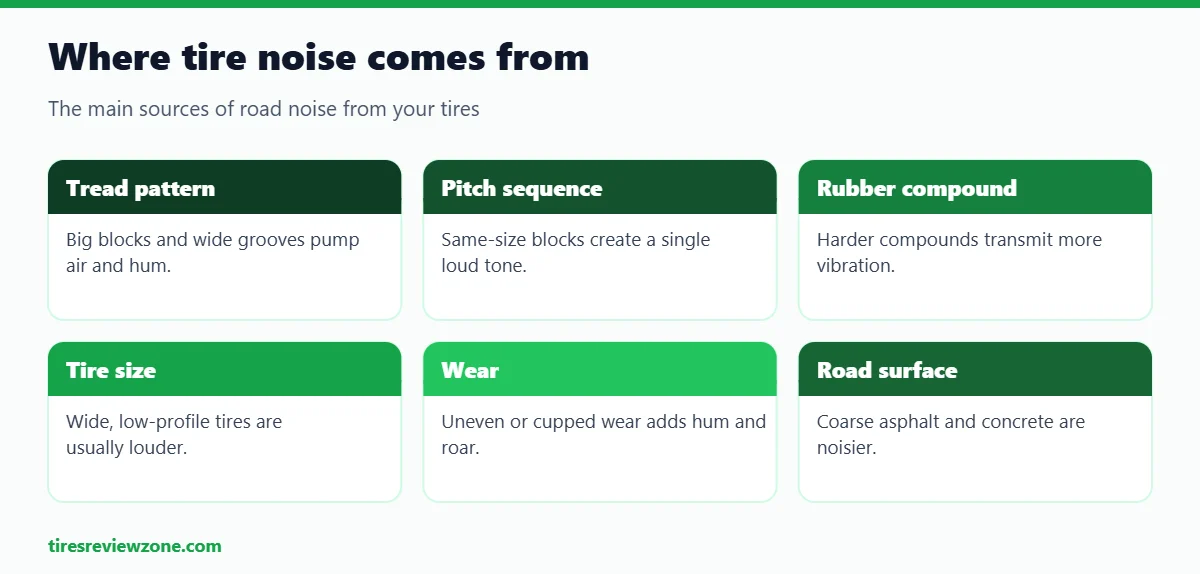
Tire noise comes from several sources working together:
- Tread pattern: large blocks and wide grooves trap and release air as the tire rolls, creating a hum. This is why all-terrain and mud-terrain tires are louder than touring tires.
- Pitch sequence: if all tread blocks were the same size, they would create one loud tone. Quiet tires use blocks of different lengths, called variable pitch, to spread the sound across many frequencies so it is less noticeable.
- Rubber compound and construction: softer compounds and well-tuned internal construction absorb more vibration before it reaches the cabin.
- Size: wider tires with low-profile sidewalls usually transmit more noise than narrower tires with taller sidewalls.
- Wear: tires that wear unevenly, with cupping or feathered edges, get louder over time.
- Road surface: coarse asphalt and grooved concrete are much noisier than smooth asphalt, whatever tire you use.
Which Types of Tires Are Quietest?
Tire category is the best predictor of noise. In general, from quietest to loudest:
- Grand touring and standard touring all-season tires for cars and crossovers, which put comfort first.
- Highway all-season tires for SUVs and trucks, which use tight tread patterns for smooth highway driving.
- Performance and ultra-high-performance tires, which focus on grip and can be firmer and louder.
- All-terrain tires, which have larger blocks for off-road grip.
- Mud-terrain tires, the loudest, with big open tread blocks.
Tire Rack notes that touring all-season categories are built around comfort, quietness and long-term dependability. If noise is your main concern, start in these categories. Our guide to touring vs performance tires explains the trade-offs, and our guide to the difference between highway and touring tires helps SUV and truck owners.
Quiet Tires to Consider in 2026
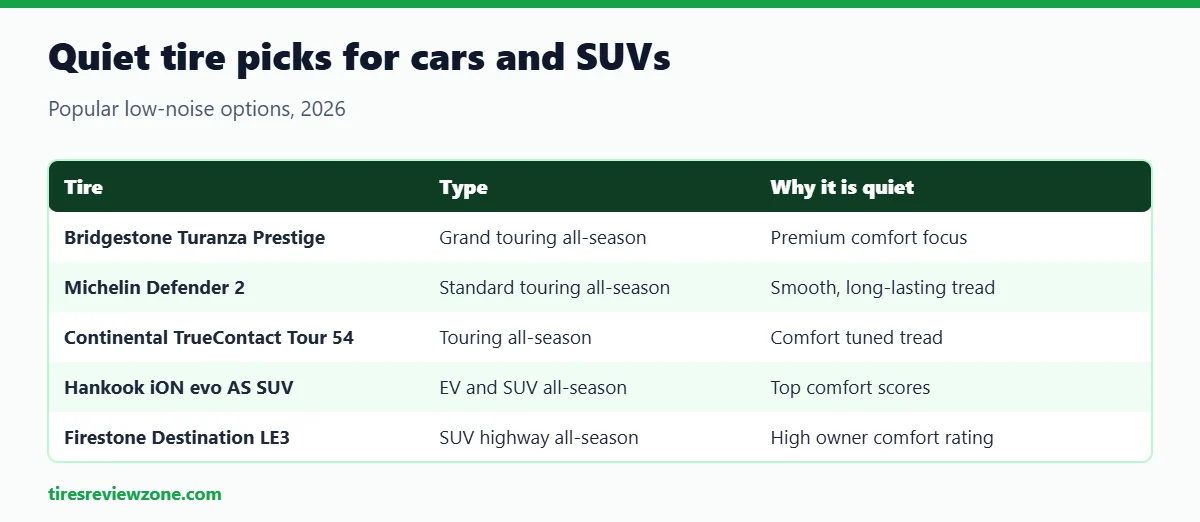
Noise ratings come from a mix of test results and owner surveys, and results vary by vehicle and size. These tires are widely recognised for comfort and low noise:
Bridgestone Turanza Prestige
A premium grand touring all-season tire designed around ride comfort and a quiet cabin. It was one of the tires in Tire Rack’s November 2025 touring all-season road test on a Toyota Camry, alongside other leading comfort-focused tires.
Michelin Defender 2
A standard touring all-season tire known for a smooth ride and very long life, with an 80,000-mile treadwear warranty. Consumer Reports ranked it as its top overall all-season tire for 2026, and it is a strong choice for drivers who want low noise and low cost per mile.
Continental TrueContact Tour 54
Continental’s comfort-focused touring tire, which combined two earlier lines, the PureContact LS and TrueContact Tour, into one product. It is aimed at sedans and crossovers and balances quietness with wet grip.
Hankook iON evo AS and iON evo AS SUV
Designed for electric vehicles, where tire noise is more noticeable because there is no engine sound to mask it. Tire Grades rates the iON evo AS SUV as having category-leading comfort, and it also works well on non-electric crossovers.
Firestone Destination LE3 (SUVs)
For SUVs and pickups, Tire Rack has named the Firestone Destination LE3, Bridgestone Dueler LX and Goodyear Wrangler Steadfast HT among the quietest highway all-season tires it has tested. More than 600 Tire Rack customers rated the Destination LE3 9.0 out of 10 for comfort, a category that includes road noise.
For the latest independent comparisons, see Tire Rack’s touring all-season tire road test and its grand touring all-season category ratings.
How to Choose Quiet Passenger Car Tires
- Pick the right category: touring all-season tires for cars and crossovers, highway all-season tires for SUVs and trucks.
- Read owner noise ratings: retailer surveys often score noise and comfort separately. Look for consistently high scores across many reviews.
- Consider sidewall height: if your car offers several wheel sizes, a smaller wheel with a taller sidewall is usually quieter.
- Look for noise-reduction features: some tires use variable-pitch tread, special compounds or foam liners inside the tire to absorb sound.
- Balance noise with safety: do not choose a tire for quietness alone. Check wet braking and snow performance for the weather you drive in. Our guide to all-season tires explains the main types.
How to Keep Your Tires Quiet
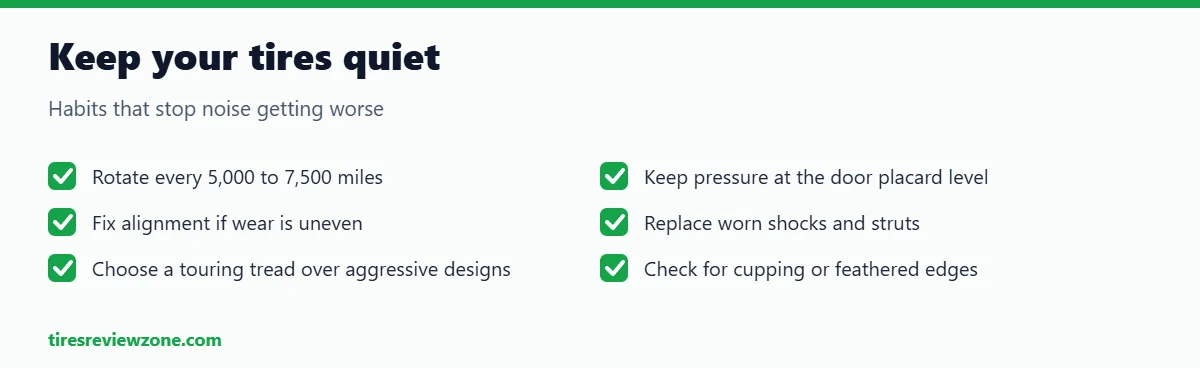
Even the quietest tire gets louder if it wears unevenly. These habits help keep noise down:
- Rotate regularly: every 5,000 to 7,500 miles helps tires wear evenly. See our guide to the purpose of tire rotation.
- Keep the right pressure: underinflated tires flex more and can wear unevenly, while overinflated tires ride harshly. Use the pressure on your door placard; our tire PSI guide explains how.
- Check alignment: poor alignment causes feathered edges that hum loudly.
- Replace worn suspension parts: worn shocks and struts let tires bounce, which causes cupping and noise.
- Inspect the tread: run your hand across the tread. If it feels saw-toothed or scalloped, get it checked.
Is the Noise Really Coming From the Tires?
Not every hum is tire noise. A worn wheel bearing often causes a growl that gets louder with speed and changes when you turn. Worn suspension parts, loose heat shields and wind noise from door seals can also sound like tire noise. If new tires do not fix the problem, ask a mechanic to check the bearings and suspension. Unusual noises can also be a sign of tire damage, so stop and inspect your tires if a new sound appears suddenly. The NHTSA tire safety guide covers basic tire checks.
Quiet Tires and Comfort: What Else to Expect
Quiet tires are often comfortable tires too, because the same design choices that reduce noise also soften small bumps. Touring tires with flexible sidewalls and comfort-tuned compounds absorb cracks and expansion joints better than stiff performance tires. The trade-off is usually steering response: quiet touring tires feel softer and less sharp in corners than sporty tires.
Many quiet touring tires also have long treadwear warranties, often 60,000 to 80,000 miles, and low rolling resistance, which can help fuel economy slightly. If you drive mostly on highways and value a relaxed ride, a quiet touring tire is often the best all-round choice for a family car or commuter.
Frequently Asked Questions
What type of tire is the quietest?
Touring all-season tires for cars and highway all-season tires for SUVs are usually the quietest, because they use tight, variable-pitch tread patterns designed for comfort.
Do new tires get louder over time?
Yes, most tires get somewhat louder as they wear, especially if wear is uneven. Regular rotation and correct alignment slow this down.
Are low-profile tires louder?
Usually. Low-profile tires have shorter sidewalls that absorb less vibration, so more noise reaches the cabin.
Do electric cars need special quiet tires?
They do not need them, but EV-specific tires often reduce noise and rolling resistance, which helps comfort and range.
Final Thoughts
The quietest passenger car tires are usually touring all-season models with variable-pitch tread and comfort-focused construction. Choose a tire from that category, check owner noise ratings for your size, and keep it rotated, aligned and properly inflated. That combination gives you a calmer cabin for the life of the tire.