

Disclosure: Tires Review Zone is reader-supported. As an Amazon Associate I earn from qualifying purchases, at no extra cost to you. Learn more.
205 and 215 are two of the most common tire widths on compact cars, small crossovers and family sedans. Because they are so close, drivers often wonder whether they can fit one instead of the other, either to save money, to get a tire that is in stock, or to switch to narrower winter tires. In many cases you can. This guide explains the difference between 205 and 215 tires in plain terms, gives the real dimensions for popular sizes, and shows how to switch safely.
Key takeaways: a 215 tire is 10 mm (about 0.39 inch) wider than a 205 and, with the same aspect ratio, about 1.7% to 2% taller. Most 6.5 to 7-inch wheels take either size, but check the approved rim width, keep the overall diameter within about 3% and make sure the load index meets your door placard.
The difference between 205 and 215 in one sentence
A 215 tire is 10 millimeters wider than a 205: about 8.46 inches compared with 8.07 inches. If the aspect ratio stays the same, the 215 also has a slightly taller sidewall, so the whole tire is a little taller and covers a little more ground with each turn.
That height difference is what most people forget. For example, a 215/55R16 is 1.7% taller than a 205/55R16, so at an indicated 60 mph you would actually be traveling about 61.0 mph.
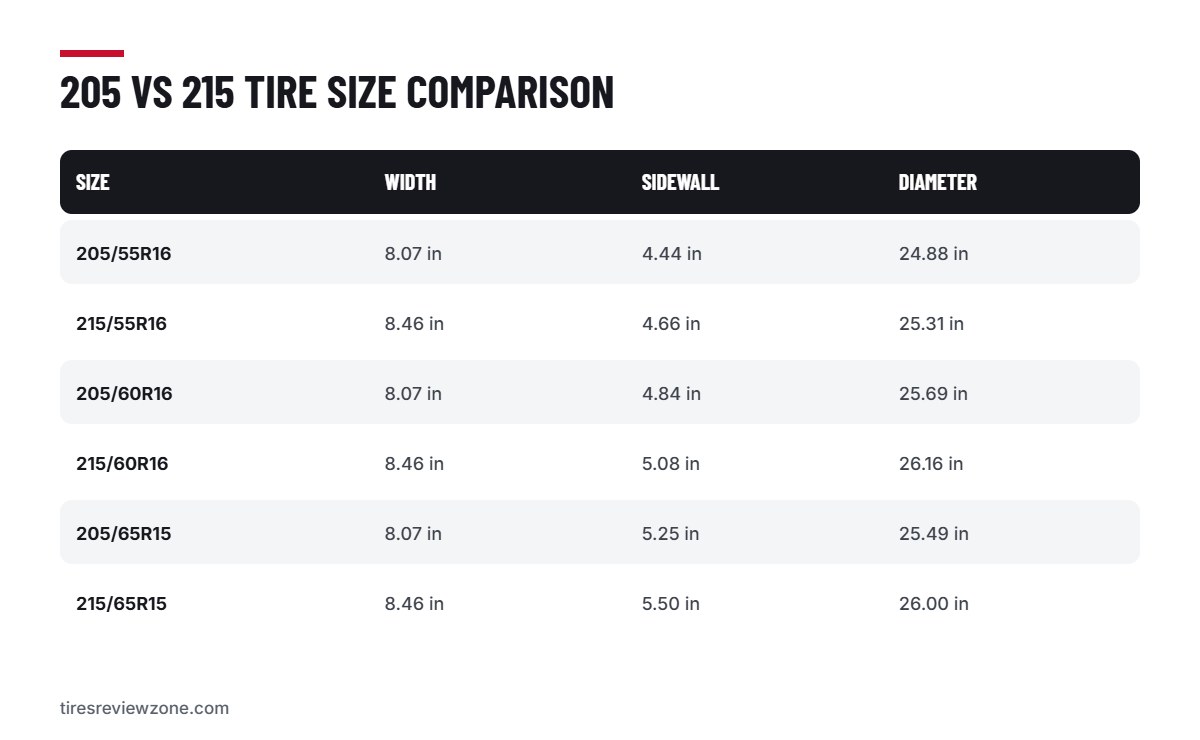
205 vs 215 size chart
These are the most common pairs, with dimensions calculated from the size codes. Measured sizes vary slightly between tire models.
| Size | Width | Sidewall | Overall diameter | Revs per mile |
|---|---|---|---|---|
| 205/55R16 | 8.07 in | 4.44 in | 24.88 in | 811 |
| 215/55R16 | 8.46 in | 4.66 in | 25.31 in | 797 |
| 205/60R16 | 8.07 in | 4.84 in | 25.69 in | 785 |
| 215/60R16 | 8.46 in | 5.08 in | 26.16 in | 771 |
| 205/65R15 | 8.07 in | 5.25 in | 25.49 in | 791 |
| 215/65R15 | 8.46 in | 5.50 in | 26.00 in | 776 |
In every pair, the 215 is about 0.39 inch wider and about 0.4 to 0.5 inch taller than the matching 205.
Will a 215 tire fit where a 205 was?
Usually, if your wheel is wide enough and there is room in the wheel arch. Tire makers publish an approved rim width range for every size. Typical ranges are roughly 5.5 to 7.5 inches for a 205 and 6.0 to 7.5 inches for a 215, so most 6.5- and 7-inch wheels accept either one. Rim width charts such as the one from TyreSizeCalculator list both widths as ideal for a 7-inch rim. Your wheel width is stamped on the back of the wheel, often as a number followed by “J”, such as 6.5J.
As a rule of thumb, each half inch of wheel width changes the mounted width of a tire by about 5 mm, so the same tire will sit slightly wider on a wider wheel. Our guide to tire size by wheel width goes into more detail.
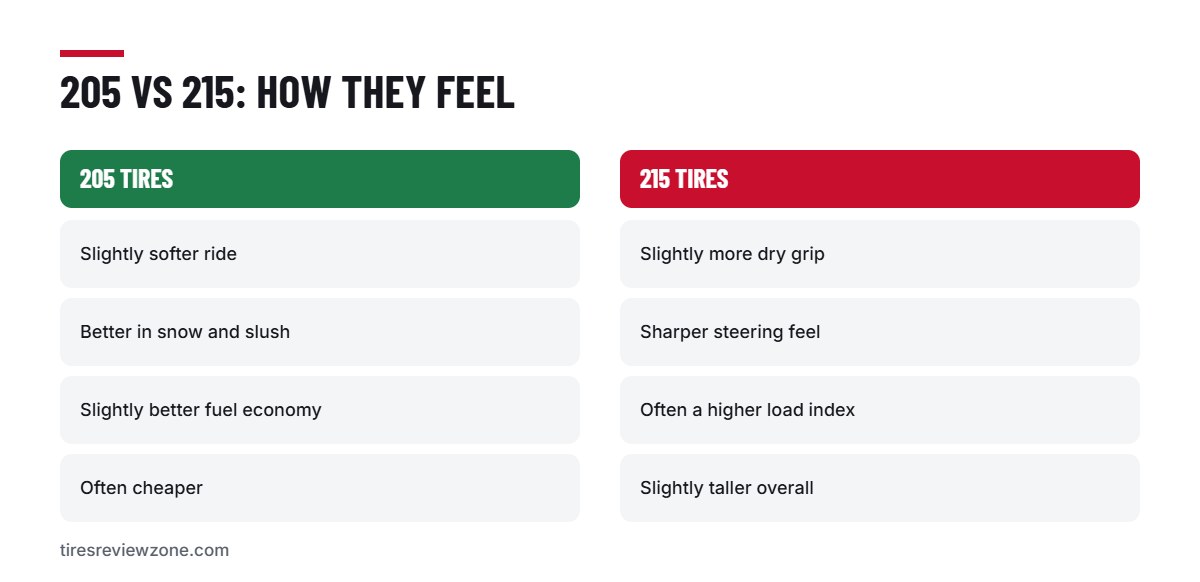
How 205 and 215 tires feel different
| 205 (narrower) | 215 (wider) | |
|---|---|---|
| Ride comfort | Slightly softer | Slightly firmer |
| Dry grip and steering | Good | Slightly better |
| Snow and slush | Better: cuts through snow | Slightly worse: floats more |
| Hydroplaning resistance | Slightly better | Slightly worse |
| Fuel economy | Slightly better | Slightly worse |
| Price | Often cheaper | Often a little more |
These differences are small. Most drivers would struggle to feel the change in a blind test; the model of tire you choose has a much bigger effect than 10 mm of width. Our guide on how tires affect car performance explains why.
Keeping the overall diameter the same
If you want a wider tire but do not want to change the overall height, lower the aspect ratio by one step. A 215/50R16 is only 1.7% shorter than a 205/55R16, which keeps speedometer error and gearing almost unchanged. Going the other way, a 205/60R16 is within 1.5% of a 215/55R16, a popular way to fit a narrower tire for winter without making the car sit lower.
Narrower 205 tires for winter
Many drivers whose cars came on 215 tires choose 205s for their winter set. A narrower tire puts more weight on each square inch of tread, which helps it bite through snow and slush to the road below, and narrower winter tires are often cheaper. If you do this, keep the overall diameter close to the original, make sure the tire’s load index meets your placard, and fit the winter tires on all four wheels.
Load index: why size changes can matter
Every tire has a load index, the number just before the speed rating on the sidewall, that tells you the most weight it can carry at its maximum pressure. Wider tires of the same construction can usually carry a little more. A standard-load 205/55R16 typically has a load index of 91, rated for about 1,356 lb per tire, while a standard-load 215/55R16 is often 93, about 1,433 lb. Extra-load (XL) versions are rated higher again.
That means moving from 215 down to 205 can reduce load capacity. Before you buy, compare the load index on the new tire with the figure on your door placard and make sure it is equal or higher. This matters most on cars that regularly carry a full load of passengers and luggage.
Cost and availability
Both 205 and 215 widths are produced in huge numbers, so you will find budget, mid-range and premium choices in most popular sizes. The narrower size is often slightly cheaper, and because winter tires are commonly sold in narrower widths, 205s can be easier to find in a good winter model. On the other hand, if your car came with 215s, the original-equipment model may only be sold in that width. Compare a few brands in both sizes before you decide; the price gap is usually small, and the better tire is worth more than the width.
A practical example: if your compact car came with 215/55R16 tires on 6.5-inch wheels and you want a cheaper winter set, a 205/60R16 keeps the overall height within about 1.5%, fits the same wheels, and gives you a slightly narrower footprint for snow. Just check that its load index matches the placard.
What about 185 vs 195 tires?
The same rules apply one size down, on small cars and older compacts. A 195 is 10 mm wider than a 185 and, with the same aspect ratio, about 2% taller:
| Size | Width | Sidewall | Diameter |
|---|---|---|---|
| 185/65R15 | 7.28 in | 4.73 in | 24.47 in |
| 195/65R15 | 7.68 in | 4.99 in | 24.98 in |
| 185/60R15 | 7.28 in | 4.37 in | 23.74 in |
| 195/60R15 | 7.68 in | 4.61 in | 24.21 in |
Moving from 185/65R15 to 195/65R15 makes the tire 2.1% taller, and 185/60R15 to 195/60R15 adds 2.0%, both within the usual 3% guideline. Typical approved rim widths are about 5.0 to 6.5 inches for a 185 and 5.5 to 7.0 inches for a 195, so most 5.5 to 6.5-inch steel and alloy wheels take either. As with 205 and 215 tires, keep the load index at or above the door placard figure and fit the same size on both wheels of an axle.
Rules for switching safely
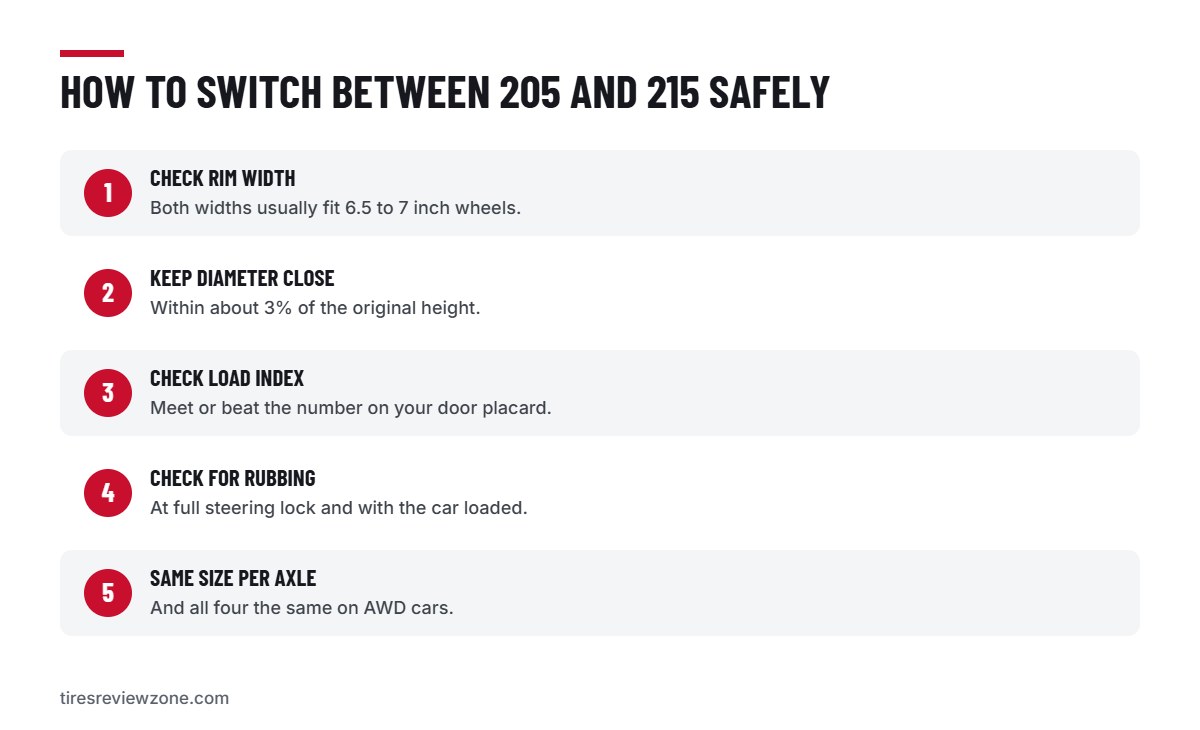
- Check that the new size is approved for your wheel width.
- Keep the overall diameter within about 3% of the original size.
- Match or exceed the load index and speed rating on your door placard.
- Fit the same size on both wheels of an axle, and on all four wheels of an all-wheel-drive car.
- Check for rubbing at full steering lock and with the car loaded.
- Set pressures from the door placard, or from the tire maker’s load tables if the load index changes.
If you are not sure what size your car takes, our guide to reading a tire size explains the code, and our tire size calculator by vehicle lists common options. The NHTSA TireWise guide also recommends checking the tire and loading information label on your door jamb for the correct size. For the next step up, see our comparison of 215 vs 225 tires.
Frequently asked questions
Can I use 215 tires instead of 205?
Usually yes, if your wheels are approved for the 215 width, the tires clear the suspension and the load and speed ratings match. Expect a speedometer change of about 1.7% to 2.0% with the same aspect ratio.
Is a 215 tire taller than a 205?
Yes, if the aspect ratio is the same. The sidewall is a percentage of the width, so the wider tire is about 0.4 to 0.5 inch taller overall.
Can I put 205 tires on the front and 215 on the back?
No, unless your vehicle maker specifies different front and rear sizes. Mixing widths front to rear can upset handling and, on all-wheel-drive cars, damage the drivetrain.
Are 205 tires better in snow?
Slightly. Narrower tires cut through snow more easily, which is why many drivers fit a narrower size for their winter tires.
Will a 215 tire rub?
On most cars the extra 5 mm on each side will not rub, but check at full steering lock and over bumps, especially if the car is lowered or has aftermarket wheels.