

Disclosure: Tires Review Zone is reader-supported. As an Amazon Associate I earn from qualifying purchases, at no extra cost to you. Learn more.
Highway tires and touring tires sound similar, and both are designed for comfortable driving on paved roads. But there is a real difference between a highway tire and a touring tire: they are built for different vehicles and different jobs. Choosing the right one can make your car or truck quieter, more comfortable and cheaper to run, while choosing the wrong one can mean a soft, wallowy truck or a car with more tire than it needs.
This guide explains what highway and touring tires are, how they differ in design, load capacity, comfort and tread life, and how to choose between them for your vehicle. We also look at how both compare with all-season tires in general and when an all-terrain tire might be a better fit.
What Is a Highway Tire?
A highway tire, often marked H/T (highway terrain), is designed for pickups, full-size SUVs and vans that spend most of their time on paved roads. These vehicles are heavy and often tow or carry loads, so highway tires are built to support weight, stay stable at highway speed and last a long time.
Highway tires usually have a tight tread with continuous ribs, which keeps them quiet and stable on long drives. They come in both P-metric sizes for lighter trucks and SUVs and LT (light truck) sizes for heavy-duty pickups. Many highway all-season tires carry long treadwear warranties, and some also carry the 3PMSF severe snow symbol.
What Is a Touring Tire?
A touring tire is designed for passenger cars, minivans and crossovers. Its main goals are a comfortable, quiet ride, predictable handling and long tread life. Touring tires usually fall into two groups:
- Standard touring all-season tires, which put comfort and tread life first.
- Grand touring all-season tires, which add a bit more handling precision and higher speed ratings. Tire Rack notes that grand touring all-season tires are often fitted as original equipment.
There are also crossover/SUV touring tires, which use touring-style tread and compounds in sizes for crossovers and smaller SUVs. Tire Rack describes crossover/SUV touring all-season tires as a single-tire solution for drivers who see all four seasons but do not need dedicated winter tires.
Difference Between a Highway Tire and a Touring Tire: Key Points
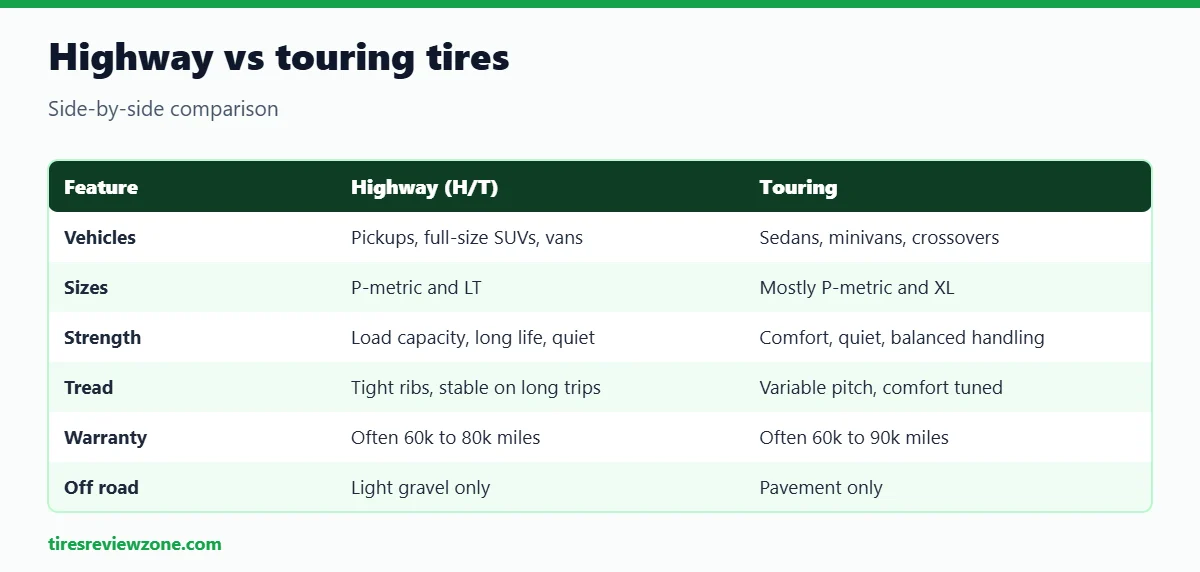
| Feature | Highway tires | Touring tires |
|---|---|---|
| Typical vehicles | Pickups, full-size SUVs, vans | Cars, minivans, crossovers |
| Sizes | P-metric and LT | Mainly P-metric and XL |
| Main strength | Load capacity, stability, long life | Comfort, low noise, balanced handling |
| Tread design | Tight ribs, stable at speed under load | Variable-pitch blocks tuned for comfort |
| Ride | Smooth, but firmer in LT sizes | Softest and quietest of everyday tires |
| Towing | Good, especially in LT load ranges | Light loads only |
| Off-road use | Light gravel at most | Pavement only |
Load and construction
The biggest difference is load capacity. Highway tires, especially LT versions, have stronger internal construction to carry heavy payloads and trailer tongue weights. Touring tires are built for the weight of passenger cars and crossovers. If your truck tows or hauls regularly, a highway tire with the correct load range is the safer choice. Our light truck tire buying guide explains load ranges.
Comfort and noise
Both types are designed to be quiet, but touring tires usually win on comfort because they are built for lighter vehicles and use softer sidewalls. Highway tires in P-metric sizes can be very quiet too, while LT versions ride more firmly. Our guide to quiet passenger car tires covers the quietest options.
Handling
Touring tires are tuned for the steering and suspension of cars and crossovers, so they feel more responsive on those vehicles. Highway tires focus on straight-line stability and predictable handling under load.
Tread life
Both types often carry long treadwear warranties, commonly between about 60,000 and 80,000 miles or more, depending on the model and size. LT sizes sometimes carry shorter warranties than P-metric versions of the same tire.
Where Do All-Season and All-Weather Tires Fit?
Most highway and touring tires are all-season tires, meaning they are designed to work in dry, wet and light snow conditions. Some newer highway and touring models are all-weather tires, which carry the 3PMSF symbol for severe snow. If you face regular snow, look for that symbol. Our guide to all-season tires explained covers the differences.
Highway Tires vs All-Terrain Tires
Truck owners often choose between highway and all-terrain tires. Highway tires are quieter, more fuel-efficient and usually last longer. All-terrain tires add grip on gravel, dirt and mud, and tougher sidewalls, but are heavier and louder. If your truck rarely leaves pavement, highway tires are usually the better value. For highway options, see our list of the best light truck highway tires.
Price and Running Costs
Highway tires usually cost more than touring tires because they come in larger sizes and need stronger construction, especially in LT load ranges. A set for a full-size pickup typically costs noticeably more than a set for a mid-size sedan. Touring tires are often the cheapest per mile for cars because they combine moderate prices with long warranties.
Both types tend to have lower rolling resistance than all-terrain tires, which helps fuel economy. Keeping them at the right pressure matters too: underinflation increases rolling resistance and wear. Over the life of a set, correct pressure, regular rotation and good alignment can save more money than a small difference in purchase price.
How to Choose Between Highway and Touring Tires
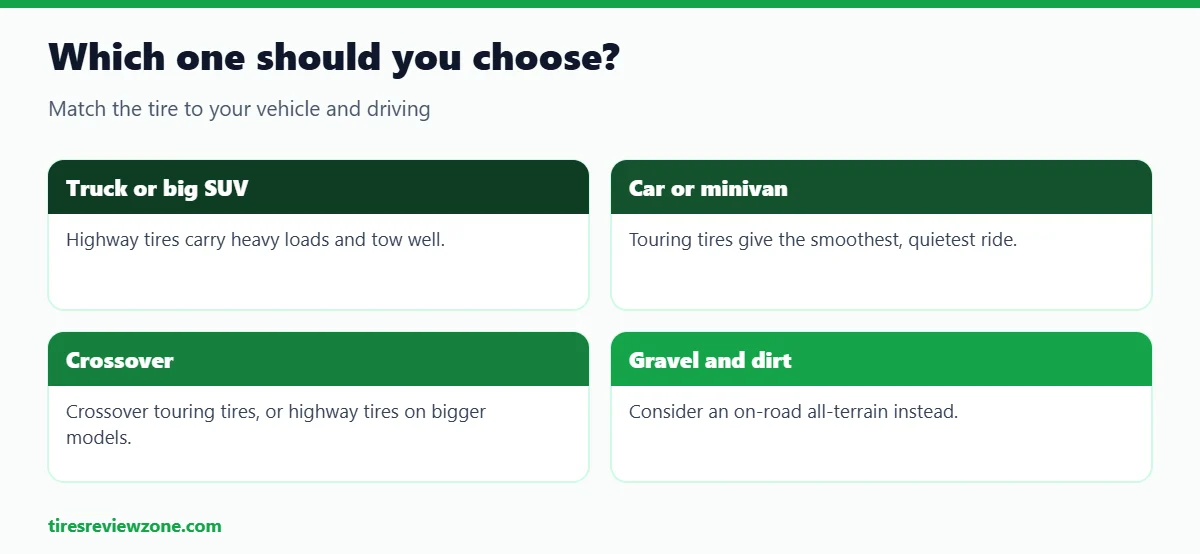
- Start with your vehicle: cars and minivans almost always use touring tires; pickups and full-size SUVs usually use highway or all-terrain tires.
- Check your door placard: match the size, load index and speed rating your vehicle maker specifies.
- Think about loads: if you tow or carry heavy loads, choose a highway tire with the correct load range.
- Think about weather: pick an all-weather version if you drive in heavy snow.
- Compare warranties and reviews: long treadwear warranties and strong owner comfort ratings are good signs.
For more on passenger tire categories, read our guides to what a passenger tire is and touring vs performance tires.
Buying Checklist
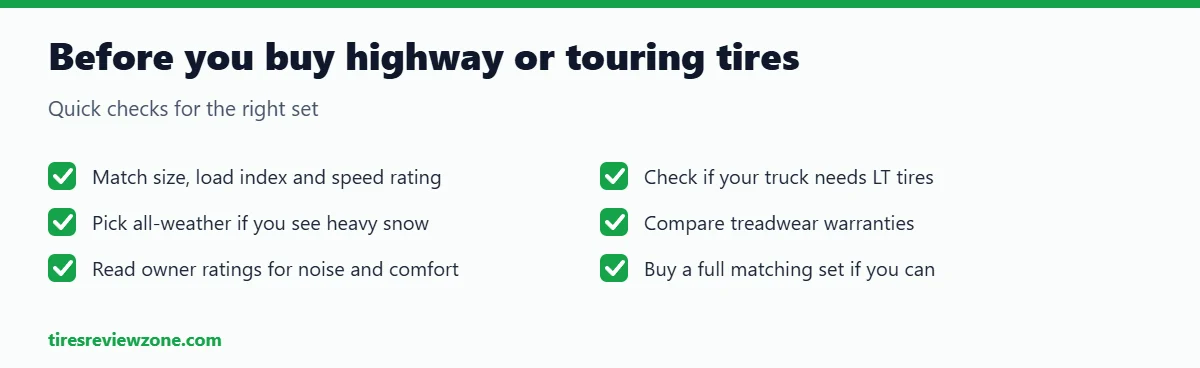
- Match size, load index and speed rating to your placard.
- Check whether your truck needs LT tires for its weight or towing.
- Look for the 3PMSF symbol if you drive in snow.
- Compare treadwear warranties for your exact size.
- Read owner ratings for noise, comfort and wet grip.
- Buy a matching set, especially on all-wheel-drive and four-wheel-drive vehicles.
After fitting new tires, keep them at the correct pressure and check them regularly. The NHTSA tire safety guide explains how to read sidewall markings and check for recalls.
Frequently Asked Questions
Can I put touring tires on a truck?
Only if they are available in your truck’s size and meet its load requirements. Most pickups are better served by highway tires.
Are highway tires good in the rain?
Most modern highway all-season tires have good wet grip. Check test results and owner wet-traction ratings for the model you choose.
Do touring tires last longer than highway tires?
Both can last a long time. Many touring and highway tires carry 60,000 to 80,000-mile warranties, but the exact figure depends on the model and size.
What does H/T mean on a tire?
H/T stands for highway terrain. It identifies a highway tire designed mainly for paved roads.
Final Thoughts
Highway tires and touring tires both aim for comfort and long life on pavement, but highway tires are built for heavier trucks, SUVs and towing, while touring tires are built for cars, minivans and crossovers. Start with your vehicle type and placard, think about loads and weather, and you will quickly find the right choice.