

Disclosure: Tires Review Zone is reader-supported. As an Amazon Associate I earn from qualifying purchases, at no extra cost to you. Learn more.
When to put on winter tires? The best time is when daytime temperatures stay at or below 7°C (45°F), not when the first snow falls. Below that point, the rubber in summer and all-season tires starts to stiffen and lose grip, even on dry roads. Most drivers in Canada and the northern U.S. reach that point between mid-October and mid-November. This guide explains the 7°C rule, the legal dates by province and when to take winter tires off in spring.
Key takeaways: fit winter tires once daytime temperatures settle around 7°C (45°F), well before the first snow. In Quebec they are mandatory from December 1 to March 15, and British Columbia requires them on designated highways from October 1. Take them off in spring once temperatures stay above about 7°C. Always fit all four, and check the tread first, because snow grip drops below about 4.8 mm (6/32 in).
When to put on winter tires: the 7°C rule explained
Winter tires use a softer rubber compound with lots of small slits (sipes) in the tread. That compound stays flexible in the cold, so the tread can grip ice and packed snow. All-season and summer tires are designed for warmer roads; once it gets cold they harden, and braking distances grow.
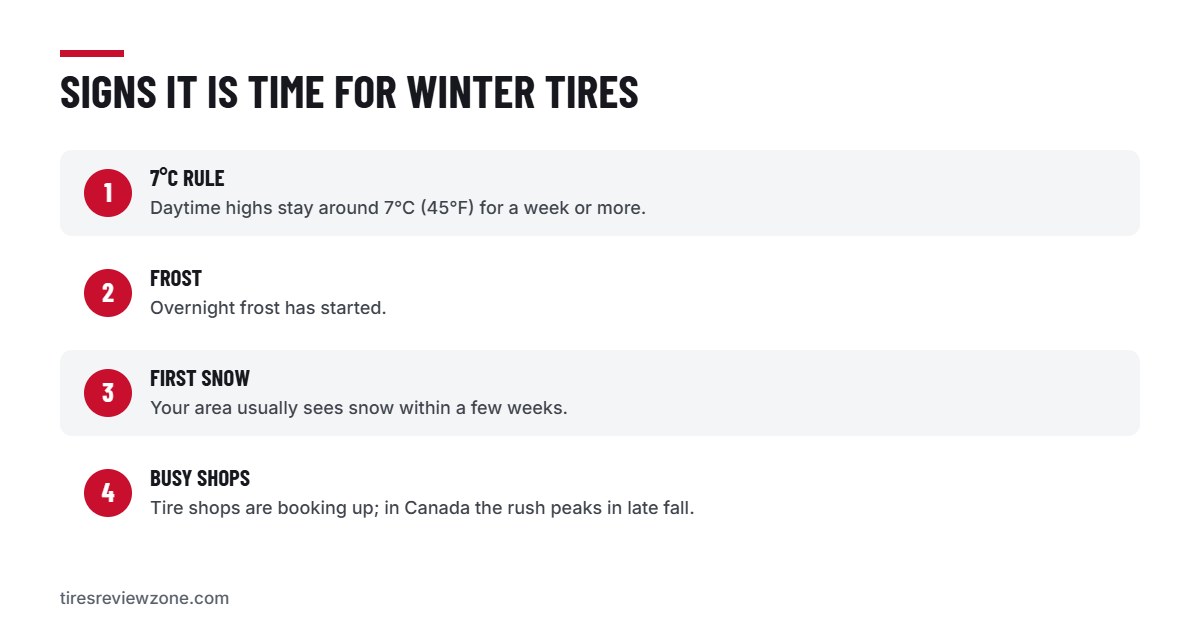
That is why the calendar is only half the answer. Use these signs together:
- Daytime highs have dropped to about 7°C (45°F) for a week or more.
- Overnight frost has started.
- Your area typically gets its first snow within a few weeks.
- Tire shops are booking up; in Canada the rush usually peaks in early November.
Installing a little early costs you very little tread. Installing late can leave you stuck, or sliding, during the first storm.
Winter tire laws and dates by province
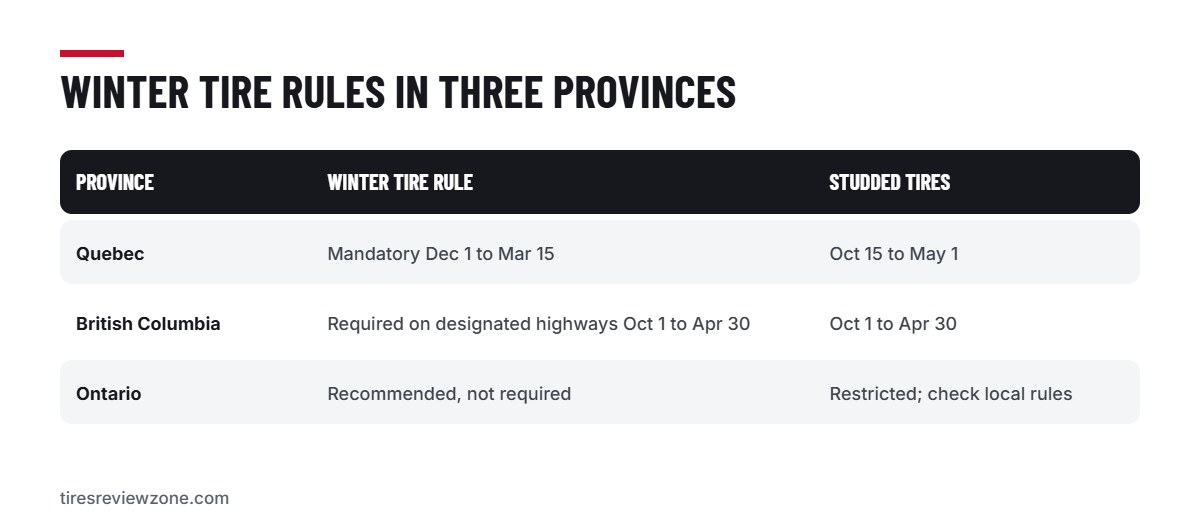
Only Quebec requires winter tires on all passenger vehicles. British Columbia requires them on many highways. Everywhere else they are strongly recommended, and studded tires are allowed only within set dates.
| Province | Winter tire rule | Studded tires allowed |
|---|---|---|
| Quebec | Mandatory Dec 1 to Mar 15 | Oct 15 to May 1 |
| British Columbia | Required on designated highways Oct 1 to Apr 30 (Oct 1 to Mar 31 on some routes) | Oct 1 to Apr 30 |
| Ontario | Recommended, not required | Northern Ontario only |
| Manitoba | Recommended | Oct 1 to Apr 30 |
| New Brunswick | Recommended (required on school buses) | Oct 15 to May 1 |
| Nova Scotia | Recommended | Oct 15 to May 31 |
| Prince Edward Island | Recommended | Oct 1 to May 31 |
| Newfoundland and Labrador | Recommended | Nov 1 to May 31 |
Dates change from time to time, so confirm with your province before relying on them. In Nova Scotia the rule comes from the province’s Studded Tires Regulations.
Quebec
From December 1 to March 15 inclusive, every passenger vehicle registered in Quebec must have four winter tires, and only tires with the three-peak mountain snowflake pictogram (or studded tires) count. The fine for driving without them is $200 to $300 plus costs. The SAAQ recommends installing them before December 1, because cold and snow usually arrive earlier. See the SAAQ winter preparation page for the full rule.
Toronto and the rest of Ontario
Ontario has no winter tire law, but drivers in Toronto usually reach the 7°C mark by early to mid-November. Ontario insurers must offer a discount to drivers who use winter tires, which often covers part of the cost. Studded tires are allowed only for residents of northern Ontario.
Nova Scotia and New Brunswick
Neither province requires winter tires, but both see heavy snow and freezing rain. Studded tires are legal in Nova Scotia from October 15 to May 31 and in New Brunswick from October 15 to May 1. Studs give the best grip on glare ice; studless winter tires are quieter and grip well on snow and slush.
Winter tire vs all-season: why it matters
Look for the three-peak mountain snowflake (3PMSF) symbol on the sidewall. In Canada, tires with that symbol must pass a standard snow traction test. The Tire and Rubber Association of Canada explains the test and why winter tires stop shorter on cold roads. An M+S (mud and snow) marking alone does not meet Quebec’s legal definition of a winter tire.
If you are still deciding which set to buy, read our guide to choosing the right winter tires.
When to take winter tires off
Swap back once daytime temperatures stay above 7°C and the risk of a late storm has passed, usually late March in milder areas and mid to late April further north. In Quebec you cannot remove them before March 16, and the SAAQ suggests keeping them on for a few weeks longer.
Do not run winter tires all summer. The soft compound wears quickly on warm pavement, and braking on hot, wet roads is worse than with all-season tires.
Signs it is time to book your changeover
Temperature is the main trigger, but a few practical signs tell you not to wait any longer:
- Frost on the windshield on several mornings in a row, even if afternoons still feel mild.
- Snow in the 10-day forecast for your area or for a route you drive often, such as a mountain pass.
- Tire shops booking out. Appointments fill up fast after the first storm, so book two to three weeks ahead.
- A long trip coming up into colder regions, where conditions can be weeks ahead of home.
Before the swap, check the tread depth and the DOT date code on your winter set. Tires that sat all summer can look fine but have hardened with age, which our guide to how winter tires work explains.
Changeover checklist
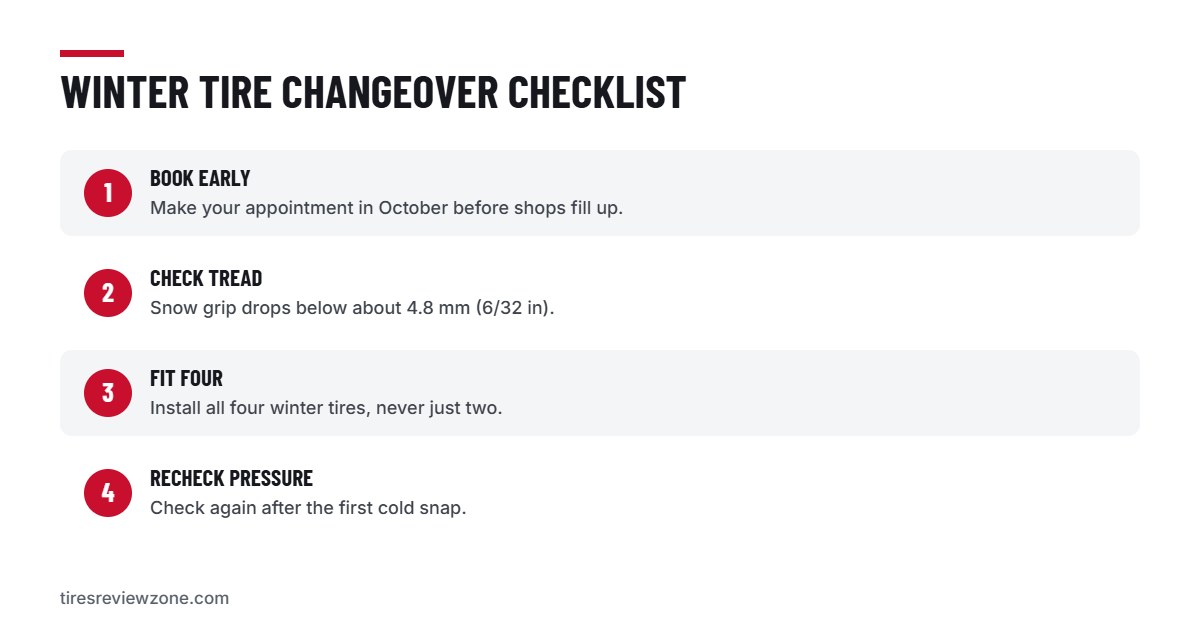
- Book your appointment in October; shops get busy fast.
- Check tread depth; winter tires lose much of their snow grip below about 4.8 mm (6/32 in).
- Install all four winter tires, never just two.
- Re-check pressure after the first cold snap; pressure falls as temperatures drop.
- Store the off-season set clean and out of the sun. Our winter tire maintenance tips cover storage.
For more on cold-weather prep, see our guide to preparing your car for winter.
Frequently asked questions
What temperature should I put winter tires on?
Put winter tires on when daytime temperatures stay at or below about 7°C (45°F). Below that, all-season and summer tires lose grip.
When are winter tires mandatory in Quebec?
Winter tires are mandatory in Quebec from December 1 to March 15 inclusive, with a fine of $200 to $300 for driving without them.
When should I put winter tires on in Toronto?
Most Toronto drivers should install winter tires by early to mid-November, when daytime highs fall to about 7°C. Ontario does not require them by law.
When can you put studded tires on in Nova Scotia?
Nova Scotia allows studded tires from October 15 to May 31.
When can you use studded tires in New Brunswick?
New Brunswick allows studded tires from October 15 to May 1.
When should winter tires come off?
Take winter tires off once daytime temperatures stay above about 7°C, usually from late March to late April depending on where you live.