

Disclosure: Tires Review Zone is reader-supported. As an Amazon Associate I earn from qualifying purchases, at no extra cost to you. Learn more.
Tire racks turn a pile of seasonal tires into a tidy, safe corner of the garage. The right rack keeps tires off a damp floor, out of the way of the car, and easy to reach when it is time to swap. The wrong one sags, tips or takes up more room than the tires themselves.
This guide compares the main types of tire storage racks, how much weight they need to hold, and how to store tires on them so they last. If you were looking for the online retailer Tire Rack rather than storage racks, see our review: is Tire Rack worth it?
Why use tire racks at all?
Tires age faster when they sit in the wrong conditions. The U.S. Tire Manufacturers Association’s tire care and safety guide recommends storing tires in a clean, dry, cool, well-ventilated place, out of direct sunlight, and away from electric motors, battery chargers, generators, welders and other sources of ozone. It also warns against contact with gasoline, oil and solvents. A rack makes that easier because it lifts tires off concrete floors, where moisture and spilled chemicals collect, and keeps them in one controlled spot.
Racks also save space and prevent damage. Tires leaning against a wall can roll into a car door, and stacks on the floor are easy to knock over.
5 types of tire racks compared
1. Wall-mounted tire racks
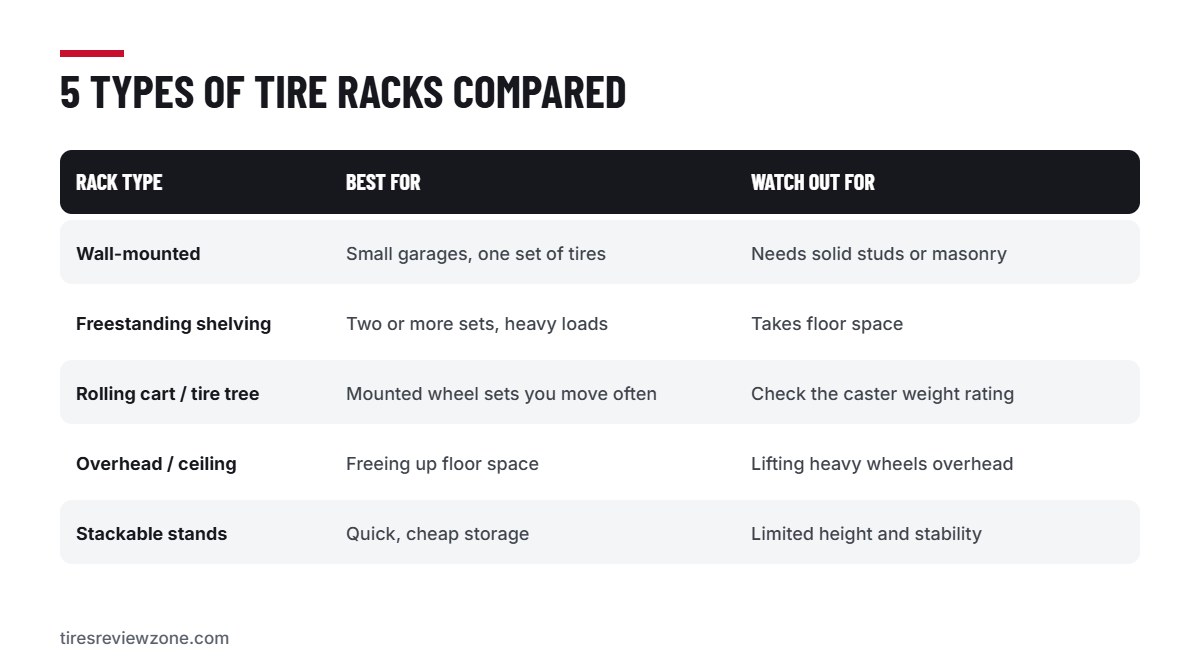
Wall racks bolt to the studs or masonry and hold tires on two horizontal arms, often folding flat when empty. They are the best choice for a single seasonal set in a one-car garage, because they use no floor space. The catch is installation: the rack is only as strong as what it is anchored into, so it must go into studs or solid block, not drywall alone.
2. Freestanding shelving racks
Heavy-duty shelving units with tire-sized bays can hold two or more sets and carry far more weight than a wall rack. They are the usual choice for households with several vehicles or for anyone storing truck tires. They take floor space, and tall units should be anchored to the wall so they cannot tip.
3. Rolling tire carts and tire trees
A tire cart or “tree” holds a set of mounted wheels on a vertical post or frame with casters. It is ideal if you swap wheels yourself, because you can roll the whole set to the car. Check the caster weight rating, since four mounted truck wheels can exceed what light-duty casters are built for.
4. Overhead and ceiling racks
Ceiling-mounted platforms free up floor and wall space entirely and work well in garages with high ceilings. They are the hardest to use, because you have to lift heavy wheels overhead twice a year. They suit bare tires or light car wheels better than big truck wheels.
5. Stackable tire stands
Simple stands or totes let you stack a set on a small frame or dolly. They are cheap and portable, but stacks should stay low. A tall stack is unstable, and the bottom tire carries the weight of everything above it.
How much weight does a tire rack need to hold?
Weight is the number people most often underestimate. A bare passenger car tire is fairly light, but once it is mounted on a wheel, the pair can weigh roughly twice as much, and light truck tires on steel or alloy wheels are heavier again. A full set of four mounted truck wheels can easily approach the limit of a light-duty wall rack.
The safe approach is to weigh one of your tires (or tire and wheel) on a bathroom scale, multiply by the number you will store, and choose a rack rated comfortably above that total. If you are not sure what size you run, our tire size guide explains how to read the sidewall.
How to choose the right tire rack
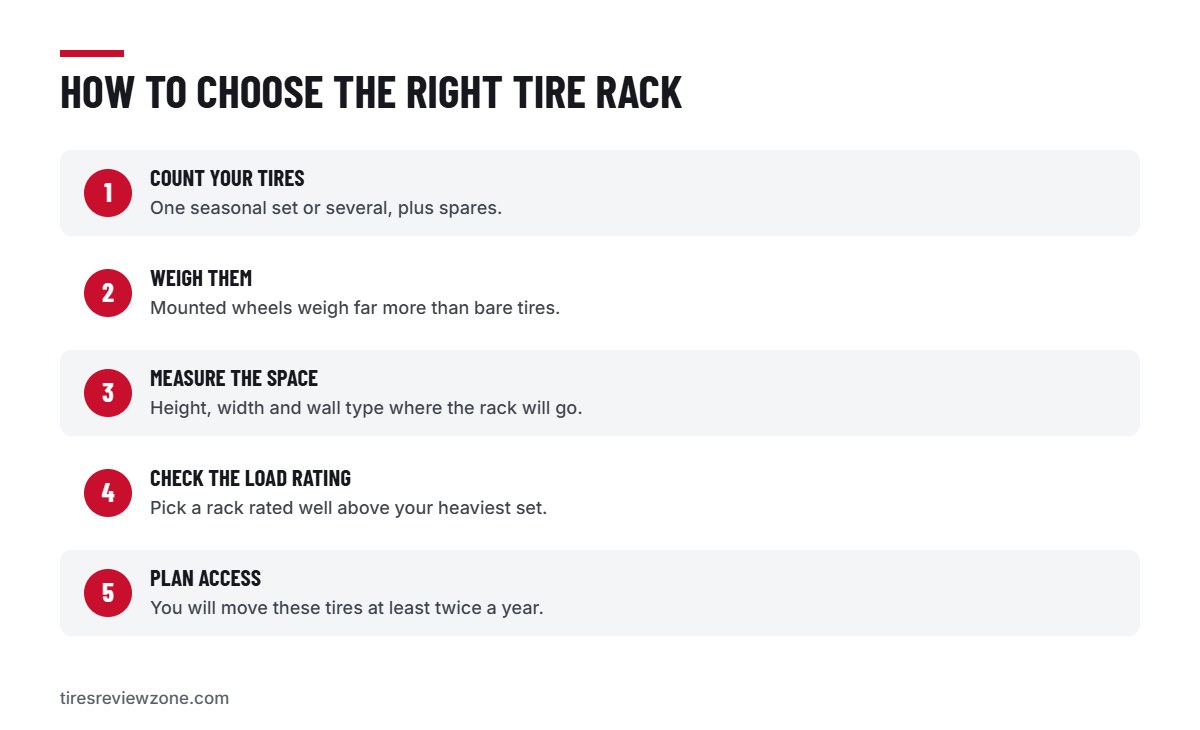
- Count your tires: one seasonal set, or several sets plus spares.
- Weigh them: mounted wheels weigh far more than bare tires.
- Measure the space: height, width, and what the wall is made of.
- Check the load rating: choose a rack rated well above your heaviest set.
- Plan access: you will lift or roll these tires at least twice a year, so keep the heaviest ones low.
How to store tires on a rack
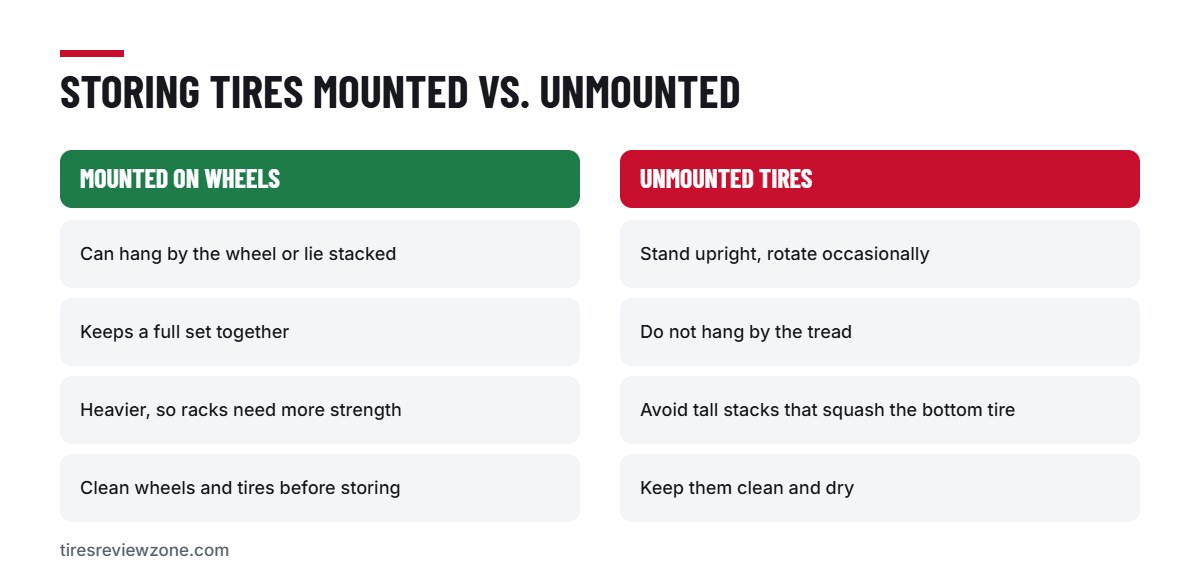
Mounted and unmounted tires are stored a little differently. Both Michelin and BFGoodrich give the same basic rule: the wheel supports a mounted tire, so it can hang or lie flat, while a bare tire should stand upright.
- Mounted on wheels: they can hang by the wheel or lie flat in a low stack, which keeps the set together.
- Unmounted tires: stand them upright on a shelf and turn them now and then, rather than hanging them by the tread or stacking them high.
- Either way: clean off road salt and brake dust first, let them dry, and mark each tire with its position (front left, rear right) so you can rotate them next season.
Before the tires go back on, check the tread depth and the DOT date code. Our guide to winter tire maintenance and storage covers the full seasonal routine, and our tire maintenance checklist explains how to read the date code.
Tire racks for trucks and SUVs
Truck and SUV owners need to think harder about strength. Light truck tires on 17- to 20-inch wheels are bulky and heavy, and a set of four can overload racks designed for car tires. Look for a freestanding steel rack or a heavy-duty wall rack with a stated weight rating, check that each bay is deep and wide enough for your tire’s width, and keep the set at waist height or below so you are not lifting heavy wheels over your head.
Buy a rack or build one?
A bought rack comes with a known weight rating, mounting hardware and a design that has been tested, which is why it is the safer choice for heavy or mounted wheels. A simple DIY wooden shelf or a pair of sturdy brackets can work for one set of bare car tires, but only if it is screwed into studs and built well beyond the weight it will carry. If you are unsure, buy rather than build: a falling set of wheels can damage a car or hurt someone.
Common tire storage mistakes
- Storing tires next to a furnace, water heater or freezer. Motors and heat sources speed up rubber aging.
- Leaving tires in direct sun by a garage window or outdoors under a tarp.
- Using a rack that is not anchored into studs or masonry.
- Stacking unmounted tires too high, which can distort the bottom tire.
- Storing tires dirty or wet, which traps moisture and road salt against the rubber and wheels.
Frequently asked questions
Can I hang tires on hooks?
Hanging works for tires mounted on wheels, because the wheel carries the load. Bare tires are better stored upright on a shelf than hung by the tread.
Is it OK to store tires in a garage?
Yes, if the garage is dry and the tires are kept out of direct sunlight and away from motors, heaters and chemicals.
Do I need a tire rack for one set of tires?
Not strictly, but a simple wall rack or stand keeps one set off the floor and out of the way, and costs little compared with the tires it protects.