
Disclosure: Tires Review Zone is reader-supported. As an Amazon Associate I earn from qualifying purchases, at no extra cost to you. Learn more.
As an Amazon Associate, Tires Review Zone earns from qualifying purchases. We did not test these compressors in person; this guide is based on manufacturer specifications, dealer listings and owner feedback.
If you air down for trails, sand or snow, you need a reliable way to air back up before you drive home on the highway. A portable compressor works, but digging it out, clipping it to the battery and waiting for it to cool between tires gets old fast. An onboard air compressor is bolted to your truck or Jeep, wired to the battery, and ready at the flip of a switch. Many can also run air lockers and small air tools.
This guide compares the most popular onboard compressors from ARB, VIAIR and Smittybilt, explains what CFM and duty cycle mean in real use, and lists what you need to plan before installing one.
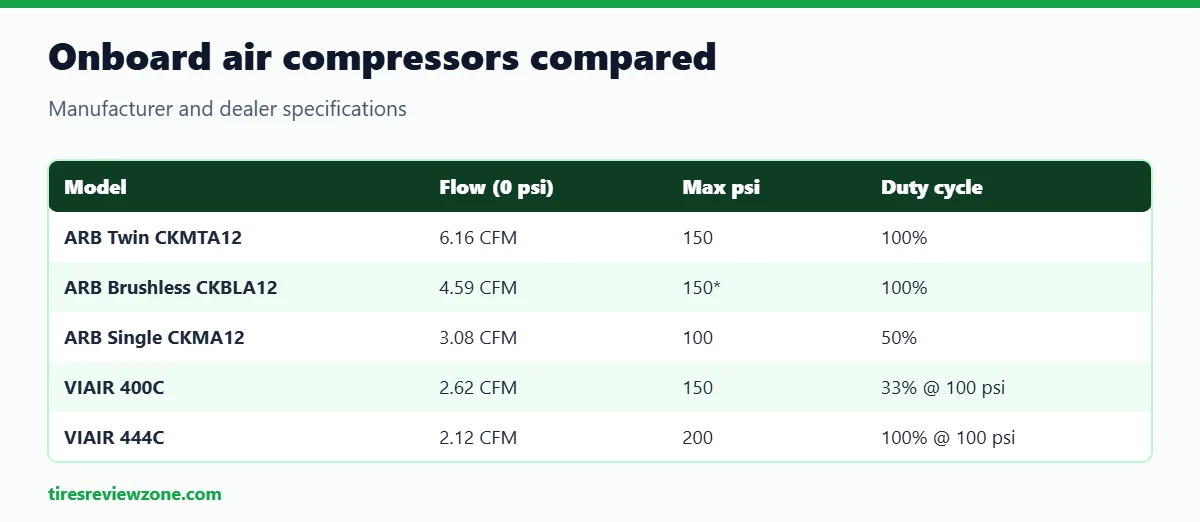
Max psi in the table is the pressure switch cut-out pressure listed by the maker.
Quick Picks
- Best overall: ARB Twin Motor Onboard Compressor (CKMTA12)
- Best brushless single: ARB Brushless Single Onboard (CKBLA12)
- Best for Jeep Wrangler under-seat installs: ARB Single Motor Onboard (CKMA12)
- Best for 150 psi tank systems: VIAIR 400C onboard kit
- Best for air suspension and air tools: VIAIR 444C
- Best budget high-flow option: Smittybilt 2781 (portable, can be hard-wired)
1. ARB Twin Motor Onboard Air Compressor (CKMTA12)
Best overall for big tires. The ARB twin is one of the most common onboard compressors on built trucks, Jeeps and overland vans. ARB lists 6.16 CFM at 0 psi and about 4.68 CFM at 29 psi, a 100% duty cycle at room temperature, and a 150 psi cut-out. That flow is what makes it popular with owners running 35- and 37-inch tires: you can air up four tires without waiting for the motor to cool. Dealer specifications such as those on Suspension Connection’s CKMTA12 listing show a 50 amp draw under load, so it needs a healthy battery and charging system.
It is sealed against dust and moisture, has a built-in cooling fan, and can supply ARB Air Lockers. With an optional air tank it can also run small air tools.
Pros: very high flow, 100% duty cycle, compact for its output, works with ARB lockers.
Cons: expensive, high amp draw, hose and inflation kit often sold separately.
Check the ARB Twin CKMTA12 on Amazon
2. ARB Brushless Single Onboard Compressor (CKBLA12)
Best brushless single-motor option. ARB’s newer brushless line uses a brushless motor with a built-in fan. According to ARB’s CKBLA12 specification sheet, it has a 100% duty cycle at 29 psi, a 45 amp maximum draw, a 60 amp fuse and a 150 psi pressure switch cut-out. Dealers list 4.59 CFM at 0 psi and 3.10 CFM at 29 psi, an IP67 water resistance rating and a three-year warranty. Because the motor is brushless, ARB notes that separate relays are not needed, which simplifies wiring.
Pros: more flow than the classic single, 100% duty cycle, IP67, simpler wiring.
Cons: costs about as much as some twin compressors; newer model with less long-term owner history.
Check the ARB Brushless CKBLA12 on Amazon
3. ARB Single Motor Onboard Compressor (CKMA12)
Best for Jeep under-seat installs. The classic ARB single (often called the High Output) is small and light at about 7.7 lb, which is why ARB sells vehicle kits that mount it under the seat of Jeep Wrangler JK and JL models and in the Ford Bronco. Dealer specifications list 3.08 CFM, a 100 psi cut-out, a 50% duty cycle and a 32 amp draw. It is a proven choice for running ARB Air Lockers and airing up 33-inch tires, but it is slower on 35-inch and larger tires.
Pros: compact, vehicle-specific mounting kits, long track record.
Cons: 100 psi limit, 50% duty cycle, slower on large tires.
Check the ARB Single CKMA12 on Amazon
Check ARB Jeep under-seat kits on Amazon
4. VIAIR 400C Onboard Compressor
Best for 150 psi tank systems. VIAIR is the go-to brand for onboard air systems with tanks. VIAIR’s 400C product page lists 2.62 CFM at 0 psi, a 150 psi working pressure and an IP67 rating. Dealer listings show a 33% duty cycle at 100 psi but 100% at 40 psi, which matters because most tire inflation happens below 40 psi. Maximum draw is about 30 amps.
VIAIR also sells complete kits, such as its Heavy Duty Onboard Air System with a 400C, a 2.5-gallon tank, a pressure switch (110 psi on, 145 psi off), a dash gauge and a coil hose. A tank lets you run tools like an impact wrench in short bursts and gives a faster blast of air for seating beads.
Pros: affordable, IP67, full kits with tanks available, 100% duty cycle at tire pressures.
Cons: lower flow than the ARB twin; you need a tank for air tools.
Check the VIAIR 400C on Amazon
Check VIAIR onboard air systems on Amazon
5. VIAIR 444C Onboard Compressor
Best for air suspension and higher pressure. The 444C trades some flow for pressure and duty cycle. Dealer specifications list 2.12 CFM at 0 psi, a 200 psi working pressure, and a 100% duty cycle at 100 psi. That makes it a strong choice for air bags, air horns and refilling a tank, while still handling tire inflation.
Pros: 200 psi, 100% duty cycle at 100 psi, IP67.
Cons: slower than higher-flow units when filling large tires.
Check the VIAIR 444C on Amazon
6. Smittybilt 2781 (Budget High-Flow Option)
Best budget pick. The Smittybilt 2781 is sold as a portable compressor, but many owners hard-wire it in a bed box or cargo area. Smittybilt’s product page lists 5.6 CFM maximum output, a 150 psi maximum and a 24-foot coil hose. Dealers list a 40-minute continuous run time at 40 psi and a 45 amp draw. Owners often mention that the built-in gauge is not very accurate, so use a separate tire gauge.
Pros: high flow for the money, long hose, easy to start with as a portable.
Cons: not designed as a sealed onboard unit; inaccurate gauge reported by owners; bulkier than ARB units.
Check the Smittybilt 2781 on Amazon
How Much Airflow Do You Need?
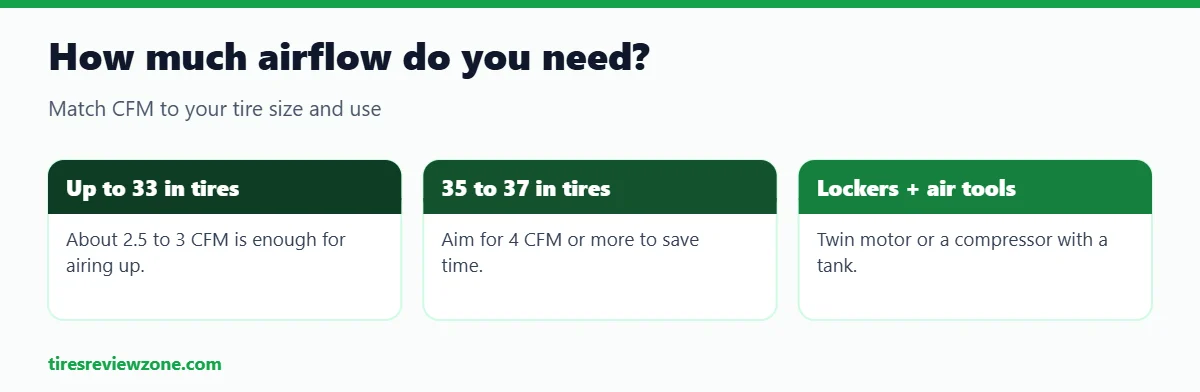
CFM (cubic feet per minute) tells you how fast a compressor moves air. Always compare flow at a real tire pressure, such as 29 psi, not just the 0 psi headline number, because flow drops as pressure rises.
- Up to 33-inch tires: a compressor in the 2.5 to 3 CFM range airs up a set at a reasonable pace.
- 35- to 37-inch tires: 4 CFM or more at 0 psi saves a lot of time after a day of wheeling.
- Air lockers, tools and air suspension: choose a twin motor or add an air tank.
Not sure what your tire numbers mean? Our guide to reading tire sizes explains it, and our article on how big a tire you can use covers fitment.
Duty Cycle Explained
Duty cycle is how long a compressor can run in an hour before it needs to cool. VIAIR, for example, rates duty cycle at 100 psi and 72°F: a 33% unit can run 15 minutes and must rest 30. A 100% duty cycle compressor can run continuously under the stated conditions. Check the pressure the rating was measured at, because a compressor rated 33% at 100 psi may be 100% at 40 psi. For airing up tires, the rating near tire pressure is what matters.
Installation Checklist
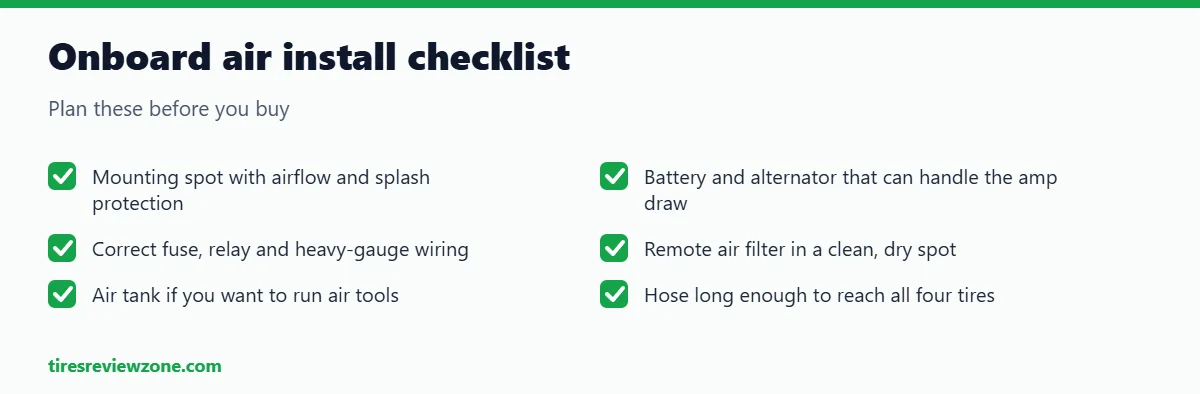
- Location: under a seat, in the engine bay, in a bed box or on the frame. Keep it away from direct water spray and exhaust heat, and give it airflow for cooling.
- Electrical: high-flow compressors draw 30 to 70 amps. Use the wire gauge, fuse and relay specified by the maker, and run it with the engine on to keep the battery charged.
- Air filter: mount the intake filter in a clean, dry place. Many kits include a remote filter for this reason.
- Air tank: optional for tire inflation, but useful for tools, horns and seating beads.
- Hose and chuck: make sure the hose reaches all four tires and the spare. A lock-on chuck with an inline gauge makes airing up easier.
- Switch: a dash-mounted switch with an indicator light prevents leaving it on by mistake.
Onboard vs Portable: Which Is Right for You?
An onboard compressor is always there, frees up cargo space and can feed air lockers. A portable compressor costs less, needs no installation and can move between vehicles. If you air down every trip or run lockers, onboard is worth it. If you only air down a few times a year, a high-flow portable may be the smarter buy.
Whatever you choose, carry a good tire pressure gauge and a plug kit. If you use a tire pressure monitoring system, read our explainer on how tire pressure sensors work, since TPMS readings can lag while you air up. If you plan to mount your own tires, see our guide to the best tire changer and wheel balancer combos.
Tips for Airing Up Faster
- Run the engine so the compressor gets full voltage.
- Use a four-tire inflation manifold or a hose that reaches every wheel without moving the vehicle.
- Remove valve cores with a deflator kit when airing down to save time.
- Let a hot compressor cool if it cycles off on thermal protection.
- Check pressure with a separate gauge once the tires are back to your target.
Accessories Worth Adding
The compressor is only part of an onboard air setup. These add-ons make it faster and easier to use on the trail:
- Inflation hose kit: ARB and VIAIR compressors often ship without a long hose. A coil hose of 25 feet or more with a lock-on chuck lets you reach every tire from one spot. See inflation hose kits.
- Tire deflators: automatic deflators screw onto the valve stems and let air out to a preset pressure, so you can air down all four tires at once. See tire deflators.
- Digital tire gauge: built-in compressor gauges are rarely precise. A separate digital or dial gauge gives you consistent readings. See tire pressure gauges.
- Air tank: a 1- to 2.5-gallon tank smooths out pressure, helps seat tire beads and lets you run short bursts from tools.
- Mounting bracket: vehicle-specific brackets for Wrangler, Bronco, Tacoma and full-size trucks save drilling and keep the compressor protected.
Common Mounting Locations
Under the seat: popular on Jeep Wrangler JK and JL models because it keeps the compressor dry and cool, and ARB sells brackets for it. Space is tight, so compact singles fit best.
Engine bay: short wiring runs to the battery, but heat and water exposure are higher. Choose a sealed unit and mount the intake filter high.
Truck bed or bed box: plenty of room for a twin compressor and tank, easy to reach for airing up. Protect it from rain with a sealed box or cover.
Frame rail: keeps cab and bed space free, but exposes the compressor to mud and water. Only sealed, high IP-rated compressors suit this spot.
Frequently Asked Questions
What is the best onboard air compressor for a Jeep Wrangler?
For under-seat installs, ARB’s single-motor kits for the JK and JL are the most common choice. If you run 35-inch or larger tires, the ARB twin or brushless models air up much faster.
Can an onboard compressor run air tools?
Yes, with an air tank. The tank stores air so tools can draw short bursts beyond what the compressor alone can deliver. Continuous-use tools like sanders are not a good match.
How long does it take to air up four 35-inch tires?
It depends on starting and target pressure and compressor flow. Higher-flow twin compressors take a fraction of the time of small single units, which is why flow at 29 psi is the number to compare.
Do I need a relay?
Most brushed compressors use a relay so the dash switch only handles a small current. ARB says its brushless compressors do not need separate relays.
Is a 100 psi compressor enough?
For tires and ARB Air Lockers, yes. For air tools, air suspension or filling a tank to 150 psi, choose a 150 or 200 psi model.
Final Verdict
The ARB Twin CKMTA12 remains the best all-round onboard compressor for trucks and Jeeps with big tires. The ARB Brushless CKBLA12 is the best single-motor upgrade, the ARB CKMA12 kits are easiest for Wrangler under-seat installs, and VIAIR’s 400C and 444C are the better choice when you want a tank system for tools or air suspension. On a budget, the Smittybilt 2781 delivers a lot of airflow for the price.