

Disclosure: Tires Review Zone is reader-supported. As an Amazon Associate I earn from qualifying purchases, at no extra cost to you. Learn more.
As an Amazon Associate, Tires Review Zone earns from qualifying purchases. We did not test these machines in person; this guide is based on manufacturer specifications, seller listings and owner feedback.
Paying a shop to mount and balance tires adds up fast, especially if you run summer and winter sets, own a truck with big all-terrains, or help family and friends with their cars. A tire changer and wheel balancer combo lets you do the whole job in your own garage. But these machines are heavy, need compressed air and take real floor space, so choosing the right one matters.
This guide compares the most popular tire changer and wheel balancer combos sold online for home garages, explains the specs that actually matter, and lists everything you need in place before you order.
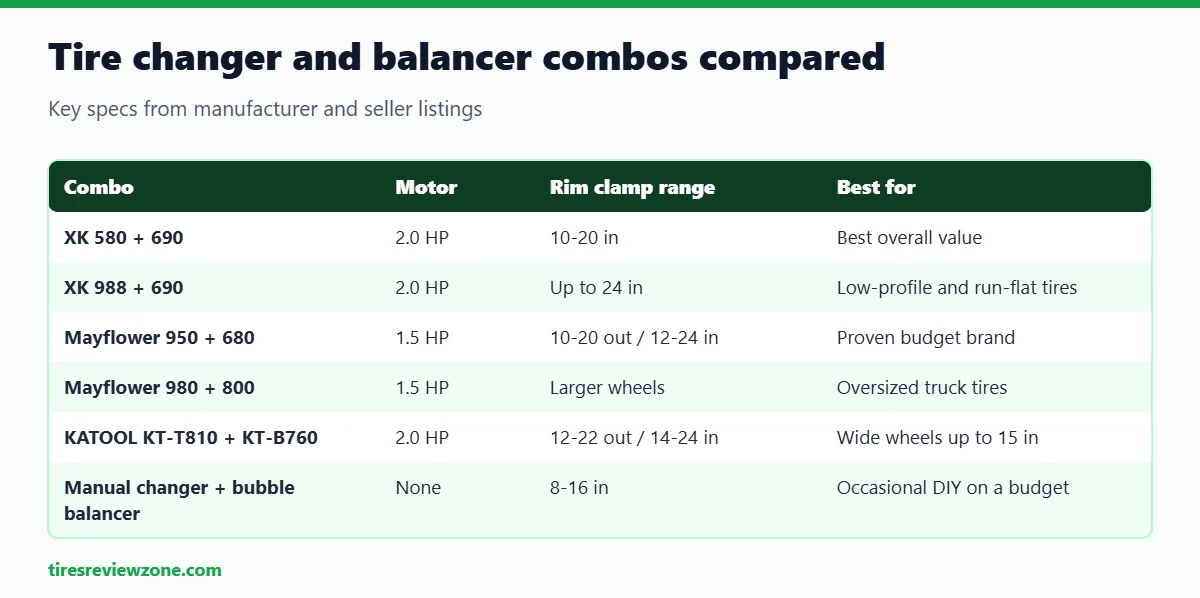
Quick Picks
- Best overall value: XK 580 tire changer and 690 balancer combo
- Best for low-profile and run-flat tires: XK 988 tire changer with assist arms and 690 balancer
- Best known budget brand: Mayflower 950 tire changer and 680 balancer combo
- Best for oversized truck tires: Mayflower 980 and 800 combo
- Best for wide wheels: KATOOL KT-T810 tire changer and KT-B760 balancer
- Best budget alternative: manual tire changer plus a bubble balancer
1. XK 580 Tire Changer and 690 Wheel Balancer Combo
Best overall value for most home garages. The XK 580 and 690 combo is one of the most frequently recommended home garage packages. Listings describe a 2.0 HP motor, rim clamping from 10 to 20 inches, about 5,600 lb of bead-breaking force, 110V single-phase power and a 36-month parts replacement warranty, which is long for this price class.
The 580 is a semi-automatic, rim-clamp swing-arm changer, so it covers most car, crossover and light truck wheels. The 690 balancer is an electronic spin balancer with several balancing modes for steel and alloy wheels.
Pros: strong motor for the price, long parts warranty, runs on standard 110V power.
Cons: no assist arm, so stiff low-profile and run-flat tires are harder; you need your own air compressor.
Check the XK 580 + 690 combo on Amazon
2. XK 988 Tire Changer and 690 Wheel Balancer Combo
Best for low-profile and run-flat tires. The 988 adds helper (assist) arms and a bead blaster to the XK design. Assist arms push the tire down while you mount it, which makes stiff low-profile and run-flat tires far easier to handle without damaging the bead or rim. Listings describe a 2.0 HP motor and support for rims up to about 24 inches, and one owner reports using it on 38-inch truck tires.
Pros: assist arms and bead blaster, wider wheel range, long parts warranty.
Cons: heavier and bigger than the 580; some owners mention air lines being pinched by the folding arms, so route them carefully during setup.
Check the XK 988 + 690 combo on Amazon
3. Mayflower 950 Tire Changer and 680 Wheel Balancer Combo
Best known budget brand. Mayflower is one of the most established names in affordable tire machines, and The Drive picked a Mayflower 1.5 HP combo as its best value choice in its tire changer and balancer combo guide. The 950 changer has a 1.5 HP motor, outside rim clamping from 10 to 20 inches, inside clamping from 12 to 24 inches, a maximum tire diameter of 37 inches and a 12-inch maximum wheel width, and it includes a bead blaster with an air reserve tank.
Pros: established brand, bead blaster included, wide inside clamp range.
Cons: smaller motor than the XK and KATOOL machines; one-year warranty is shorter.
Check the Mayflower 950 + 680 combo on Amazon
4. Mayflower 980 Tire Changer and 800 Wheel Balancer Combo
Best for oversized truck tires. If you run large all-terrain or mud-terrain tires on a lifted truck or Jeep, look for a machine designed for larger wheels. The Drive named the Mayflower 980 and 800 combo its best pick for oversized tires. Check the exact maximum tire diameter and wheel width in the listing against your largest tire before ordering. For help with sizes, see our guide on how big a tire you can use.
Pros: aimed at larger truck wheels, bead blaster, 1.5 HP motor.
Cons: needs more space; confirm the balancer’s maximum wheel weight for heavy truck wheels.
Check the Mayflower 980 + 800 combo on Amazon
5. KATOOL KT-T810 Tire Changer and KT-B760 Wheel Balancer
Best for wide wheels. KATOOL builds a step up in capacity. According to dealer specifications, the KT-T810 changer handles wheels up to 41 inches in diameter and 15 inches wide, with outside clamping from 12 to 22 inches and inside clamping from 14 to 24 inches, a 2.0 HP motor on 120V single-phase power and an operating air pressure of 116 to 145 psi. The KT-B760 balancer is listed with a fast 7-second measurement time. You can review the full specifications on Best Buy Auto Equipment’s KATOOL combo page.
Pros: handles wide wheels, strong motor, fast balancer.
Cons: higher price than entry combos; shop-sized footprint.
Check KATOOL tire changer combos on Amazon
6. Budget Alternative: Manual Tire Changer and Bubble Balancer
Best if you only change a few tires a year. A manual tire changer stand with a bead breaker, paired with a portable bubble balancer, costs a fraction of a powered combo and stores in a corner. Many manual changers handle 8- to 16-inch wheels, which covers trailers, small cars, ATVs and lawn equipment, but they are hard work on large or stiff tires and do not suit low-profile wheels. Bubble balancers only do static balancing, so expect less precision than a spin balancer.
Check manual tire changers on Amazon
Check bubble wheel balancers on Amazon
What You Need Before You Buy
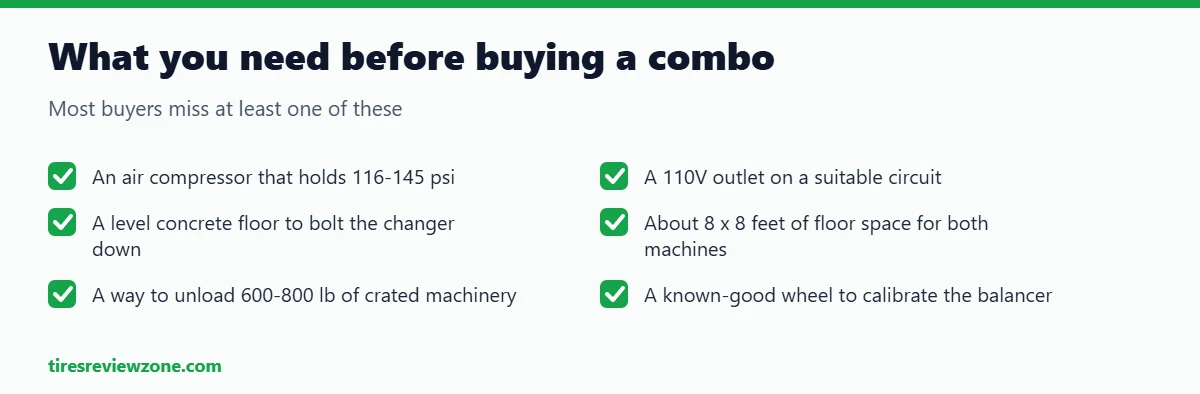
Most disappointment with home tire machines comes from setup, not the machines themselves. Plan for these before ordering:
- Compressed air: most powered tire changers need roughly 116 to 145 psi from a shop compressor to run the bead breaker, clamps and bead blaster. A small pancake compressor will struggle. Mayflower lists 120 to 145 psi for its 988 changer, as shown on FactoryPure’s Mayflower 988 combo listing.
- Power: both machines in these combos run on 110 to 120V, but the changer motor draws a lot of current at start-up, so use a suitable circuit.
- Floor and anchoring: tire changers should be bolted to a level concrete floor so they do not rock under bead-breaking force.
- Space: allow room to walk around both machines and swing the arm. Roughly 8 by 8 feet is a practical minimum.
- Delivery: combos usually arrive on a pallet weighing several hundred pounds, often curbside. Plan for a pallet jack, engine hoist or helpers.
- Calibration: spin balancers need calibrating with a known-good wheel and the supplied weight.
Key Specs Explained
Rim clamping range
The clamp range shows which wheel diameters the turntable can hold. Outside clamping grips the rim from the outside; inside clamping grips from the inside, usually allowing larger wheels. Make sure your smallest and largest wheels fall inside the range. Our tire size guide explains how to read wheel diameter from your tire size.
Maximum tire diameter and wheel width
These limit how big a tire the machine can handle. Truck owners running 33- to 37-inch tires should check these numbers carefully.
Motor power
A 1.5 HP motor is fine for most car and light truck tires. 2.0 HP motors give more torque for stiff tires and frequent use.
Assist arms and bead blaster
Assist arms make low-profile and run-flat tires much easier to mount. A bead blaster releases a burst of air to seat stubborn beads. Both are worth having if you work on modern performance cars or large tires.
Balancer accuracy and modes
Electronic spin balancers measure static and dynamic imbalance and tell you where to place weights. Multiple modes let you use clip-on or stick-on weights for alloy wheels. Our guide to tire balance and alignment explains why balancing matters.
Which Type Should You Choose?
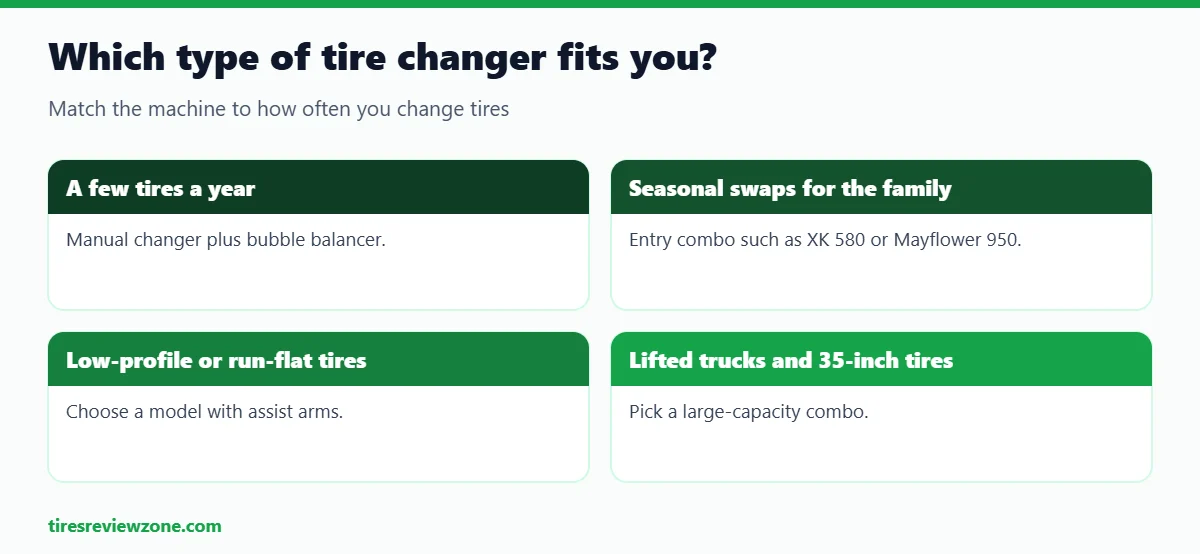
- A few tires a year: a manual changer and bubble balancer will do.
- Seasonal swaps for one or two cars: an entry combo such as the XK 580 or Mayflower 950 pays for itself over a few seasons.
- Low-profile, run-flat or performance tires: choose a model with assist arms, such as the XK 988.
- Lifted trucks and big all-terrains: pick a large-capacity combo and check maximum tire diameter and balancer wheel weight.
Is a Home Tire Changer Worth It?
The Drive notes that for personal vehicles or a small fleet, a combo in the roughly $2,000 to $3,000 range is usually enough. If you change and balance 16 or more tires a year, or swap seasonal sets on several vehicles, the savings on shop fees can add up within a few seasons. If you only buy new tires every few years, a local shop is usually the cheaper choice.
Owning the equipment also lets you fix problems on your own schedule, such as rebalancing a wheel that causes vibration or swapping winter tires the day the first snow arrives. If you store seasonal sets, our guide to tire racks for storage helps keep them organised.
Safety Tips
- Read the manual fully and wear eye protection; bead seating can be violent.
- Never exceed the tire’s maximum seating pressure printed on the sidewall.
- Keep hands clear of the bead breaker and turntable jaws.
- Use rim protectors on alloy wheels to avoid scratches.
- Check that each wheel’s TPMS sensor is positioned correctly before breaking the bead; see our guide to how tire pressure sensors work.
Frequently Asked Questions
Do tire changers need an air compressor?
Yes. Powered tire changers use compressed air for the bead breaker, clamps and bead blaster, typically around 116 to 145 psi.
Can a home tire changer handle low-profile tires?
Yes, but a model with assist arms makes it much easier and reduces the risk of damaging the tire or wheel.
Will these machines run on household power?
The combos in this guide are listed for 110 to 120V single-phase power, which is standard in US garages.
How much space do I need?
Plan for roughly 8 by 8 feet for both machines, plus room to move wheels around them.
Is a combo better than buying separately?
Combos are usually cheaper than buying the same two machines separately and ship together, but buying separately lets you choose a better balancer or changer if one matters more to you.
Final Verdict
For most home garages, the XK 580 and 690 combo offers the best mix of power, capacity and warranty. Choose the XK 988 if you work on low-profile or run-flat tires, the Mayflower combos if you prefer an established budget brand, and the KATOOL KT-T810 if you need capacity for wide wheels. If you only change a few tires a year, a manual changer and bubble balancer are the sensible budget choice. Whatever you pick, make sure your compressor, power, floor and space are ready before the pallet arrives.