
Disclosure: Tires Review Zone is reader-supported. As an Amazon Associate I earn from qualifying purchases, at no extra cost to you. Learn more.
As an Amazon Associate, Tires Review Zone earns from qualifying purchases. We did not test these compressors in person; this guide is based on manufacturer specifications, dealer listings and owner feedback.
Truck tires hold a lot more air than car tires. The small inflators sold for cars plug into the 12V socket, draw little current and can take a very long time to fill a light truck tire, or overheat halfway through. A proper portable compressor for truck tires clamps directly to the battery, moves far more air and is built to keep running long enough to finish all four tires.
This guide compares the best portable 12V compressors for pickups, SUVs and off-road trucks, from compact VIAIR units for topping off highway tires to high-flow ARB and Smittybilt models for airing up big all-terrains after a day on the trail.
Quick Picks
- Best overall for most trucks: VIAIR 400P
- Best for continuous use and RVs: VIAIR 450P-RV Automatic
- Best for big off-road tires: ARB Twin Portable (CKMTP12)
- Best value high-flow: Smittybilt 2781
- Best rugged single-motor: ARB Single Portable (CKMP12V2)
- Best compact budget pick: VIAIR 88P
1. VIAIR 400P Portable Compressor
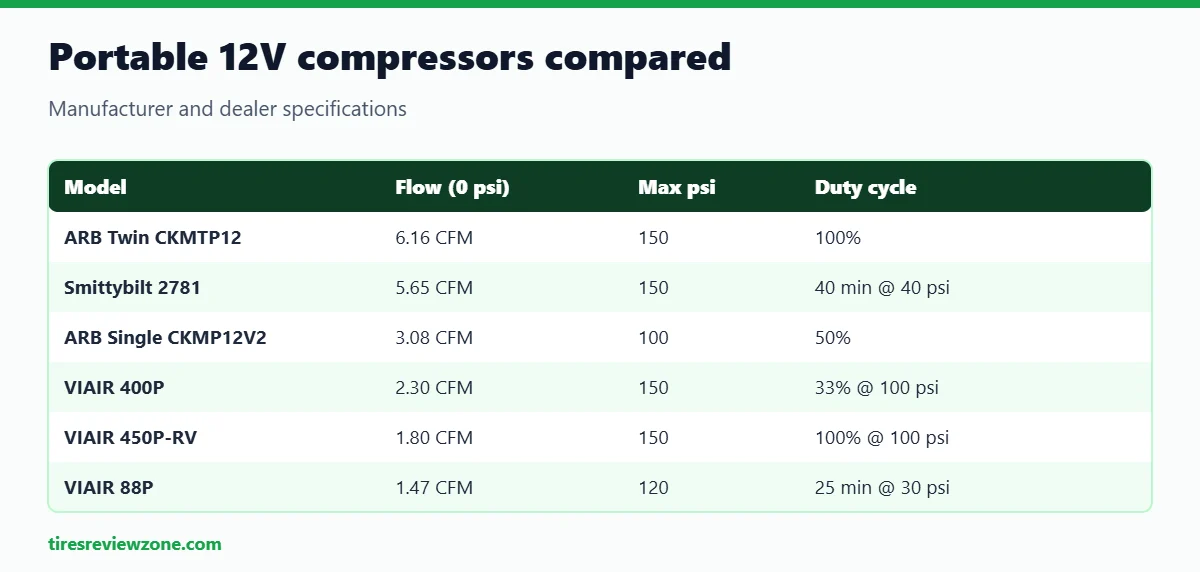
Best overall for most trucks. The 400P is the most widely recommended portable compressor for pickups and SUVs. Listings show 2.30 CFM at 0 psi, a 150 psi maximum, a 30 amp maximum draw and a 33% duty cycle at 100 psi. VIAIR rates it for tires up to 35 inches. It comes in a carry bag with battery clamps and a 25-foot hose with an inline gauge and deflator.
The 33% duty cycle is measured at 100 psi, which is far above typical truck tire pressure, so in practice it can usually fill a set of light truck tires with short rests. VIAIR’s own guide, how to choose your first VIAIR compressor, points mid-size SUV, light truck and off-road owners toward its larger portable models.
Pros: proven reliability, good flow for its size, 150 psi, complete kit.
Cons: needs cool-down breaks on big jobs; much slower than twin-motor units on 35-inch tires.
Check the VIAIR 400P on Amazon
2. VIAIR 450P-RV Automatic
Best for continuous use, heavy-duty trucks and RVs. The 450P trades flow for endurance. Listings show 1.80 CFM at 0 psi, 150 psi maximum and a 100% duty cycle at 100 psi, with a 23 amp draw and an IP54 rating. The RV kit includes long hoses (about 60 feet of total reach) so you can get around a long truck and trailer, and VIAIR rates it for very large tires. The automatic version shuts off when it reaches its pressure limit.
It suits three-quarter and one-ton pickups with high-pressure load range E tires (often 65 to 80 psi), and owners who tow trailers. One RV owner who compared the 400P and 450P reported that the time difference when topping off tires was smaller than expected, and kept the 450P for its continuous duty cycle.
Pros: runs continuously, lower amp draw, long hose reach, great for high-pressure tires.
Cons: lower flow means slower filling from low pressure after airing down; heavier at about 13 lb.
Check the VIAIR 450P-RV on Amazon
3. ARB Twin Motor Portable Compressor (CKMTP12)
Best for big off-road tires. If you air down to 15 psi on trails and run 35-inch or larger tires, flow is everything. ARB’s portable twin uses the same twin-motor design as its onboard unit, mounted in a carry case with an air tank. ARB’s operation guide lists 6.16 CFM at 0 psi and 4.68 CFM at 29 psi, a 100% duty cycle at 72°F, and a 150 psi cut-out. It draws about 50 amps at tire pressure, so connect it directly to the battery with the engine running.
Pros: fastest in this guide, 100% duty cycle, built-in tank for tools, sealed against dust and water.
Cons: expensive, heavy, high current draw.
Check the ARB Twin Portable on Amazon
4. Smittybilt 2781 Portable Compressor
Best value high-flow option. The Smittybilt 2781 is the budget favourite of many Jeep and truck owners. Smittybilt’s 2781 product page lists 5.6 CFM maximum output, a 150 psi maximum, a 24-foot coil hose and a 10-foot power cord. Dealers list a 40-minute continuous run time at 40 psi and a 45 amp draw. Owners often praise its speed for the price but say the built-in gauge reads inaccurately, so use a separate tire gauge.
Pros: very high flow for the money, long hose, long run time at tire pressures.
Cons: bulky, inaccurate gauge reported by owners, flow drops noticeably above 40 psi.
Check the Smittybilt 2781 on Amazon
5. ARB Single Motor Portable Compressor (CKMP12V2)
Best rugged single-motor. ARB’s single portable comes in a weatherproof, impact-resistant case. Dealers such as Rovers North’s CKMP12V2 listing show 3.08 CFM at 0 psi and 2.34 CFM at 29 psi, a 50% duty cycle (30 minutes on, 30 off), a 32 amp maximum draw and an IP55 rating. Its pressure switch cuts out at about 100 psi, which covers tires but not high-pressure jobs.
Pros: tough case, good flow for a single, ARB build quality.
Cons: 100 psi limit, pricey for a single-motor unit.
Check the ARB Single Portable on Amazon
6. VIAIR 88P Portable Compressor
Best compact budget pick. The 88P is small enough to live under a seat. Dealer specifications list a 120 psi maximum, a 25-minute duty cycle at 30 psi, a 20 amp draw and a weight of about 4.75 lb, and VIAIR rates it for tires up to 33 inches. Flow is about 1.47 CFM, so it is best for topping off stock-size truck tires and emergencies rather than airing up from trail pressure.
Pros: compact, affordable, battery clamps, reputable brand.
Cons: slow on large tires, short hose compared with bigger kits.
How to Choose the Right Compressor
Match flow to your tires
CFM tells you how fast air moves. Bigger tires hold more air, so they need more CFM to fill in a reasonable time. Compare flow at around 29 psi when the maker lists it, because 0 psi figures look bigger than real-world performance.
Check the duty cycle
Duty cycle is how long the compressor can run before resting. Check the pressure the rating was measured at. A unit rated 33% at 100 psi can often run longer at 35 psi, while a 100% unit can keep going all day.
Power connection
Truck-tire compressors draw 20 to 50 amps, far more than a cigarette-lighter socket can supply. Look for battery clamps and keep the engine running while inflating.
Hose length and fittings
Measure from your battery to the farthest tire, including a trailer if you tow. A lock-on or quick-connect chuck is easier to use than a press-on chuck, and an inline deflator helps fine-tune pressure.
Maximum pressure
Heavy-duty pickups with load range E tires may need 80 psi in the rear. Make sure the compressor’s maximum comfortably exceeds the pressure on your door placard. Our guide to proper tire pressure explains why this matters.
Buying Checklist
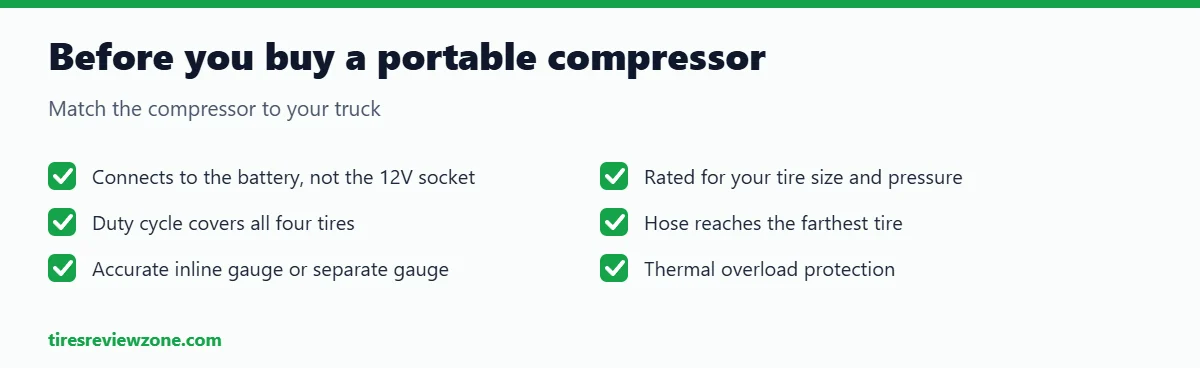
Before you order, confirm the compressor clamps to the battery, is rated for your tire size and pressure, can finish all four tires within its duty cycle, has a hose that reaches every wheel, and has thermal overload protection. Add a quality separate gauge either way.
Portable vs Onboard Compressors
A portable compressor needs no installation, can move between vehicles and is easy to replace. An onboard compressor is always ready, saves cargo space and can run air lockers. If you air down every weekend, onboard air is worth a look; see our guide to the best onboard air compressors for trucks and Jeeps. For most truck owners who check pressure monthly and air down occasionally, a good portable is the better value.
How to Air Up Truck Tires Safely
- Park on level ground, set the parking brake and start the engine.
- Connect the clamps to the battery: red to positive, black to negative or chassis ground.
- Check the cold pressure on your door placard, not the sidewall maximum.
- Attach the chuck to the valve stem and switch on the compressor.
- Stop a little above target, then use the deflator and a separate gauge to fine-tune.
- Let the compressor rest if it gets hot or the thermal cut-out trips.
- Disconnect from the battery before storing the compressor.
Remember that pressure rises as tires warm up, so check pressure before driving or after the truck has been parked for a few hours. If you do not own a compressor yet, see where to get tire pressure checked for free.
Best Compressor by Truck Type
Half-ton pickups and mid-size trucks
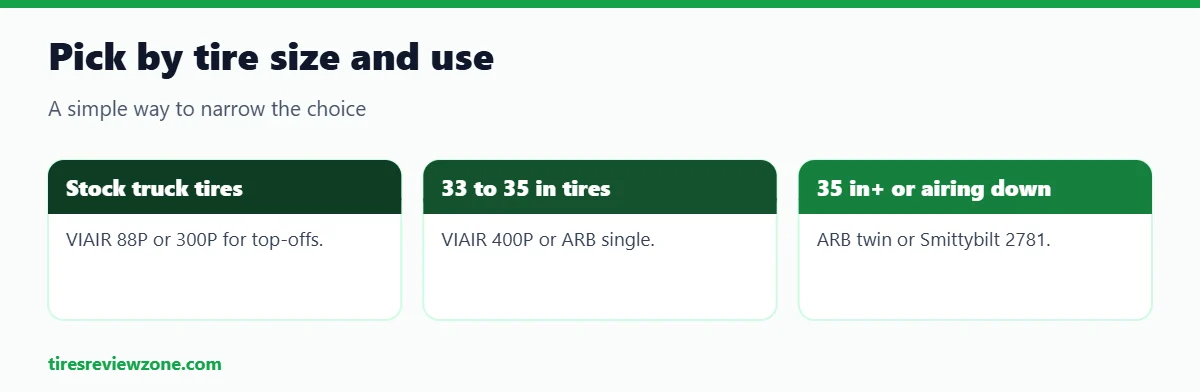
Trucks like the F-150, Silverado 1500, Ram 1500, Tacoma and Ranger usually run passenger or light truck tires at 35 to 45 psi. For highway driving and monthly checks, the VIAIR 88P or 300P is enough. If you run 33-inch all-terrains and air down occasionally, step up to the 400P or the ARB single.
Heavy-duty pickups
Three-quarter and one-ton trucks often carry load range E tires that need 65 to 80 psi, especially when towing or hauling. Here, a compressor that keeps pushing air at high pressure matters more than raw flow at 0 psi, which is why the VIAIR 450P-RV is a strong match. A long hose also helps reach dual rear wheels and a trailer.
Lifted trucks and overland rigs
If you run 35- to 37-inch tires and air down to trail pressure, the amount of air you need to put back is large. A twin-motor ARB or the Smittybilt 2781 turns a long wait into a short stop. Many overlanders carry one of these even if they also have onboard air, as a backup.
Accessories Worth Buying
- Digital tire gauge: more accurate than most built-in compressor gauges. See tire gauges.
- Tire deflators: set them to your trail pressure and air down all four tires at once. See tire deflators.
- Tire plug kit: a compressor is much more useful when you can also seal a puncture on the spot. See tire plug kits.
- Hose extension: useful for long-bed trucks, duallies and trailers.
Care and Maintenance
Portable compressors last longer with a little care. Clean or replace the intake filter when it gets dusty, especially after trail use. Store the compressor in its bag or case so the hose and fittings stay clean. Check the battery clamps and power cord for damage before each trip, and keep the inline fuse and a spare in the bag. If the compressor stops on thermal protection, let it cool fully before restarting rather than forcing it.
Frequently Asked Questions
Can a portable compressor fill a flat truck tire?
Yes, if the tire is not damaged and the bead is still seated. Larger compressors do this much faster. If the bead has come off the rim, you may need more airflow or a tire shop.
How long does it take to air up truck tires?
It depends on tire size, starting pressure and the compressor’s flow. High-flow twin-motor units fill large off-road tires in a fraction of the time of compact inflators, so check flow at tire pressure when comparing.
Is a cordless tire inflator good enough for a truck?
Cordless inflators from tool brands are handy for topping off a few psi, but they usually move less air than 12V battery-clamp compressors and are slow for airing up from trail pressure.
Can I use the 12V outlet?
Only for small inflators. Truck-tire compressors draw more current than most accessory sockets are fused for, which is why they use battery clamps.
What size compressor do I need for 35-inch tires?
VIAIR rates the 400P for tires up to 35 inches. If you air down often, a twin-motor unit or the Smittybilt 2781 saves a lot of time.
Final Verdict
For most pickups and SUVs, the VIAIR 400P is the best all-round portable compressor. Choose the VIAIR 450P-RV for heavy-duty trucks, high-pressure tires and towing. Off-roaders on 35-inch and larger tires should look at the ARB Twin Portable or, on a budget, the Smittybilt 2781. The ARB Single is a tough mid-range choice, and the VIAIR 88P is a compact budget pick for topping off stock tires. Pair any of them with a good tire gauge, and see our picks for the best tires for the Ford F-150 if your tires are due for replacement.