

Disclosure: Tires Review Zone is reader-supported. As an Amazon Associate I earn from qualifying purchases, at no extra cost to you. Learn more.
As an Amazon Associate, Tires Review Zone earns from qualifying purchases. We did not test these systems in person; this guide is based on manufacturer specifications, dealer listings and owner feedback.
Trailer and RV tires fail in a way car tires rarely do. A slow leak on a travel trailer can go unnoticed from the driver’s seat until the tire overheats, shreds and tears up the wheel well, fender or wiring. Many trailers have no factory tire pressure monitoring at all, and the tow vehicle’s TPMS only watches its own four tires. An aftermarket RV TPMS puts the pressure and temperature of every tire on a screen in your cab and sounds an alarm when something changes.
This guide compares the most popular RV and travel trailer TPMS systems, explains the difference between sensor types, and shows how to set alarms that actually protect you.
Quick Picks
- Best overall: TST 507 Series with color display and repeater
- Best for most travel trailers: TireMinder i10
- Best smartphone-based system: TireMinder Smart TPMS
- Best for big rigs and many tires: EEZTire TPMS Pro (518C)
- Best budget pick: GUTA RV TPMS
1. TST 507 Series TPMS (Color Display)
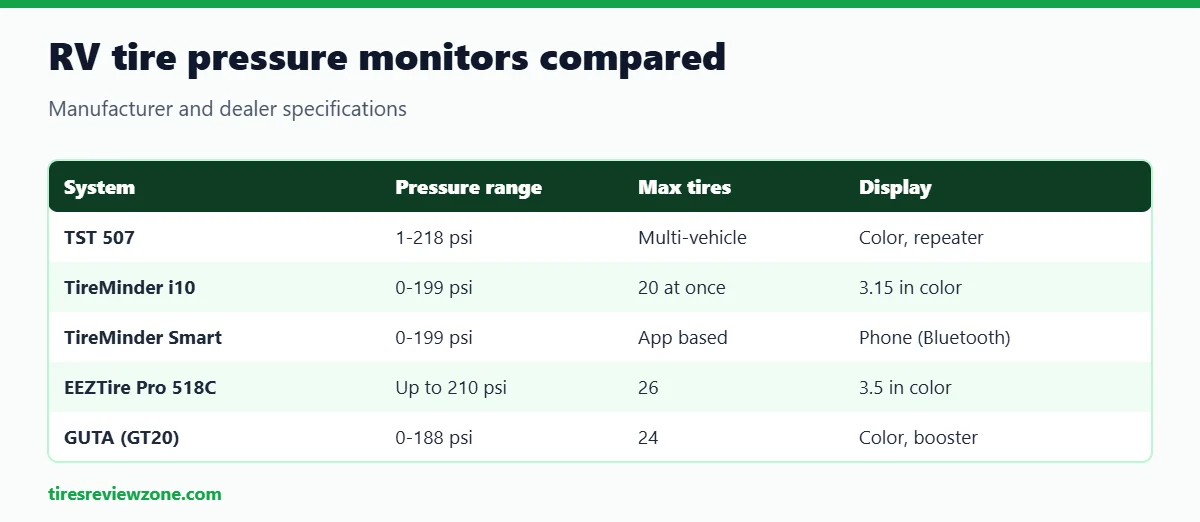
Best overall. Truck System Technologies (TST) is one of the most established names in RV tire monitoring, and the 507 series is sold in kits with 2 to 10 or more sensors. According to TechnoRV’s TST 507 listing, the sensors read from 1 to 218 psi with about ±1.5 psi accuracy, use common CR2032 batteries that last roughly 1 to 1.5 years, and the included signal repeater lets the monitor read sensors around 100 feet away. That high pressure range covers heavy-duty motorhome tires as well as trailers.
TST offers cap, flow-through and internal sensors, and the color monitor works with all of them. The monitor can store several vehicle presets, so you can switch between a motorhome, a toad and a trailer. Some owners report readings a few percent lower than a hand gauge, which you can account for when setting alarm levels.
Pros: very wide pressure range, choice of sensor types, strong dealer support, replaceable batteries.
Cons: pricier than budget kits; the repeater needs a 12V connection.
Check TST 507 TPMS kits on Amazon
2. TireMinder i10 RV TPMS
Best for most travel trailers. The TireMinder i10 is one of the most recommended systems for towing. RV.com’s TireMinder i10 article notes that its sensors are accurate to about ±1 psi from 0 to 199 psi, that the receiver can watch 20 tires at once or 40 across several vehicles, and that kits start at around $279 with four sensors and a signal booster. Dealers list a 3.15-inch color screen, sensor battery life of 9 to 14 months and a three-year warranty.
The i10 is sold with cap or flow-through sensors. Its booster wires to 12V power on the trailer and helps signals reach the cab on long rigs.
Pros: accurate sensors, easy setup, booster included, good warranty.
Cons: small screen compared with some rivals; sensor batteries need yearly changes.
Check the TireMinder i10 on Amazon
3. TireMinder Smart TPMS (Bluetooth)
Best smartphone-based system. If you would rather not add another screen to your dash, TireMinder’s Smart TPMS sends readings to an app on your phone through a Bluetooth repeater. Dealer listings show the same 0 to 199 psi sensor range as the i10, with cap or flow-through sensor kits. It suits owners who already mount a phone in the cab for navigation.
Pros: no extra monitor, app shows all tires clearly, works with flow-through sensors.
Cons: depends on your phone staying connected and charged; less convenient if you use the phone for other apps while driving.
Check the TireMinder Smart TPMS on Amazon
4. EEZTire TPMS Pro (518C)
Best for big rigs and many tires. EEZTire’s current color system has a 3.5-inch display, real-time updates and capacity for up to 26 tires at pressures up to 210 psi, according to seller listings. That makes it a good fit for a motorhome towing a car, or a dually towing a fifth wheel. Kits include anti-theft sensors, and a booster is available for long rigs. Owners upgrading from an older EEZTire system should note that the 518C sensors are not compatible with the earlier T515, E518 and E618 systems.
Pros: large color display, high tire capacity, strong owner reviews.
Cons: sensors not compatible with older EEZTire systems.
Check the EEZTire TPMS Pro on Amazon
5. GUTA RV TPMS
Best budget pick. GUTA sells several RV and trailer kits on Amazon, often with 6 to 12 sensors and a booster at a lower price than the big names. Listings for models such as the GT20 show capacity for up to 24 tires, a pressure range up to 188 psi and about 100 feet of range with the booster. It is a reasonable option for a travel trailer and tow vehicle on a tight budget, but check the exact model, sensor style and warranty in the listing.
Pros: low price, many sensors per kit, booster included on many kits.
Cons: lower top pressure than TST; brand support is less established.
Check GUTA RV TPMS kits on Amazon
Cap vs Flow-Through vs Internal Sensors
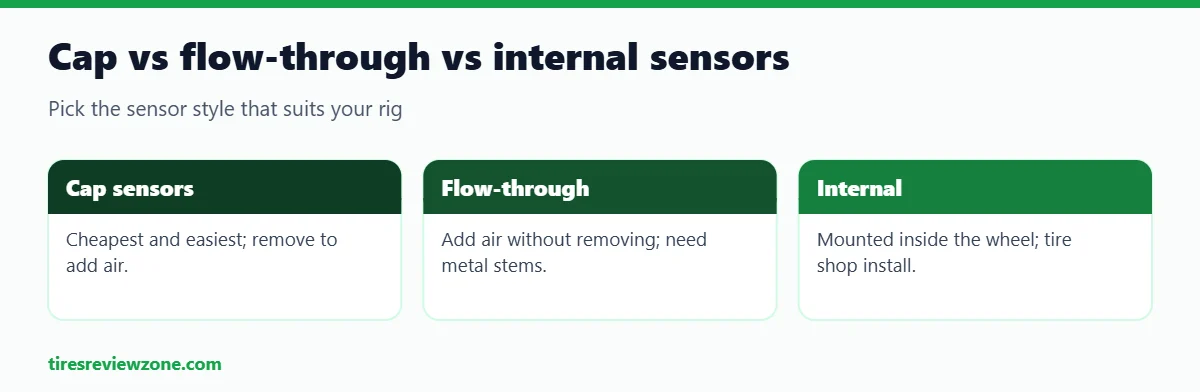
Cap sensors screw onto the valve stem in place of the valve cap. They are cheap and quick to install, but you must remove them to add air.
Flow-through sensors also screw onto the stem, but have their own valve so you can add air without removing them. They are longer and heavier, so they need metal valve stems; dealers warn against using them on rubber stems.
Internal sensors mount inside the wheel, so they are protected from theft and damage and read tire air directly. They require the tire to be dismounted, so most owners have them fitted when buying new tires.
What to Look For in an RV TPMS
- Pressure range: pick sensors rated well above your tires’ maximum pressure. Load range E trailer tires often run 80 psi, and many motorhome tires run over 100 psi.
- Tire capacity: count every tire on the trailer, tow vehicle, spare and any towed car you want to monitor.
- Signal booster: on travel trailers longer than about 25 feet, or fifth wheels, a repeater makes readings far more reliable.
- Temperature alerts: a hot tire or a dragging brake often shows up as rising temperature before pressure drops.
- Update speed: faster updates catch rapid leaks sooner.
- Display: a dedicated color monitor is easiest to glance at while driving; app-based systems save dash space.
Choosing the right tires matters just as much. See our guide to the best travel trailer tires, and learn why proper tire pressure matters.
How to Set Up an RV TPMS
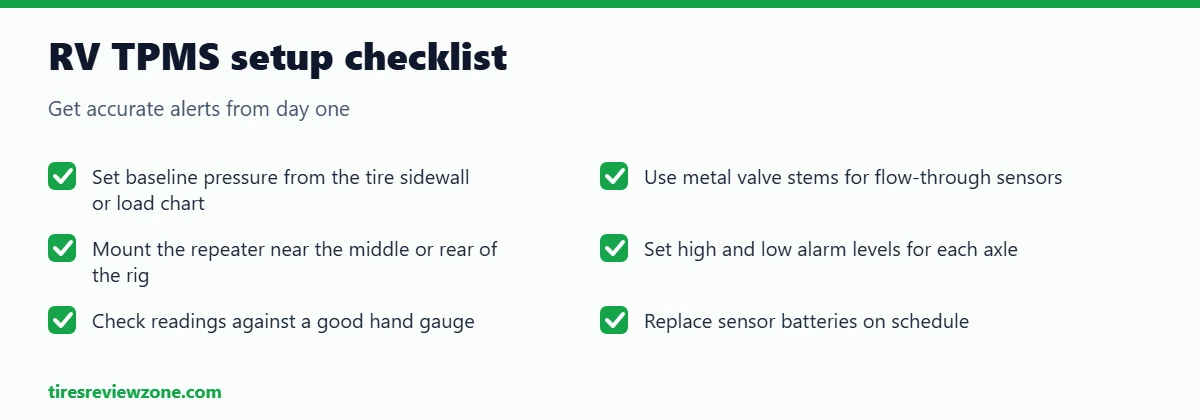
- Set your baseline: inflate tires cold to the pressure recommended for your load, usually on the trailer’s placard or the tire maker’s load chart.
- Install sensors: tighten by hand, use the anti-theft nuts if supplied, and check for leaks with soapy water.
- Program the monitor: assign each sensor to its wheel position so alerts point to the right tire.
- Set alarm levels: many owners set the low alarm about 10% below cold pressure and the high alarm about 20% above, since pressure rises as tires warm up.
- Mount the repeater: place it on the trailer frame or inside a front storage bay, connected to 12V power.
- Verify: compare readings with a quality hand gauge before your first trip.
Why RV Tires Need Monitoring
Trailer tires carry heavy loads, sit for months between trips and often run on axles you cannot see from the cab. Underinflation causes extra flexing and heat, which is a leading cause of tread separation. Because a trailer tire failure may not be felt in the tow vehicle, a TPMS is often the only early warning you get. If the worst happens, our guide on what to do in a tire blowout explains how to stay in control.
A TPMS also helps on the road between fuel stops. You can see when a tire is slowly losing air and top it off at the next stop, rather than discovering it flat at the campground. For airing up on the road, see our picks for the best onboard air compressors.
Recommended Setups by Rig Type
Single-axle travel trailer or teardrop
Two trailer sensors plus four on the tow vehicle cover everything. A four- or six-sensor kit with cap sensors is usually enough, and a booster is often optional on short trailers. Budget kits work well here.
Tandem-axle travel trailer
Four trailer sensors are the minimum, and six lets you add the truck’s front or rear axle. Tandem trailers are where TPMS pays off most: if one tire on an axle goes flat, the other tire carries both loads and can fail soon after. A booster is strongly recommended on trailers over about 25 feet.
Fifth wheel with a dually truck
Expect 10 to 12 sensors: six on the truck and four to six on the trailer. Choose a system with enough capacity and a booster mounted toward the rear of the fifth wheel. Flow-through sensors make airing up inner duals much easier, but use metal stems or stem extenders rated for them.
Class A or Class C motorhome with a towed car
Motorhome tires often run above 100 psi, so a high pressure range matters. Kits of 10 sensors (six on the coach, four on the toad) are common. Systems that store multiple vehicles let you leave the car’s sensors on when you unhook.
Common TPMS Problems and Fixes
- Lost signal on rear tires: move the booster closer to the rear axle or raise the monitor higher on the dash for better line of sight.
- Slow leak at the sensor: check the O-ring and do not overtighten; a dab of soapy water shows bubbles if it leaks.
- False high-pressure alarms: pressure rises as tires warm up. Set the high alarm with enough headroom, often 20% to 25% above cold pressure.
- Readings stop updating: many sensors only transmit regularly when they detect motion or pressure change, and weak batteries cause dropouts. Replace batteries before long trips.
- Sensor theft: use the locking nuts and wrench supplied with most kits, especially at campgrounds and storage lots.
Is an RV TPMS Worth the Money?
A trailer tire blowout can damage fenders, wiring, plumbing and floors, and can leave you stranded far from a tire shop. Compared with that cost, a TPMS is an inexpensive layer of protection. It also helps tires last longer by keeping them at the right pressure, and it gives you peace of mind on long travel days. For most RV owners who tow more than a few times a year, it is one of the most useful safety upgrades available.
Frequently Asked Questions
Does my tow vehicle’s TPMS monitor my trailer?
Some newer trucks can pair with trailer sensors, but most factory systems only watch the truck’s own tires. An aftermarket RV TPMS covers the trailer and can also cover the truck.
Do I need a signal booster?
For short trailers it may not be needed, but most RV owners use one. Signals must travel past metal walls and long distances, and a booster prevents dropouts.
Can I use flow-through sensors on rubber valve stems?
It is not recommended. The extra weight can bend or damage rubber stems at speed. Switch to metal stems first.
How often do sensor batteries need replacing?
It depends on the system. TST lists about 1 to 1.5 years for its cap sensors, and TireMinder lists 9 to 14 months. Keep spare batteries in the RV.
Why does my TPMS read differently from my gauge?
Sensors have a small tolerance, and pressure changes with temperature. Compare readings cold, with a known-good gauge, and adjust your alarm thresholds if needed. Our article on how tire pressure sensors work explains more.
Final Verdict
The TST 507 is our top pick for its wide pressure range and sensor choices. The TireMinder i10 is the easiest recommendation for most travel trailers, while the TireMinder Smart suits owners who prefer an app. Choose EEZTire’s TPMS Pro if you need to monitor many tires, and GUTA if budget is the priority. Whichever you buy, set sensible alarms and check readings against a hand gauge before your first trip.