
Disclosure: Tires Review Zone is reader-supported. As an Amazon Associate I earn from qualifying purchases, at no extra cost to you. Learn more.
Worn or cracked tires make a riding mower slip on slopes, leave ruts in wet grass and bounce the deck so the cut looks uneven. The good news is that replacing them is one of the cheapest upgrades you can make to a lawn tractor or zero-turn mower. A good set of turf tires grips without tearing up the lawn, carries the weight of the machine and lasts for years. This guide reviews six affordable turf tires that are widely available in common mower sizes, explains how to read lawn and garden tire sizes, and shows how to choose the right tread for your yard.
Key takeaways: the Carlisle Turf Saver is the best all-round turf tire for home lawns, the Turf Master suits zero-turn and pro mowers, and the Kenda K358 is the best value. Match the size printed on your old tire exactly, keep at least the original ply rating, and replace drive tires in pairs.
How we chose: we have not tested these tires on our own mowers. Our picks are based on manufacturer specifications, available sizes and ply ratings, how often each tire is fitted as original equipment, and long-term owner reviews from major retailers. Prices change often, so we describe each tire as budget, mid-range or premium rather than quoting a figure.
Quick picks: the best affordable turf tires
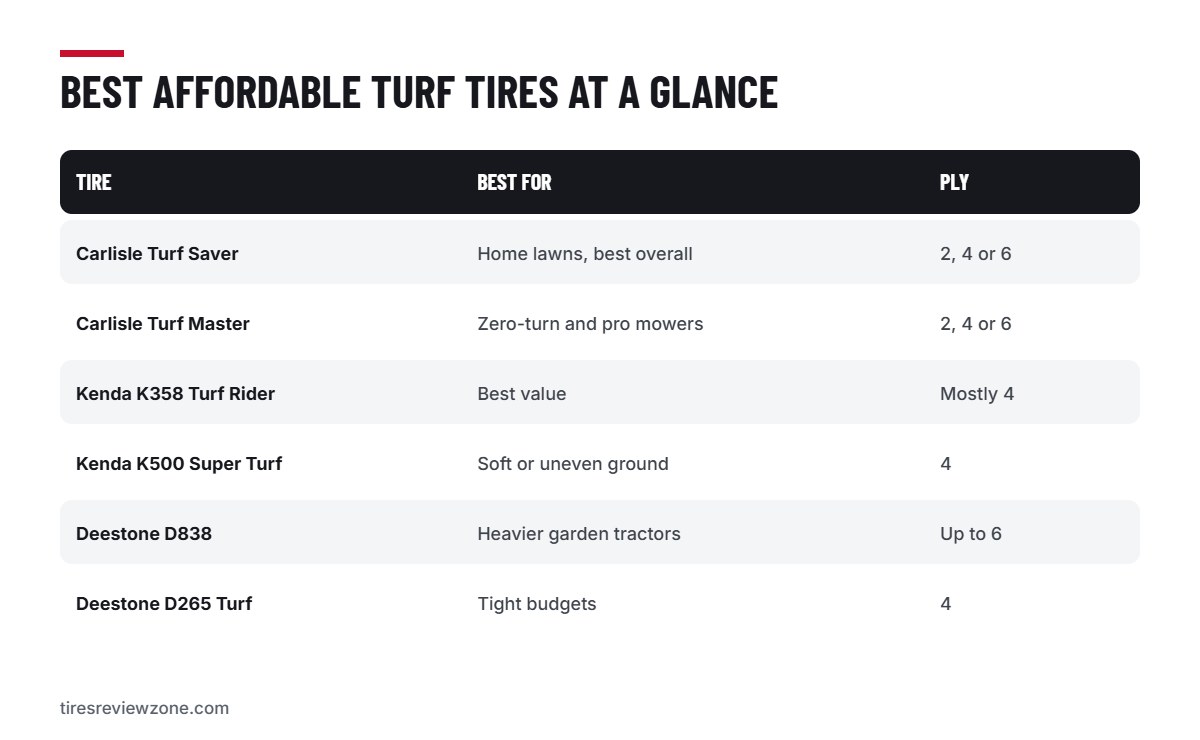
| Tire | Best for | Ply ratings | Price level |
|---|---|---|---|
| Carlisle Turf Saver | Best overall for home lawns | 2, 4 or 6 by size | Mid-range |
| Carlisle Turf Master | Zero-turn and pro mowers | 2, 4 or 6 by size | Mid-range to premium |
| Kenda K358 Turf Rider | Best value | Mostly 4-ply (B) | Budget |
| Kenda K500 Super Turf | Soft, loose or uneven ground | 4-ply (B) | Budget to mid-range |
| Deestone D838 | Heavier garden tractors | Up to 6-ply (C) | Mid-range |
| Deestone D265 Turf | Tight budgets | 4-ply (B) | Budget |
The 6 best affordable turf tires reviewed
1. Carlisle Turf Saver: best overall
The Turf Saver is the tire most people picture when they think of a lawn tractor tire. Carlisle, now sold under the Carlstar name, has supplied it as original equipment for mowers from brands such as John Deere, Toro and Jacobsen, and it comes in around 39 sizes, from small front tires to wide rear drive tires. Its shallow, closely spaced tread and wide, square-shouldered footprint spread the weight of the mower to reduce compaction and avoid tearing the grass, while still giving dependable traction on flat and gently sloping lawns.
The Turf Saver uses bias-ply construction, is rated 2-, 4- or 6-ply depending on size, and is marked NHS (not for highway service), meaning it is for off-road equipment only. Most are made in Jackson, Tennessee. For most homeowners with a riding mower or lawn tractor, this is the safest replacement choice.
Pros: very gentle on grass; huge size range, often an exact match for the original tire; proven durability.
Cons: limited grip on steep or muddy slopes; not suited to snow or rough ground.
2. Carlisle Turf Master: best for zero-turn and pro mowers
The Turf Master is Carlisle’s tougher turf tire. It keeps a lawn-friendly footprint but adds contoured shoulder protection, deeper tread lugs and a durable compound, which makes it a common choice for zero-turn mowers (ZTRs), professional mowers and groundskeeping equipment. The Turf Master is available in sizes from 13×6.50-6 up to 24×9.50-12, with most sizes rated 4-ply and some 2-ply and 6-ply options.
Choose the Turf Saver when protecting a flat lawn is the priority, and the Turf Master when the mower works harder, covers more hours or runs on bumpier ground. On a zero-turn, replace both drive tires together and match their diameter and tread depth, because uneven tires make the mower pull to one side and strain the hydrostatic drives.
Pros: sturdier build for heavy use; good stability on ZTRs; still turf-friendly.
Cons: costs more than the Turf Saver; slightly firmer ride.
3. Kenda K358 Turf Rider: best value
Kenda’s K358 Turf Rider is one of the best-selling replacement mower tires because it gives most of the Turf Saver’s performance for less money. It has a turf-friendly tread that limits damage to the grass while still giving useful traction, and it is sold in the most common riding mower sizes, including 16×6.50-8, 18×8.50-8 and 18×9.50-8, usually with a 4-ply (B) rating.
Pros: low price; 4-ply casing in most sizes; fits most residential mowers.
Cons: fewer sizes than Carlisle; tread wears a little faster on rough ground.
4. Kenda K500 Super Turf: best for soft or uneven ground
The K500 Super Turf is a step up for yards with soft soil, sand or bumpy patches. Kenda uses an optimized tread pattern and a silica compound designed to improve grip on soft, loose and uneven surfaces. It is a good choice for larger garden tractors that pull carts, spreaders or aerators across mixed ground.
Pros: better grip on soft and loose surfaces; sturdy 4-ply construction.
Cons: slightly more aggressive on delicate lawns; fewer small sizes.
5. Deestone D838: best for heavier garden tractors
Deestone, a large Thai tire maker, offers some of the best-value heavier-duty turf tires. The D838 is available in larger garden tractor sizes such as 23×10.50-12, including load range C (6-ply) versions that carry more weight than a typical mower tire. It suits heavier garden tractors, sub-compact tractors and machines that tow loaded carts.
Pros: higher load ratings in larger sizes; strong owner reviews; good price for its strength.
Cons: heavier and stiffer than residential tires; limited small mower sizes.
6. Deestone D265 Turf: best budget pick
If you just need a dependable tire at the lowest price, the D265 Turf is a simple 4-ply turf tire offered in common lawn and garden sizes. It does not have the reputation of the Carlisle tires, but it is a sensible choice for older mowers and light residential use.
Pros: lowest cost on this list; 4-ply rating.
Cons: fewer sizes; less proven over the long term.
Best turf tire by mower type
If you are not sure where to start, match the tire to the machine you own:
| Mower or tractor | Recommended tire | Why |
|---|---|---|
| Residential riding mower | Carlisle Turf Saver or Kenda K358 | Gentle on the lawn, affordable, fits most stock sizes |
| Zero-turn mower (ZTR) | Carlisle Turf Master | Stronger shoulders and deeper lugs for tight turns and long hours |
| Garden tractor with attachments | Kenda K500 or Deestone D838 | More grip on loose ground and higher load capacity |
| Older mower on a tight budget | Deestone D265 Turf | Low price for light residential use |
| Hilly or soft yard | Kenda K500 or Carlisle Turf Master | Better bite on slopes without switching to a lug tread |
Signs your mower tires need replacing
Mower tires rarely wear out from mileage alone. More often they age, crack or lose air. Replace them when you notice any of these signs:
- The tread is worn smooth and the mower slips on gentle slopes or damp grass.
- Cracks appear in the sidewalls or between the tread blocks, a sign the rubber has dried out.
- A tire keeps losing air even after a plug or sealant, or the bead will not seal on the rim.
- There is a bulge, cut or exposed cord anywhere on the tire.
- The cut looks uneven or the deck sits lower on one side, which can mean one tire is worn or a different size.
How to read a lawn mower tire size
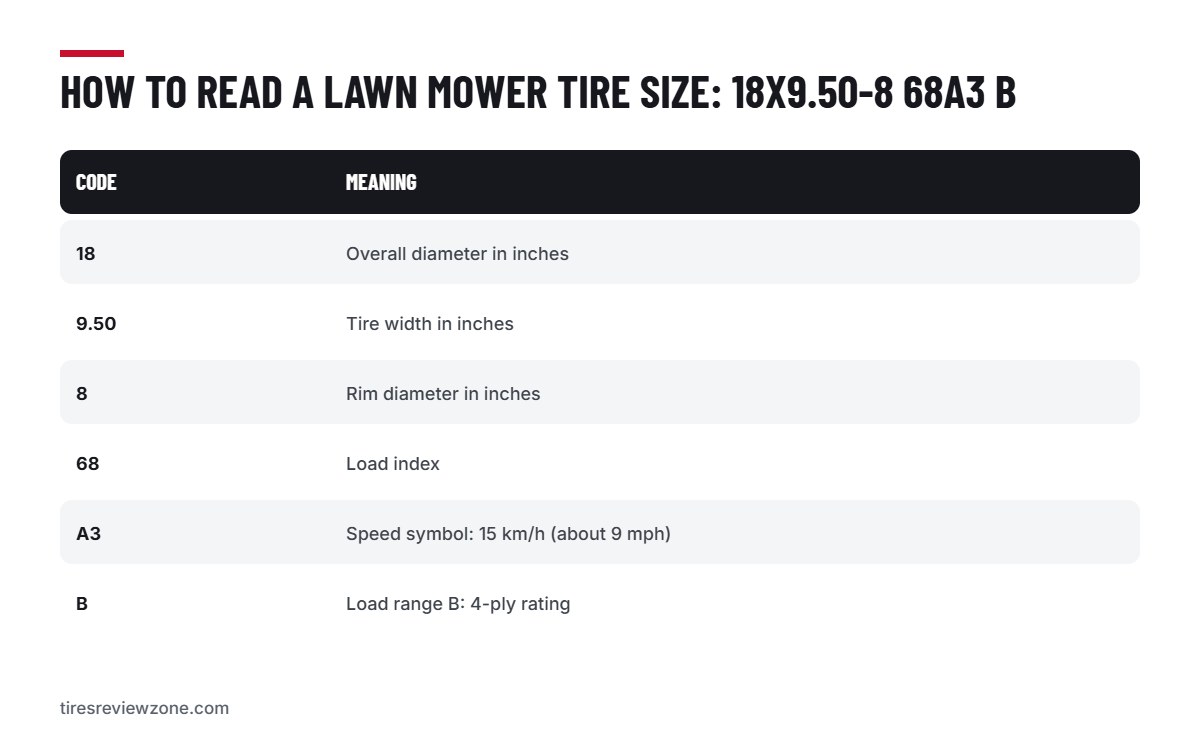
Lawn and garden tires use two size formats. The most common is three numbers, such as 18×9.50-8:
- 18: the overall diameter in inches when inflated.
- 9.50: the tire width in inches.
- 8: the wheel (rim) diameter in inches.
Older and smaller tires often use a two-number format, such as 4.80-8, where 4.80 is the section width in inches and 8 is the rim diameter. You will also see a load and speed code such as 68A3, where 68 is the load index and A3 is the speed symbol (15 km/h, about 9 mph). A4 is rated to 20 km/h, about 12 mph.
The ply rating or load range tells you how strong the tire is: A is 2-ply, B is 4-ply and C is 6-ply. Most residential riding mowers use 2- or 4-ply tires; zero-turns and garden tractors that carry attachments benefit from 4- or 6-ply.
Turf vs lug vs rib tread: which do you need?
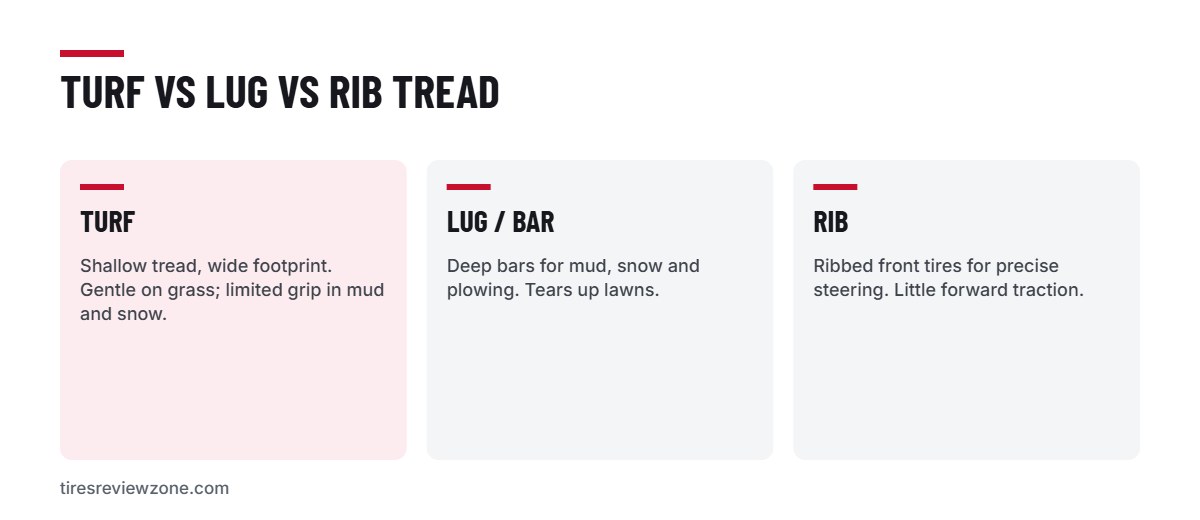
| Tread | Where it goes | Strengths | Weaknesses |
|---|---|---|---|
| Turf | Rear drive and front tires on lawn mowers | Gentle on grass, low compaction | Limited grip in mud, snow and on steep slopes |
| Lug or bar (R-1 style) | Rear tires on tractors used for snow, mud or plowing | Strong traction in soft ground and snow | Tears up lawns |
| Rib or sawtooth | Front steering tires | Precise steering, rolls easily | Little forward traction |
| Smooth | Front tires on light mowers and carts | Leaves no marks on fine turf | Poor grip when wet |
For a normal lawn, turf tread on the back and turf or rib tread on the front is the right combination. If you also use the tractor to clear snow, many owners keep a second set of rear wheels with lug tires or fit tire chains for winter.
How to choose the right turf tire
- Match the size exactly. Read the size off your current tire sidewall or the mower manual. On zero-turns, both drive tires must be the same diameter.
- Check the ply rating. Choose at least the original ply rating; go up a step if you tow a cart or carry a bagger.
- Think about your ground. Flat, well-kept lawns suit the Turf Saver or K358. Slopes, soft soil or heavy use suit the Turf Master, K500 or D838.
- Tubeless or tube-type. Most modern mower tires are tubeless. If a bead will not seal on an old rim, a tube can be fitted.
- Consider flat-free tires for caster wheels on zero-turns. They cost more but never go flat.
How to make mower tires last longer
- Keep them at the pressure in your mower manual. Lawn tractor tires usually run at low pressures, often between about 10 and 20 psi, and the right figure is important for an even cut. Our guide on when to check tire pressure explains why cold readings matter.
- Use a low-pressure gauge; standard car gauges are not accurate at these pressures.
- Store the mower in a garage or shed, out of direct sun, to slow rubber cracking.
- Avoid sharp turns on the spot with standard mowers, which scuffs the tread and the grass.
- Fix small punctures quickly. A plug kit works on tubeless mower tires, and the steps are the same as in our guide to using a tire repair kit. Tire sealant can also prevent slow leaks.
- Replace tires when the tread is worn smooth, the sidewalls crack or the tire will not hold air.
If your mower also needs new wheels, see our guide to the best specialty wheel and tire combinations. Owners comparing review scores can also check retailer ratings such as the Carlstar Turf Master reviews on SimpleTire.
How to replace a riding mower tire
Most owners can swap a riding mower tire in under an hour with basic tools. Many tire shops will also mount a new tire on your wheel for a small fee if you bring the wheel in.
- Park on level ground, set the parking brake, remove the key and disconnect the spark plug wire.
- Loosen the wheel, then lift that corner with a jack and support it on a jack stand.
- Remove the wheel. Rear wheels are usually held by a clip or bolt and a key on the axle; keep the key safe.
- Let all the air out, then break the bead with a bead breaker or by pressing it down carefully.
- Lever the old tire off the rim with tire spoons, protecting the rim with rim guards or rags.
- Clean the rim, lubricate the new tire’s beads with soapy water, and lever it on.
- Inflate slowly until the beads seat, then set the pressure from your manual and refit the wheel.
Frequently asked questions
What are turf tires?
Turf tires have a shallow, closely spaced tread and a wide, flat footprint. They are designed to give enough traction for mowing while spreading the machine’s weight so they do not rip up or compact the grass.
Are Carlisle and Carlstar the same brand?
Yes. Carlisle tires are now sold under the Carlstar name, but the tread designs such as the Turf Saver and Turf Master are the same.
What ply rating do I need for a riding mower?
Most residential riding mowers use 2-ply or 4-ply tires. Choose 4-ply or higher for zero-turns, heavy garden tractors or machines that pull carts and attachments.
Can I put turf tires on a tractor used for snow?
You can, but turf tires have limited grip in snow and on ice. Lug tires or tire chains work much better for snow clearing.
Should I replace mower tires in pairs?
Yes. Always replace both drive tires together so they have the same diameter and grip. This is especially important on zero-turn mowers, which steer by varying the speed of each drive wheel.
Are turf tires road legal?
No. Most turf tires are marked NHS, meaning not for highway service. They are designed for off-road equipment only.