

Disclosure: Tires Review Zone is reader-supported. As an Amazon Associate I earn from qualifying purchases, at no extra cost to you. Learn more.
A tire pressure gauge is the cheapest tool that can save you real money: correct pressure means longer tread life, better fuel economy and safer braking. But not all gauges are equal, and the analog vs digital tire pressure gauge choice matters. This guide explains how the three main types work, compares analog and digital gauges on accuracy and ease of use, and helps you pick the right range for a car, truck or trailer.
Key takeaways: digital gauges are usually the easiest to read and accurate to about 0.5 to 1 psi, with a good dial gauge close behind; pencil gauges are cheap but less precise. Buy a gauge whose range comfortably covers your highest pressure: 0 to 60 psi for most cars, and 0 to 100 psi or more for heavy-duty trucks and trailers. Always measure when the tires are cold and compare with the door-jamb placard.
How does a tire pressure gauge work?
Every gauge does the same basic job: when you press it onto the valve stem, a pin opens the valve and lets tire air into the gauge. That air pushes against something inside, and the gauge turns that push into a reading.
- Pencil (stick) gauges: air pushes a small piston against a spring, which slides a marked bar out of the body. The bar stays out so you can read it.
- Dial (analog) gauges: air flows into a curved, hollow metal tube called a Bourdon tube. Pressure makes the tube try to straighten, and a small gear system turns that movement into needle rotation on a dial.
- Digital gauges: air presses on a tiny electronic pressure sensor (a strain gauge or piezoresistive element). Its electrical signal changes with pressure, and a chip converts it to a number on the screen.
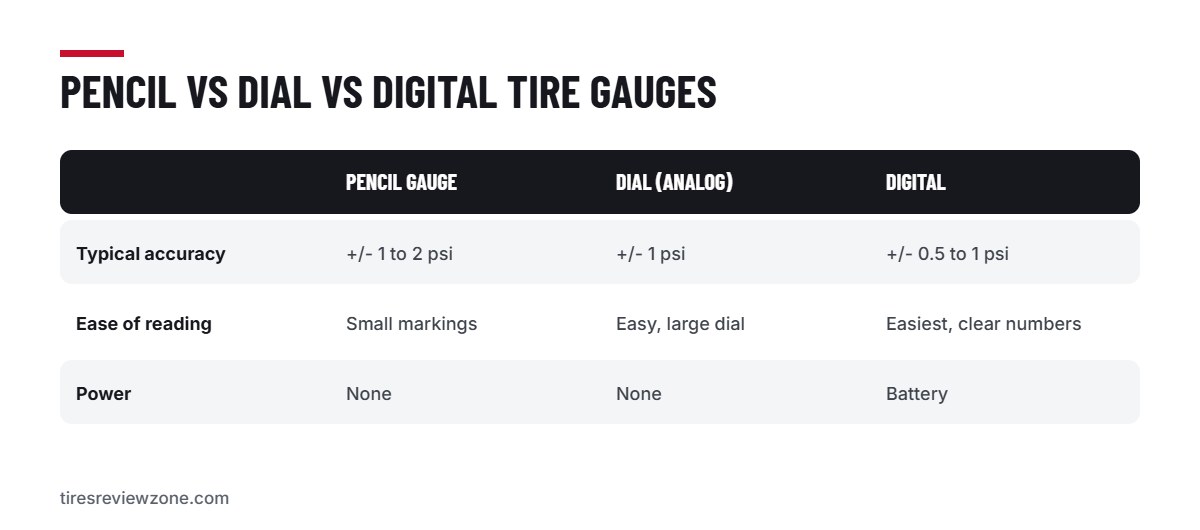
Analog vs digital tire pressure gauge: side-by-side
| Pencil gauge | Dial (analog) gauge | Digital gauge | |
|---|---|---|---|
| Typical accuracy | Plus or minus 1 to 2 psi | Plus or minus 1 psi (better on quality units) | Plus or minus 0.5 to 1 psi |
| Ease of reading | Small markings | Easy, large dial | Easiest, clear numbers |
| Needs batteries | No | No | Yes |
| Cold-weather use | Good | Good | Screens can be slow in deep cold |
| Durability | Simple, but sticks with dirt | Good if not dropped | Good; electronics can fail |
| Extra features | None | Bleed valve, hose on better models | Backlight, auto-off, unit switching |
| Cost | Lowest | Low to medium | Low to medium |
Analog dial gauges are favored by many mechanics because they need no batteries, work in any weather and, in good quality, stay accurate for years. Digital gauges are easiest to read and very accurate when new, which makes them a good choice for most drivers. Pencil gauges are cheap backups for the glove box but are the least precise.
Choose the right range
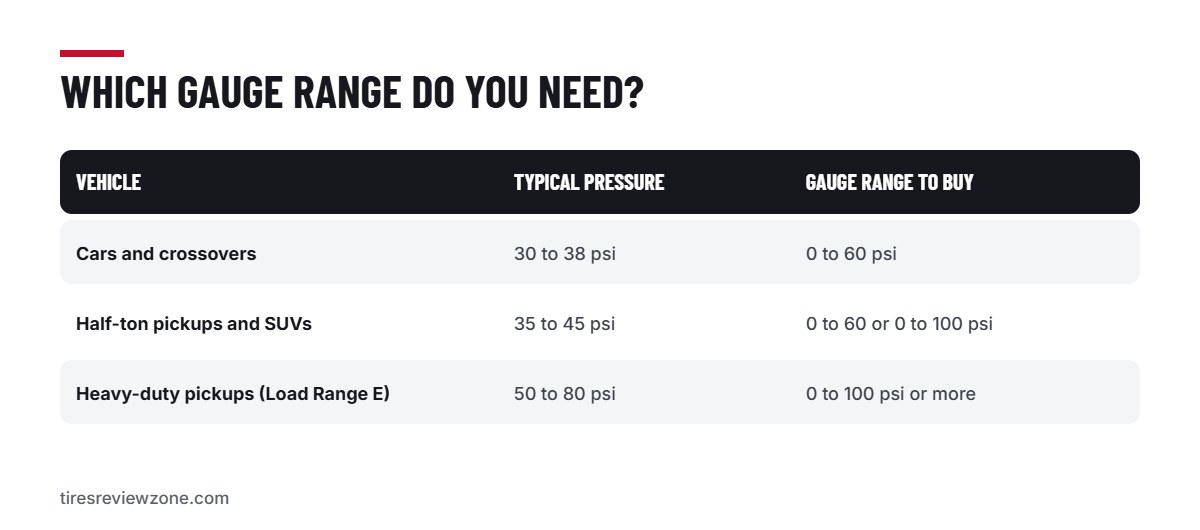
Pick a gauge whose range covers your highest pressure with room to spare. Gauges are most accurate in the middle of their range.
| Vehicle | Typical pressure | Gauge range to buy |
|---|---|---|
| Cars and crossovers | 30 to 38 psi | 0 to 60 psi |
| Half-ton pickups and SUVs | 35 to 45 psi | 0 to 60 or 0 to 100 psi |
| Heavy-duty pickups (Load Range E) | 50 to 80 psi | 0 to 100 psi or more |
| Trailers (ST tires) | 50 to 80 psi | 0 to 100 psi |
| Bicycles (road) | 80 to 120 psi | 0 to 160 psi |
Truck and trailer owners should look for a dual-head chuck to reach inner dually tires and a bleed valve to let out air without removing the gauge. See our light truck tire maintenance and trailer tire pressure guide for the right pressures.
Features worth paying for
- Hose with a locking chuck: easier to reach awkward valves and keeps a seal while you read.
- Bleed valve: lets you lower pressure to the exact number.
- Backlit display or glow dial: helpful in the dark.
- Certified accuracy: some gauges are tested to an ANSI accuracy grade.
- Rugged housing: survives being dropped in a garage.
How to check tire pressure correctly
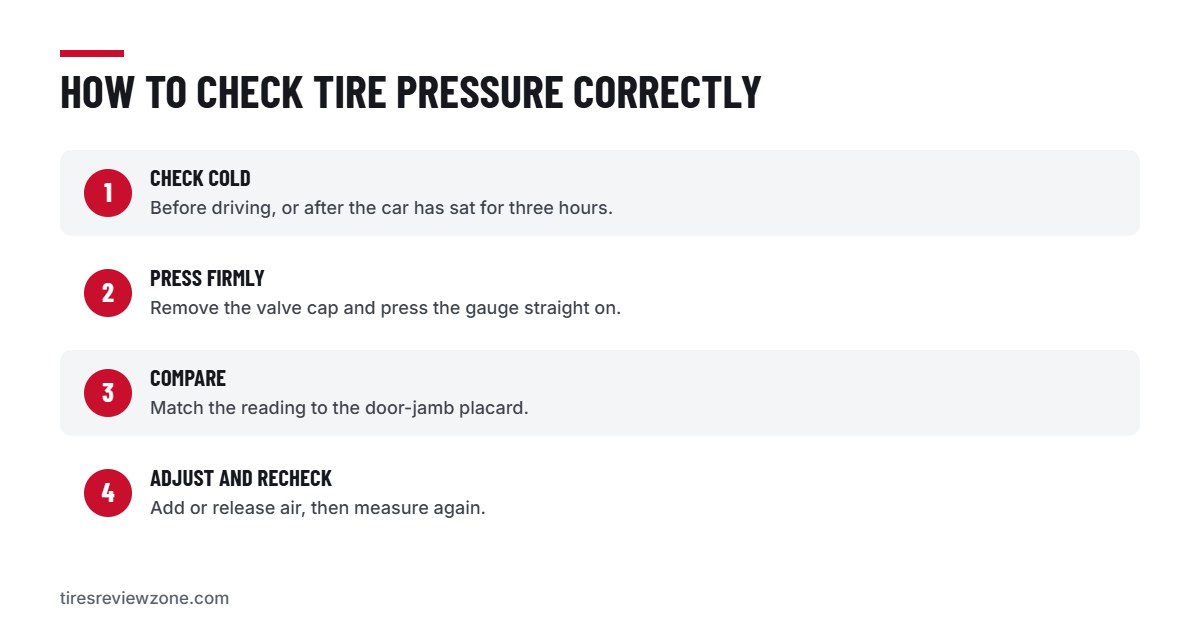
- Check cold. Measure before driving or after the car has sat for three hours.
- Find your number on the door-jamb placard, not the tire sidewall.
- Remove the valve cap and press the gauge straight onto the valve until the hissing stops.
- Read the gauge and compare with the placard pressure.
- Add or release air and re-check until it matches.
- Replace the valve cap to keep out dirt and moisture.
- Repeat for every tire, including the spare.
Check at least once a month and before long trips. Pressure falls about 1 psi for every 10°F drop, so check more often in cold weather. TPMS warning lights only come on when a tire is about 25 percent low; see how tire pressure sensors work.
How to know if your gauge is accurate
Compare your gauge with two or three others, or with a shop’s calibrated gauge, on the same tire. If yours reads more than 2 psi off, replace it. Gas-station air-line gauges are often damaged, so do not rely on them alone. Keep your gauge in a case and away from extreme heat.
The USTMA’s tire care essentials and NHTSA’s tire safety pages both recommend monthly pressure checks with your own gauge; the USTMA tire facts explain why pressure loss is so common.
Frequently asked questions
Are digital tire gauges more accurate than analog?
Good digital gauges are usually accurate to within about 0.5 to 1 psi. Quality dial gauges are similar. Cheap pencil gauges are the least accurate.
How does a dial tire pressure gauge work?
Air enters a curved metal Bourdon tube that straightens slightly under pressure. Gears turn that movement into needle rotation on the dial.
What range tire gauge do I need for a truck?
For half-ton pickups a 0 to 60 or 0 to 100 psi gauge works. Heavy-duty trucks with Load Range E tires and trailers need a gauge that reads to at least 100 psi.
How often should I check tire pressure?
At least once a month, before long trips and after big temperature drops, with the tires cold.
Should I trust the gas station air gauge?
Not on its own. Station gauges are often damaged or inaccurate. Use your own gauge to confirm the reading.
Do I still need a gauge if my car shows tire pressure?
Yes. A tire pressure monitoring system is a warning, not a gauge: it is designed to alert you when a tire is about 25 percent below the recommended pressure, which is already too low. A gauge lets you set pressure exactly.
Is a gauge with a hose better?
A gauge with a short hose and a locking chuck is much easier to use on dually inner wheels, trailers and wheels with recessed valves. For cars, a straight-head gauge is fine.
How often should I replace my tire gauge?
Replace a gauge if you drop it hard, if it reads differently from a known-good gauge by more than about 1 psi, or if a digital model shows erratic readings even with a fresh battery.