
Disclosure: Tires Review Zone is reader-supported. As an Amazon Associate I earn from qualifying purchases, at no extra cost to you. Learn more.
“Off-road tire” covers a huge range, from mild all-terrains that spend 95% of their life on pavement to deep-lugged mud tires that hum loudly on the highway but claw through clay and rock. Picking the best one starts with being honest about where you actually drive. This guide explains the four types of off-road tire, reviews the standout models in each, and covers the questions that usually come up next: which are quietest, what they cost, and which wheel size works best off-road.
Key takeaways: match the tire type to how you really drive. An off-road all-terrain such as the Falken Wildpeak A/T4W or Toyo Open Country A/T III suits most trucks; choose a hybrid for frequent trails and a mud-terrain such as the BFGoodrich KM3 only for deep mud and rock. Smaller wheels with taller sidewalls work best off-road.
How we chose: we have not tested these tires ourselves. Our picks draw on independent tests from Tire Rack and Tire Reviews, manufacturer specifications, and long-term owner feedback. For brand-by-brand warranty details on the all-terrain models, see our guide to the best light truck tire brands.
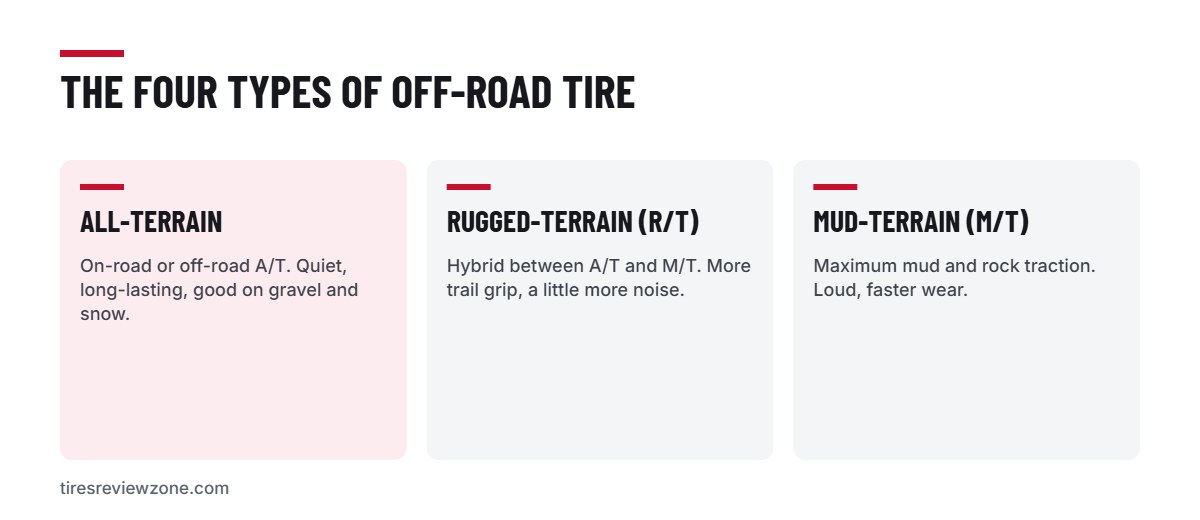
The four types of off-road tire
| Type | Typical use | On-road manners | Off-road grip |
|---|---|---|---|
| On-road all-terrain | 90%+ pavement, gravel roads, light snow | Quiet, comfortable, long-lasting | Mild |
| Off-road all-terrain (A/T) | Mostly pavement with regular dirt, gravel and snow | Good, a little louder | Good |
| Rugged-terrain or hybrid (R/T) | Mixed use with frequent trails | Moderate noise and wear | Very good |
| Mud-terrain (M/T) | Serious trails, deep mud, rock crawling | Loud, faster wear, weaker on wet roads and ice | Maximum |
Tire Rack now groups tires this way in its tests, and its first dedicated off-road test compared an off-road all-terrain, a rugged all-terrain and a maximum-traction mud-terrain to show how differently each category behaves.
Quick picks
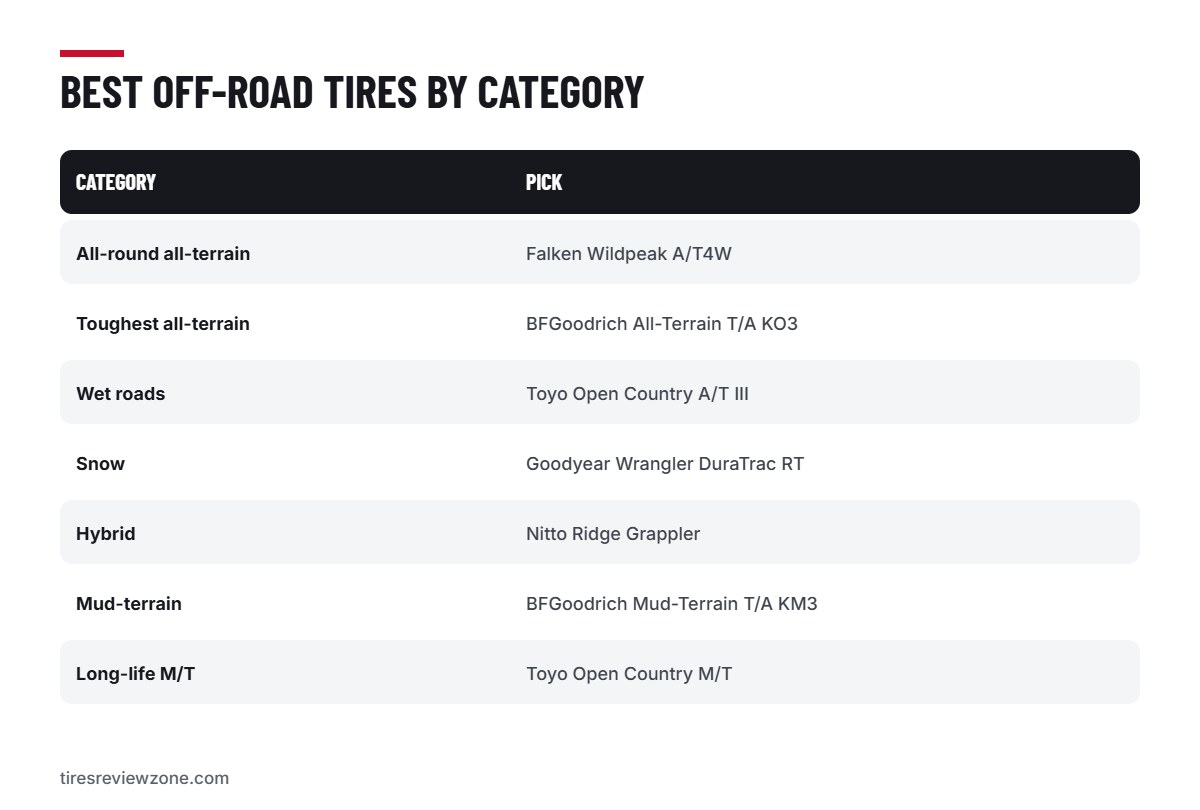
| Category | Pick | Why |
|---|---|---|
| Best all-round all-terrain | Falken Wildpeak A/T4W | Won Tire Reviews’ 2025 all-terrain comparison |
| Toughest all-terrain | BFGoodrich All-Terrain T/A KO3 | Strong sidewalls, sizes up to load range F |
| Best on wet roads | Toyo Open Country A/T III | Predictable handling and strong wet braking in tests |
| Best for snow | Goodyear Wrangler DuraTrac RT | Rugged-terrain tire with strong snow results |
| Best hybrid (R/T) | Nitto Ridge Grappler | Mud-tire looks with better road manners |
| Best mud-terrain | BFGoodrich Mud-Terrain T/A KM3 | The benchmark for mud and rock |
| Long-life mud-terrain | Toyo Open Country M/T | Known for wearing better than most M/Ts |
The best off-road tires reviewed
1. Falken Wildpeak A/T4W: best all-round all-terrain
In Tire Reviews’ 2025 all-terrain comparison, the A/T4W came out on top overall with a score of 96.8%, ahead of the BFGoodrich KO2 and Toyo Open Country A/T III. Tire Rack describes it as a smart pick for trucks and SUVs that regularly see mountain roads and weekend adventures. It is severe-snow rated and backed by a long warranty for an all-terrain. Some testers found it louder than rivals at highway speed, so it suits drivers who value grip over silence.
Pros: excellent all-round test results; severe-snow rated; long warranty for its class.
Cons: some reviewers report more highway noise; heavier than older Falken all-terrains.
2. BFGoodrich All-Terrain T/A KO3: toughest all-terrain
The KO3 replaces the long-running KO2 and keeps its focus on durability: tough sidewalls, an aggressive shoulder and sizes up to load range F for heavy trucks. It is the tire Tire Rack chose to represent the off-road all-terrain class in its off-road test. Choose it if your trail use involves sharp rocks and you air down often.
Pros: very tough construction; huge size range, including flotation sizes; severe-snow rated.
Cons: shorter warranty than some rivals; firmer and noisier than road-biased all-terrains.
3. Toyo Open Country A/T III: best on wet roads
The A/T III is the all-terrain to buy when one set has to do everything. In Tire Rack’s 2025 all-terrain test, it was praised for predictable, trustworthy behavior and cleared the emergency lane-change test every time; its subjective noise score was third best in that group. Tire Rack sums it up as the tire you buy when you want one set that can do a little bit of everything.
Pros: strong wet braking and handling; relatively quiet; severe-snow rated.
Cons: not as aggressive in deep mud as an R/T or M/T.
4. Goodyear Wrangler DuraTrac RT: best for snow
The DuraTrac RT is a rugged-terrain tire with a reputation for winter traction, and it has posted strong snow results in independent all-terrain comparisons. Tire Rack found it almost surprisingly civilized on the road for its category. It suits drivers in snowy regions who also want real trail capability.
Pros: strong snow traction; good balance for a rugged-terrain tire.
Cons: heavier, firmer ride than a standard all-terrain.
5. Nitto Ridge Grappler: best hybrid
The Ridge Grappler was one of the first hybrid tires to blend a mud-terrain look with all-terrain manners, using varied tread blocks and a wide center groove. It remains a favorite for lifted trucks that are driven daily, and Tire Rack used it to represent the rugged all-terrain class in its off-road test.
Pros: aggressive looks with acceptable road noise; good grip on dirt, gravel and light mud.
Cons: not as capable as a true M/T in deep mud; wears faster than an all-terrain.
6. BFGoodrich Mud-Terrain T/A KM3: best mud-terrain
If your weekends involve deep mud, rock crawling or technical trails, the KM3 is the benchmark. Tire Rack chose it as its off-road maximum-traction example. Its rock-gripping compound and sidewall lugs give exceptional traction when aired down, at the cost of more noise, faster wear and less grip on wet pavement and ice than an all-terrain.
Pros: top-tier mud and rock traction; tough sidewalls with extra side lugs.
Cons: loud on the highway; mud-terrains typically carry short or no treadwear warranties.
7. Toyo Open Country M/T: long-life mud-terrain
One of the longest-running mud-terrain designs on the market, the Open Country M/T is known for wearing better than most rivals and for stable towing, which makes it popular on heavy-duty diesel trucks that see real off-road use.
Pros: long tread life for a mud-terrain; stable when towing.
Cons: heavy; less refined than newer hybrid designs.
How to choose the right off-road tire
Answer these five questions before you compare models:
- What share of your driving is off pavement? Under 10%: an on-road all-terrain. 10 to 30%: an off-road all-terrain. 30 to 50% or regular trails: a hybrid. More than that, or deep mud and rock: a mud-terrain.
- What surfaces do you actually drive on? Gravel and forest roads favor all-terrains; sand favors wide tires you can air down; clay and deep mud need the open voids of an M/T; sharp rock calls for tough sidewalls and higher ply ratings.
- Do you face real winters? If so, choose a tire with the three-peak mountain snowflake symbol. Many all-terrains and a few hybrids have it; most mud-terrains do not.
- How much weight do you carry or tow? Match or beat the load index on your door placard, and consider load range E for heavy towing or rocky trails.
- What size will you run? Bigger tires cost more, weigh more and can change gearing and speedometer readings, so decide on size before you shortlist models.
Which off-road tires are quietest?
Noise comes mainly from the gaps between tread blocks. Large voids and big shoulder lugs, which are what make mud tires work, also pump air and create a hum at speed. As a rough guide, from quietest to loudest: on-road all-terrains, then off-road all-terrains like the Toyo A/T III, then hybrids such as the Ridge Grappler, then full mud-terrains. Within each class, tires with varied block shapes and sizes tend to be quieter because they spread the noise across different frequencies. If highway comfort matters, the best approach is to choose the mildest category that still handles your trails.
What do off-road tires cost?
| Category | Typical price per tire (common truck sizes) |
|---|---|
| On-road and off-road all-terrain | About $180 to $340 |
| Rugged-terrain and hybrid | About $220 to $380 |
| Mud-terrain | About $250 to $430 |
Prices rise steeply with size: a 35-inch flotation tire can cost far more than a stock-size all-terrain, and heavier load ranges add cost too. Mounting, balancing and disposal add more on top. Because mud-terrains wear faster and often lack a treadwear warranty, their cost per mile is usually much higher than an all-terrain’s. For how long each type typically lasts, see our guide on how long off-road tires last.
Best wheel size for off-road tires
- 15 to 17-inch wheels are ideal for serious off-roading. They leave room for a tall sidewall, which flexes over rocks, resists rim damage and can be aired down safely. They also offer the widest choice of mud-terrain and load range E sizes.
- 18-inch wheels are a reasonable compromise for trucks that tow and drive mostly on pavement.
- 20 to 22-inch wheels look great but leave very little sidewall. Off-road, that means more risk of rim and tire damage and less ability to air down. Choose an R/T or all-terrain rather than a full M/T, and avoid sharp rocks.
If you plan to fit bigger tires than stock, read our guide on how big a tire you can fit and our light truck tire size chart first.
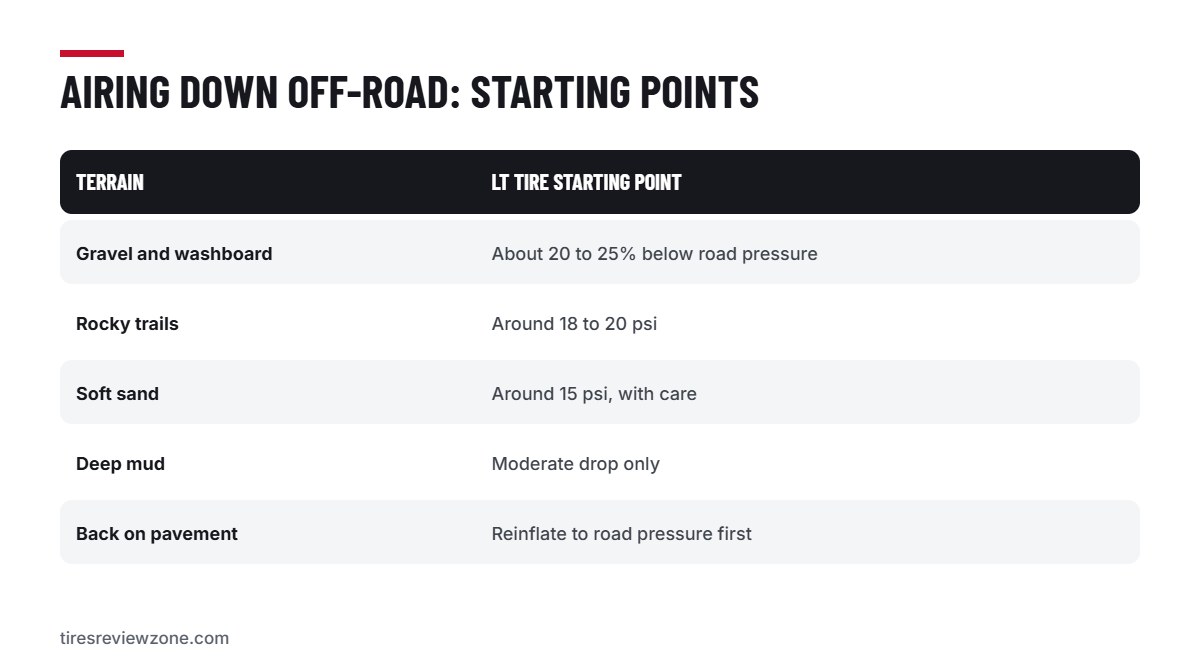
Airing down: how and how much
Lowering tire pressure on the trail lengthens the footprint, so the tire floats over sand and wraps around rocks instead of bouncing off them. It is one of the biggest improvements you can make off-road, but it needs care:
| Terrain | Typical starting point (LT tires) |
|---|---|
| Gravel and washboard roads | Drop about 20 to 25% from road pressure |
| Rocky trails | Around 18 to 20 psi |
| Soft sand | Around 15 psi, lower only with care |
| Deep mud | Moderate drop; very low pressure can let tires unseat |
- These are starting points, not rules. Heavier vehicles need more pressure, and every tire and wheel combination behaves differently.
- Drive slowly when aired down, avoid sharp turns at speed, and never drive on pavement at low pressure.
- Carry an accurate gauge, a deflator and a compressor, and reinflate before returning to the road.
- Very low pressures can push the bead off the rim; bead-lock wheels are designed to prevent this on dedicated off-road rigs.
Looking after off-road tires
- Inspect after every trail day. Look for sidewall cuts, chunks missing from the tread blocks, embedded stones and bent rims. Sidewall damage cannot be repaired.
- Rotate more often. Aggressive treads are prone to uneven wear and cupping, so many owners rotate every 3,000 to 5,000 miles. Include a matching full-size spare if you have one.
- Rebalance when needed. Mud packed inside a wheel can cause vibration; clean wheels thoroughly and rebalance if it persists.
- Check alignment after hard hits. A big rock strike can knock the alignment out and wear new tires quickly.
Off-road tires for crossovers and small SUVs
Vehicles such as the Subaru Crosstrek, Forester and Toyota RAV4 do not need, and often cannot fit, heavy LT mud tires. The better choice is a passenger-size all-terrain designed for crossovers: lighter, quieter and easier on fuel, with enough bite for gravel, forest roads and snow. Stick to the original size or a very small increase, and check that the load index meets your door placard.
Frequently asked questions
What is the best off-road tire overall?
For most drivers who split time between pavement and trails, a quality off-road all-terrain such as the Falken Wildpeak A/T4W or Toyo Open Country A/T III is the best overall choice. Choose a mud-terrain only if you regularly face deep mud or rock.
Are mud tires good in snow?
Mud-terrains can handle deep, loose snow but are often poor on packed snow and ice. Many all-terrains and some rugged-terrain tires carry the severe-snow symbol and are better for winter.
What is the difference between R/T and A/T tires?
R/T (rugged-terrain or hybrid) tires sit between all-terrain and mud-terrain: more aggressive and capable off-road than an A/T, quieter and longer-lasting than an M/T.
Do off-road tires hurt fuel economy?
Yes. Heavier construction and aggressive treads raise rolling resistance. The effect is small with on-road all-terrains and much larger with full mud-terrains.
Should I air down off-road?
Lowering pressure on trails increases the footprint and grip, especially on sand and rocks. Re-inflate to the normal pressure before driving on pavement again.