

Disclosure: Tires Review Zone is reader-supported. As an Amazon Associate I earn from qualifying purchases, at no extra cost to you. Learn more.
Should trailer tires be balanced? Car tires always are, so it surprises many owners to learn that trailer tires often leave the factory unbalanced. Some trailer makers and tire shops say it does not matter; others say every trailer tire should be balanced. The honest answer is that it depends on the trailer, the speed you tow at and how long you want the tires to last. This guide explains why many trailers skip it, when it is worth paying for and how it is done.
Key takeaways: many trailer tires are never balanced because you cannot feel their vibration through the steering wheel, yet imbalance still causes cupped tread, shorter tire life and extra stress on bearings and axles. Balance them if you tow a travel trailer, fifth-wheel or enclosed cargo trailer at highway speeds, or if you see uneven wear. A tire shop spin balance is the most reliable method.
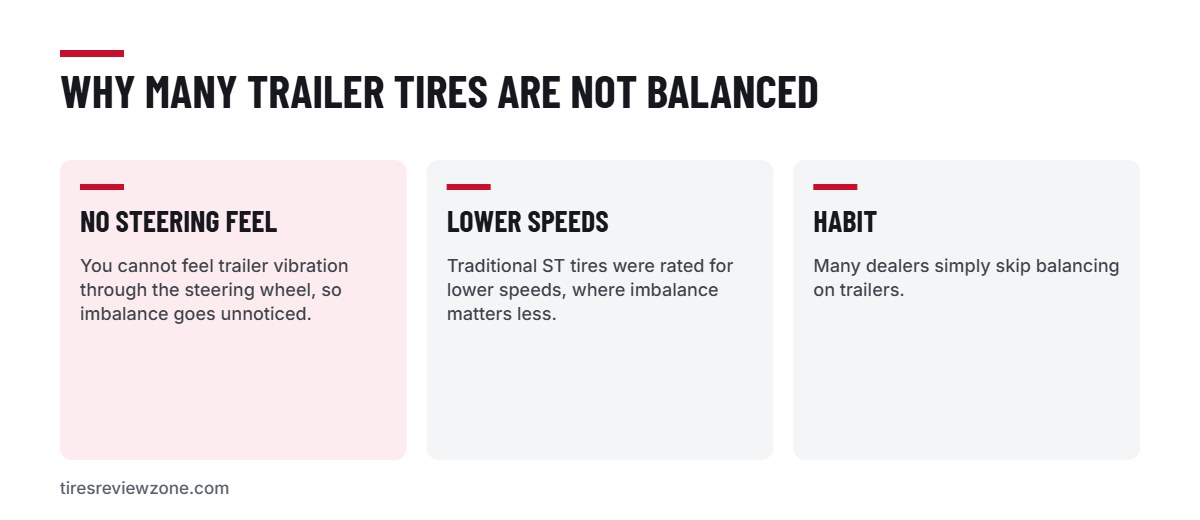
Why many trailer tires are not balanced
- No steering feedback: an out-of-balance car tire causes a vibration you feel through the steering wheel. On a trailer you feel nothing, so imbalance goes unnoticed.
- Lower speeds: traditional ST tires were rated for 65 mph, and imbalance effects grow with speed.
- Cost-cutting: balancing every tire on every new trailer adds labor, so many builders skip it on utility and budget trailers.
- Heavy loads mask vibration: a loaded trailer damps small vibrations.
None of that means imbalance is harmless. It simply means it is less obvious.
What imbalance does to a trailer
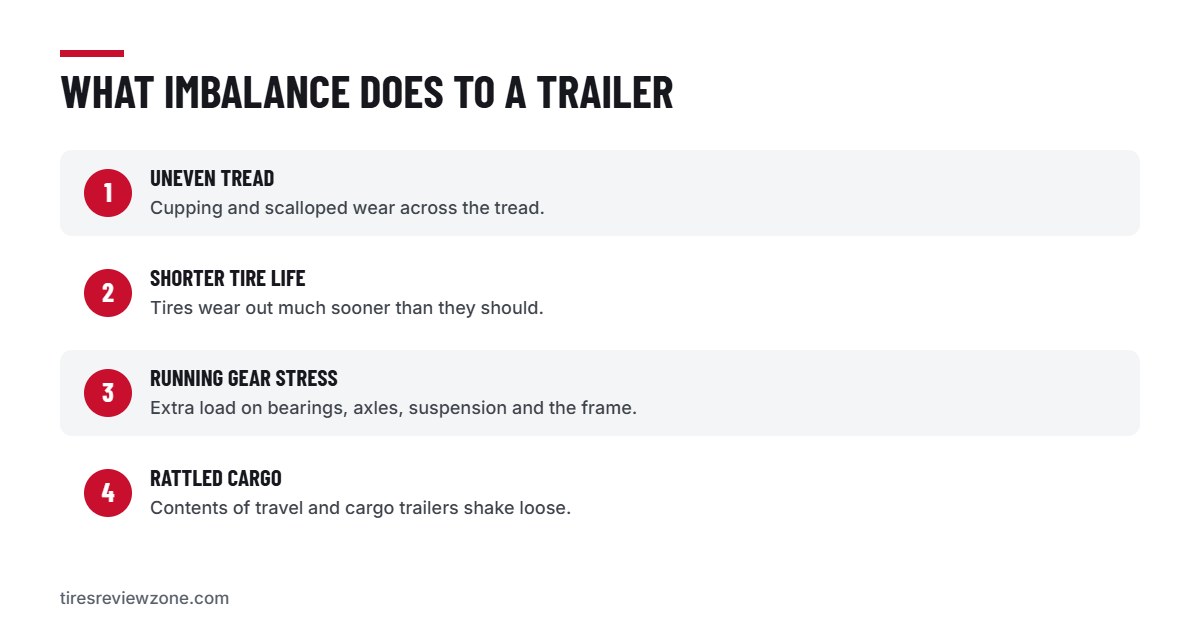
An unbalanced tire hops slightly every revolution. Over thousands of miles that causes:
- cupping and scalloped wear on the tread;
- shorter tire life, sometimes by a large margin;
- extra stress on bearings, axles, suspension and the trailer frame;
- rattling contents inside travel trailers and cargo trailers;
- more heat, which is the main enemy of trailer tires.
Should trailer tires be balanced? When it matters
Balancing is worth it if any of these apply:
- You tow a travel trailer, fifth-wheel or enclosed cargo trailer with contents that can be damaged by vibration.
- You regularly tow at highway speeds over about 55 mph.
- You see cupping, flat spots or uneven wear on the tires.
- You fitted LT tires or higher-speed-rated ST tires to tow faster.
- The trailer has single-axle suspension, which transmits more of each hop.
For a small utility trailer used a few times a year at low speed, balancing is optional.
How to balance trailer tires
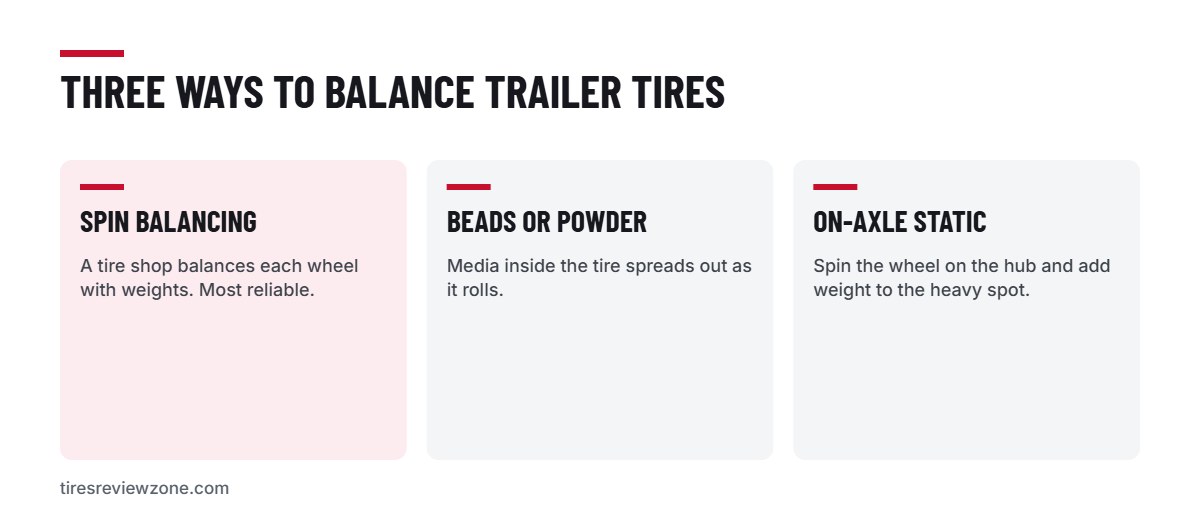
1. Spin balancing at a tire shop
The tire and wheel are mounted on a computerized balancer and spun. The machine shows where to add stick-on or clip-on weights. This is the most accurate method and is usually inexpensive per wheel. Make sure the shop’s balancer has the right adapter for trailer wheel centers.
2. Balancing beads or powder
Small ceramic or glass beads are poured into the tire through the valve or before mounting. As the wheel turns, they move to the light spots and balance it dynamically. Beads are popular with RV and trailer owners because they keep working as the tire wears. Use a valve core with a filter so beads do not clog it, and tell the tire shop they are inside.
3. On-axle (static) balancing
Some owners jack up the trailer, spin the wheel by hand and add weight opposite the heavy spot that settles at the bottom. This is crude and only catches large imbalances, but it is better than nothing on a remote trip.
| Method | Accuracy | Cost | Best for |
|---|---|---|---|
| Spin balancing | High | Low per wheel | Any trailer, new tires |
| Balancing beads | Good, adapts with wear | Low | Travel trailers, RVs |
| Static on-axle | Rough | Very low | Emergencies |
Balancing tips
- Balance when you mount new tires; it is cheapest then.
- Check the bearings at the same time; a worn bearing also causes wobble.
- Make sure tires are at the correct pressure before balancing; see our trailer tire pressure and load range guide.
- Use matching tires on each axle; never mix radial and bias-ply.
- Inspect for wear patterns every few trips with our trailer tire maintenance tips.
Balancing vs alignment
Balancing fixes uneven weight around the tire. Alignment fixes axles that are not straight or parallel, which causes one-sided or feathered wear. Trailers can be knocked out of alignment by curbs and potholes. If tires keep wearing on one edge after balancing, have the axle alignment checked.
For more on keeping trailer tires safe, register your tires through the USTMA tire registration page so you hear about recalls, and check open recalls at NHTSA. The USTMA tire care essentials cover monthly checks.
Frequently asked questions
Do trailer tires need to be balanced?
It is not always required, but balancing reduces uneven wear and vibration and is recommended for travel trailers and trailers towed at highway speeds.
Why are trailer tires not balanced from the factory?
Many builders skip it to cut cost, and because trailers have no steering wheel to reveal vibration and were traditionally towed at lower speeds.
Do balancing beads work on trailer tires?
Yes. Balancing beads move inside the tire to offset heavy spots and are popular with RV and trailer owners because they adjust as the tire wears.
What happens if trailer tires are not balanced?
Unbalanced tires can cause cupping, faster wear, extra stress on bearings and suspension, and vibration that rattles cargo.
How much does it cost to balance trailer tires?
Spin balancing at a tire shop is usually a modest per-wheel charge, and it is cheapest when done while mounting new tires.
Should new trailer tires be balanced when they are mounted?
It is worth it on travel trailers, fifth-wheels and enclosed cargo trailers that run at highway speeds. Ask the shop to spin-balance them when they are mounted; it costs little compared with the tire life it can save.
How often should trailer tires be rebalanced?
Rebalance whenever a tire is dismounted, for example after a puncture repair, and whenever you notice cupping or uneven wear. A yearly check is sensible on trailers that do long highway trips.
Does a small utility trailer need balanced tires?
A light utility trailer used for short, low-speed trips rarely needs it. If you load it heavily or tow it on the highway, balancing is cheap insurance against uneven wear.
Can unbalanced trailer tires cause sway?
Imbalance on its own rarely causes dangerous sway; that usually comes from too little tongue weight, too much speed or a poorly set-up hitch. But a vibrating, unevenly worn tire makes the trailer less stable and wears out bearings sooner, so balancing and correct pressure work alongside a good hitch setup. If your trailer sways, check the load distribution and tongue weight first, then look at the tires.