

Disclosure: Tires Review Zone is reader-supported. As an Amazon Associate I earn from qualifying purchases, at no extra cost to you. Learn more.
You crouch down to check your tires and notice something odd: the tread looks fine in the middle and on the outside, but the inside edge of a front tire is worn almost smooth. Front tires wearing on the inside is one of the most common tire complaints, and it is easy to miss because the inside of the tire is hidden under the car. It is also a warning sign. Something in the steering or suspension is making that tire lean or point the wrong way. This guide explains what causes front tires to wear on the inside, how to tell the causes apart, and how to fix the problem before it ruins another set of tires.
Key takeaways: front tires that wear on the inside edge usually have too much negative camber, toe-out, or worn ball joints and bushings. Have the suspension inspected, replace worn parts, then get a wheel alignment, and replace any tire worn down to the cords.
Why front tires wearing on the inside is a warning sign
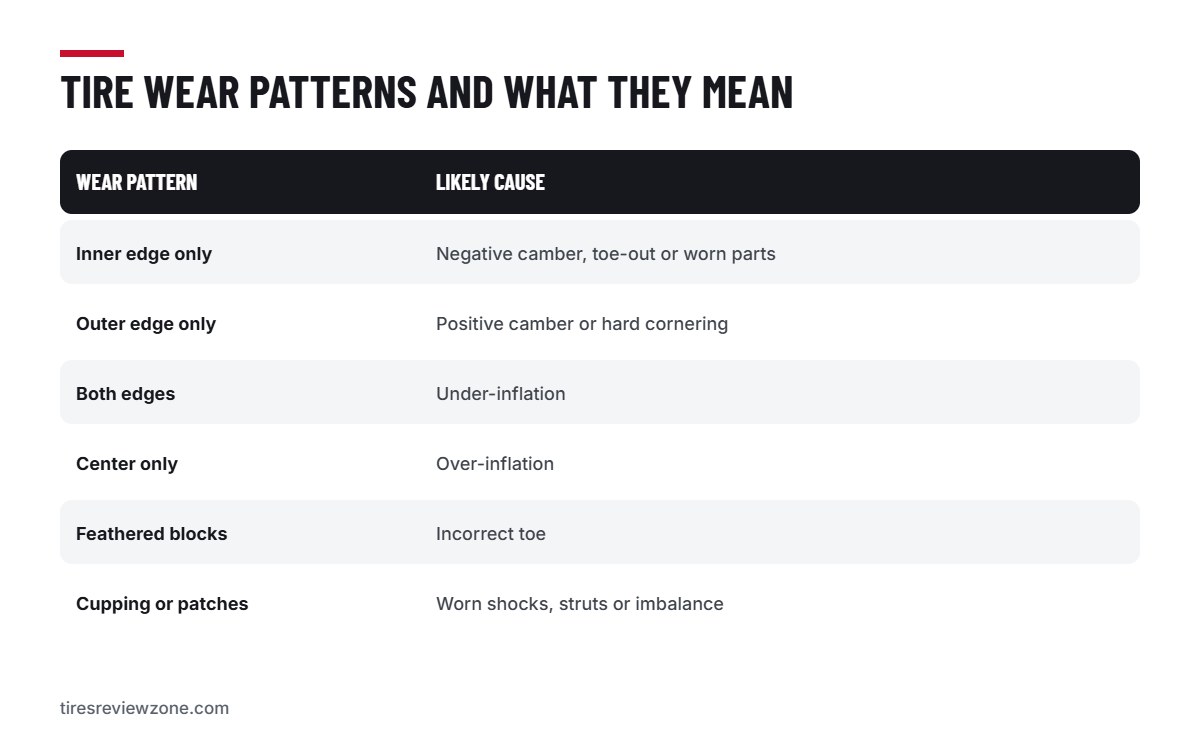
A tire should meet the road flat, so the whole width of the tread shares the load and wears at the same rate. When only the inner shoulder is wearing, that part of the tire is carrying more of the car’s weight or scrubbing sideways along the road. That points to a problem with the angles of the wheel, usually caused by alignment settings or worn parts. Pressure problems look different: as SlashGear explains, over-inflation wears the center of the tread, while under-inflation wears both the inner and outer edges.
Inside wear also matters for safety. Once the inner shoulder wears down to the cords, the tire can fail without much warning, and you may not see it until it is too late. It is worth running a hand over the inner edge every time you check your tire pressure.
The 5 most common causes
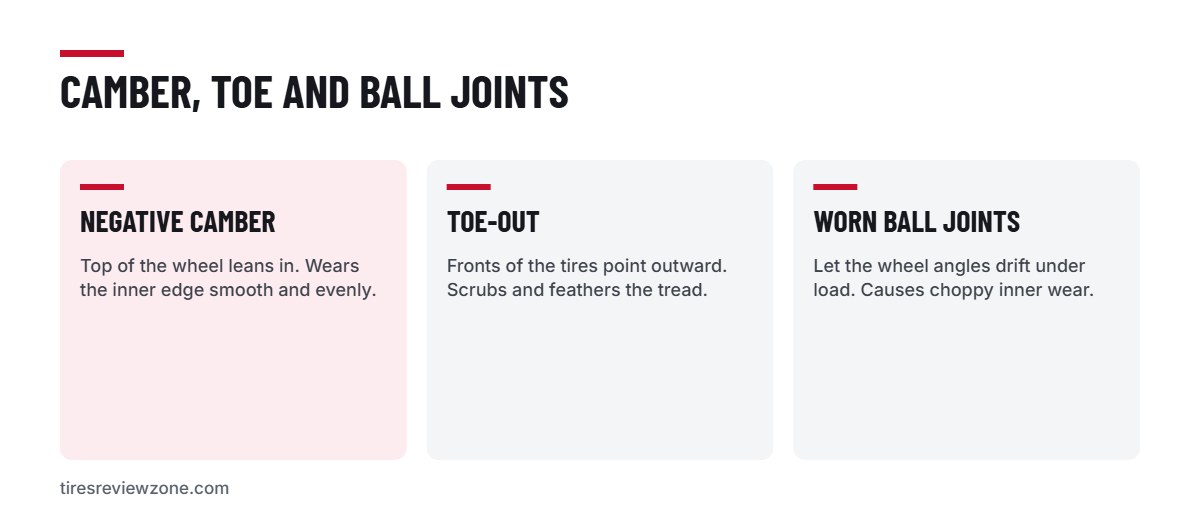
1. Negative camber
Camber is the tilt of the wheel when you look at the car from the front. If the top of the wheel leans in toward the engine, that is negative camber, and it presses the inner edge of the tire harder into the road. A little negative camber is normal and helps cornering grip, but too much wears the inner shoulder smooth and evenly.
2. Toe-out
Toe is the direction the wheels point when you look down from above. If the fronts of the tires point away from each other (toe-out), each tire scrubs sideways as it rolls. Toe problems often leave a “feathered” pattern, where the tread blocks feel sharp when you run your hand one way and smooth the other way.
3. Worn ball joints
Ball joints are the pivots that connect the steering knuckle to the control arms. When they wear, the wheel can wobble and its angles drift, especially under braking and over bumps. Worn lower ball joints are one of the most frequent causes of inner tire wear, and they are a safety issue in their own right: a ball joint that fails completely can let the wheel collapse.
4. Worn bushings, tie rods and other suspension parts
Control arm bushings, tie rod ends, strut mounts and sagging springs all help hold the wheel at the right angle. When they wear, the alignment may be correct when the car is standing still but drift under load. This is why an alignment alone sometimes does not fix inner wear: the angles move again as soon as you drive.
5. Lowered or modified suspension
Lowering springs, worn-out springs or a heavy load in the front of the car all increase negative camber. Cars that have been lowered without camber correction often wear the inner edges of their tires very quickly.
| What you see | Most likely cause |
|---|---|
| Inner edge worn smooth and even | Too much negative camber |
| Inner edge feathered, sharp one way and smooth the other | Toe-out |
| Choppy or patchy inner wear, clunking over bumps | Worn ball joints, tie rods or bushings |
| Both inner and outer edges worn | Under-inflation, not alignment |
| Only one tire worn on the inside | A worn or bent part on that wheel |
How to check for inside tire wear
- Turn the steering wheel all the way to one side so you can see the inner edge of the front tire.
- Run your hand across the tread from the inside to the outside. Feel for a smooth band, feathered blocks or steps in the tread.
- Use a tread depth gauge or a penny to compare the depth on the inside, center and outside.
- Repeat on the other side, then check the rear tires.
- Look for steel cords or bulges on the inner shoulder. If you see any, replace the tire before driving far.
Our tread depth checklist explains how to measure tread and when a tire is too worn to keep.
How to fix inner tire wear
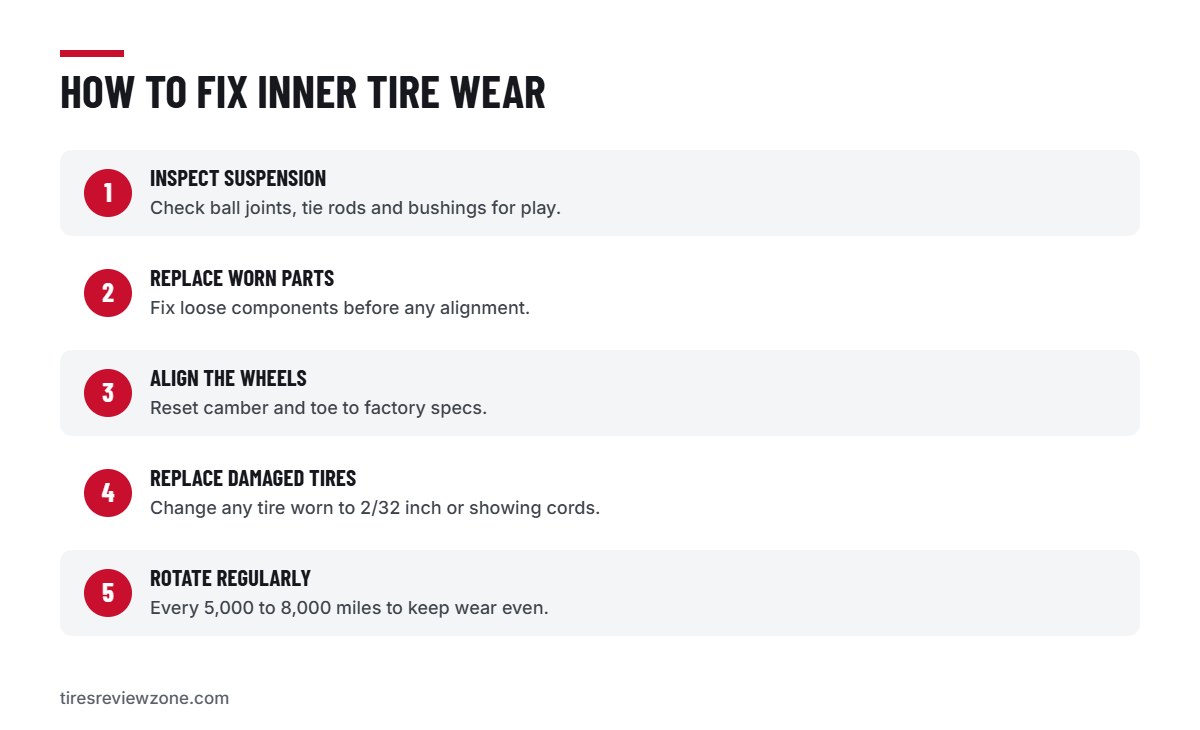
- Get a wheel alignment. A shop will measure camber, toe and caster and set them back to the vehicle maker’s specifications. Ask for the before-and-after printout.
- Inspect and replace worn parts first. A good shop will check ball joints, tie rod ends and bushings before aligning; aligning a car with loose parts is wasted money.
- Correct modifications. If the car has been lowered, camber bolts or adjustable arms may be needed to bring camber back into range.
- Replace badly worn tires. Once the inner edge is down to the wear bars or the cords, the tire must be replaced; NHTSA says tires are not safe once tread is worn to 2/32 inch.
- Rotate regularly. Rotation will not cure an alignment problem, but it spreads normal wear evenly and helps you spot changes early. See our guide to tire rotation.
For a fuller look at how alignment and balancing work, read our guide to tire balance and alignment.
How to prevent it
- Have the alignment checked once a year, after hitting a big pothole or curb, and whenever you fit new tires.
- Keep tires at the pressure on your door placard, checked monthly when cold.
- Rotate tires every 5,000 to 8,000 miles, or as Bridgestone recommends, every 5,000 miles or per the vehicle maker.
- Listen for clunks, knocks or wandering steering, which can point to worn suspension parts.
- Avoid overloading the front of the vehicle, for example with heavy plows or winches, without upgrading the suspension.
Frequently asked questions
Is it safe to drive with tires worn on the inside?
Only for a short time and only if there is still tread on the inner edge. Once the cords show, replace the tire straight away. Have the cause fixed at the same time or the new tire will wear the same way.
Will an alignment fix inside tire wear?
An alignment fixes wear caused by incorrect camber or toe settings. If worn ball joints or bushings are the cause, those parts must be replaced first, then the car aligned.
How much does an alignment cost?
Prices vary by shop and vehicle, but a front-end or four-wheel alignment is usually far cheaper than replacing a pair of tires early. Many tire shops offer alignment packages when you buy new tires.
Can low tire pressure cause inside wear?
Low pressure usually wears both the inner and outer edges together. Wear on the inside edge alone points to alignment or suspension problems.
Why are only my front tires wearing on the inside?
The front wheels steer and carry most of the car’s weight, so they are more affected by camber, toe and worn steering parts. Rear inner wear is more common on cars with independent rear suspension or a lowered ride height.