

Disclosure: Tires Review Zone is reader-supported. As an Amazon Associate I earn from qualifying purchases, at no extra cost to you. Learn more.
A flat tire on a quiet street is an inconvenience. A flat tire on the highway, with traffic passing at 70 mph a few feet away, is a genuine danger. The biggest risk is usually not the tire itself but where you stop and what you do while you are stopped. This guide focuses on exactly that: how to recognize a flat at highway speed, where to pull over, how to stay safe while you wait, and how to decide between changing the tire, using a repair kit or calling for help.
Key takeaways: if you get a flat tire on the highway, keep driving slowly with hazards on until you reach a safe spot such as an exit or a wide shoulder. Stay visible, never stand between your car and traffic, and only change the tire if you are well away from the lanes; otherwise call a safety patrol, roadside assistance or 911.
How to tell you have a flat at highway speed
Unlike a blowout, a flat usually develops over seconds or minutes. Signs include:
- The tire pressure warning light comes on, often followed by a steady pull to one side.
- A new thumping or flapping noise that gets faster as you speed up.
- Steering that feels heavy or vague, or a corner of the car that seems to sit lower.
- A vibration through the seat or steering wheel.
If the tire fails suddenly with a bang, follow the emergency steps in our guide on what to do when a tire blows out first, then use this guide once the car is under control.
Flat tire on the highway: choosing where to stop
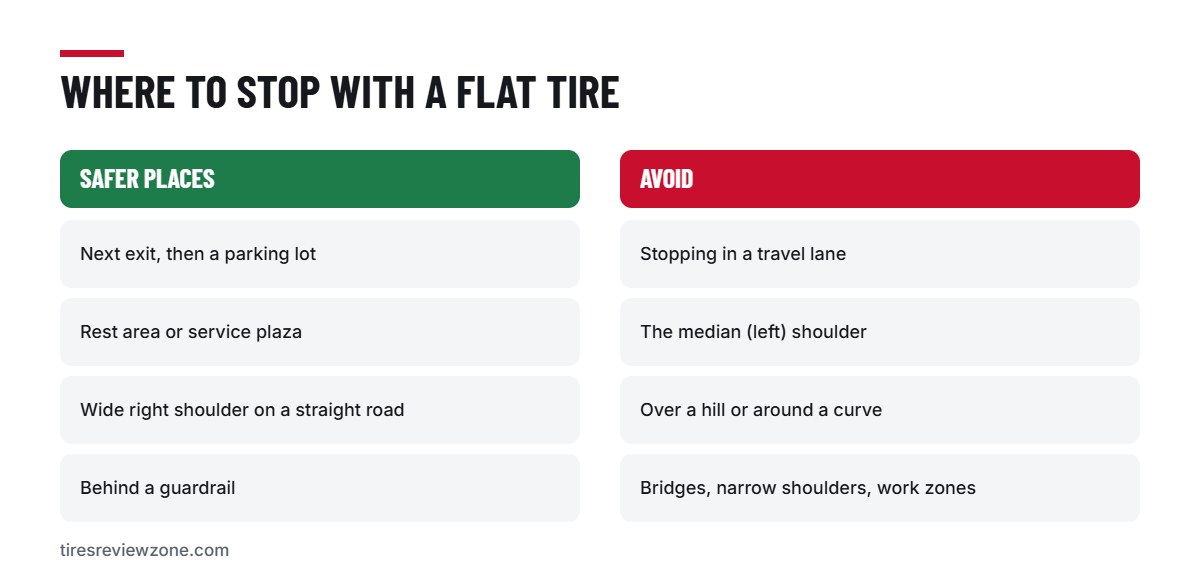
Where you stop matters more than how quickly you stop. If the car is still driving reasonably straight, keep going slowly with your hazard lights on until you reach a safer spot. Driving a short distance on a flat may ruin the tire and possibly the wheel, but a tire is cheaper than a crash.
| Safer places to stop | Places to avoid |
|---|---|
| The next exit ramp, then a parking lot or gas station | Stopping in a travel lane |
| A rest area or service plaza | The left (median) shoulder of a busy highway |
| A wide right shoulder on a straight, flat section | Just over a hill or around a curve, where drivers cannot see you |
| Behind a guardrail or barrier if one is available | Narrow shoulders, bridges and construction zones |
When you pull onto the shoulder, steer as far to the right as you safely can, so the car is well clear of the lane and you have room on the passenger side.
Make yourself visible
- Keep your hazard warning lights on the whole time you are stopped.
- If you carry reflective triangles or flares and can place them safely, put them well behind the car so approaching drivers have time to react. Do not walk along the edge of a live lane to do it.
- At night, turn on interior lights so passing drivers and responders can see people in the car.
- Raise the hood or tie something bright to the antenna or door handle if you need to signal that you need help.
Every state has a “Slow Down, Move Over” law, and many now cover disabled vehicles as well as emergency vehicles, but not every driver obeys them. The Colorado DOT, citing AAA research, reports that nearly 350 people a year are struck and killed while outside a disabled vehicle. NHTSA’s Move Over guidance explains what passing drivers are required to do, but you should never rely on them doing it.
Stay in the car or get out?
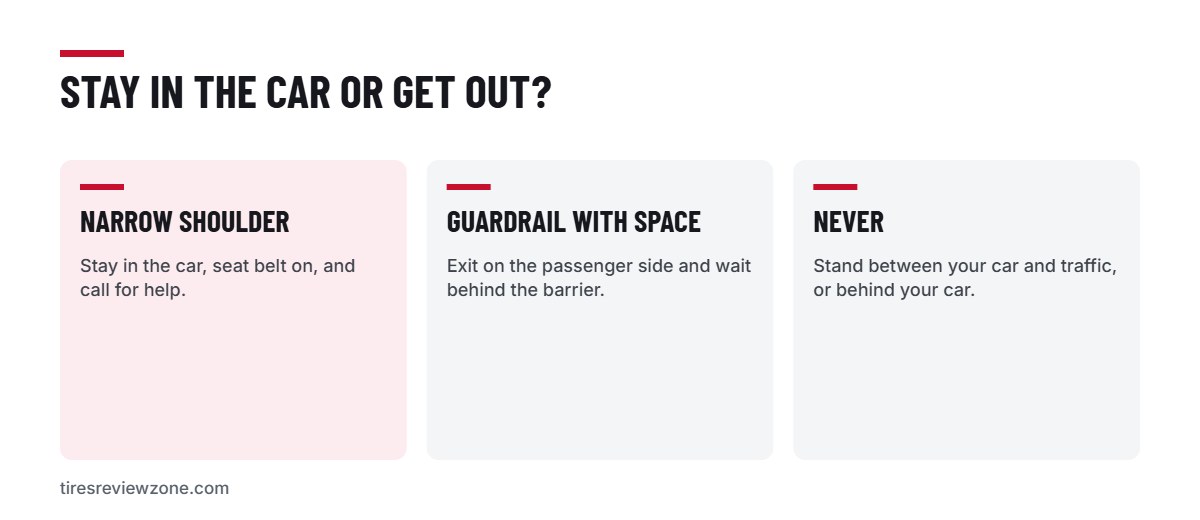
There is no single right answer; it depends on where you are stopped.
- Narrow shoulder, fast traffic, no barrier: stay in the car with your seat belt fastened and call for help. The car’s structure and airbags offer more protection than standing on the shoulder.
- Wide shoulder with a guardrail and space behind it: it can be safer to get out on the passenger side and wait well behind the barrier, away from the car and upstream of it.
- Never stand between your car and traffic, or directly behind your car.
Your options for dealing with the flat
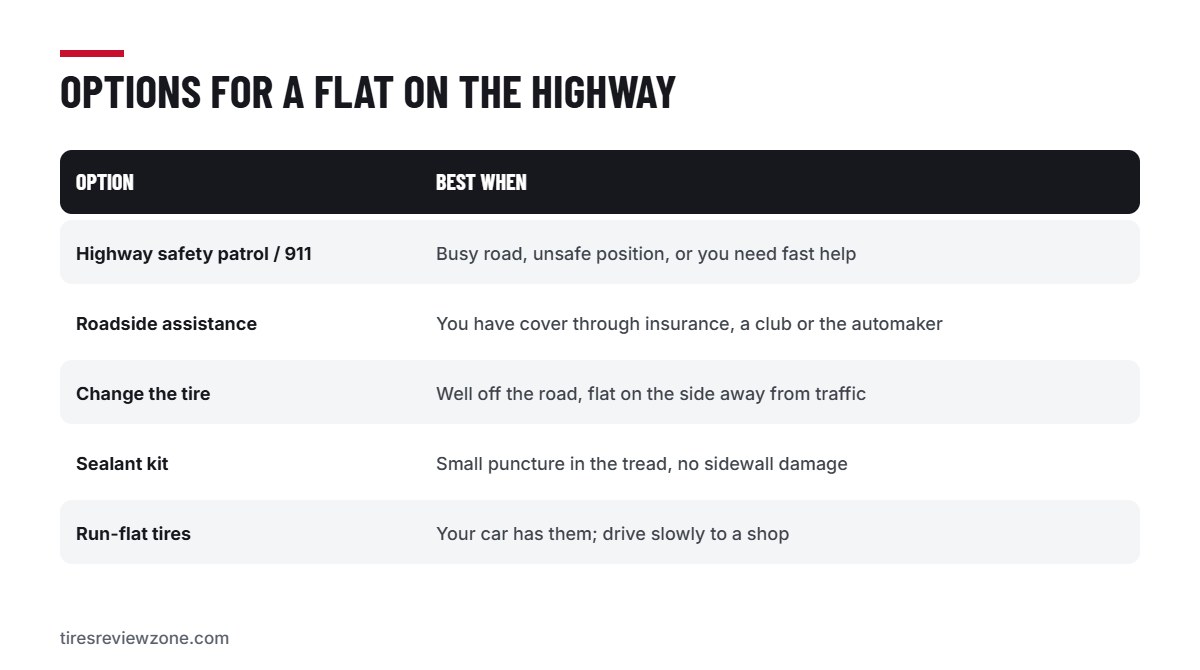
1. Call for help
On a busy highway, this is often the safest choice. Options include:
- State highway safety patrols. Many states run free patrols on busy highways that can change a flat, give you a little fuel or move your car to safety. Some are dispatched only through 911 or the state traffic center; Connecticut’s CTDOT Safety Patrol, for example, cannot be called directly.
- Roadside assistance from your insurer, an auto club, your car’s manufacturer warranty, or some credit cards.
- 911 if your car is in a dangerous position, you are in a live lane, or anyone is hurt.
2. Change the tire yourself
Only do this if the car is well away from traffic, on firm and level ground, and the flat is on the side away from the traffic lanes. Our step-by-step guide to changing a tire covers the procedure.
3. Use a sealant and compressor kit
Many newer cars come with a kit instead of a spare. It can seal small punctures in the tread in a few minutes, without jacking the car up, which makes it useful at the roadside. It will not fix sidewall damage or a tire that has been driven flat. See our guide to using a tire repair kit.
4. Drive on a run-flat tire
If your car has run-flat tires, you can usually keep driving at reduced speed for a limited distance to reach a shop. Check your owner’s manual for the limits.
After the flat: next steps
- A compact spare is temporary. Most are limited to around 50 mph and a short distance; check the sidewall or manual.
- Get the damaged tire inspected. A small nail hole in the tread can often be repaired properly from the inside; damage near the shoulder or sidewall cannot.
- If you hit something that caused the flat, have the wheel and alignment checked as well. Our guide on what to do if you hit a tire on the highway covers checking for damage and insurance.
Be ready before it happens
- Check that your spare is inflated, or that your sealant kit is in date.
- Know whether your car has a spare, a kit or run-flat tires.
- Save your roadside assistance number in your phone.
- Keep a flashlight, reflective triangles, gloves and a high-visibility vest in the car.
Frequently asked questions
How far can I drive on a flat tire?
Only as far as you need to reach a safe place to stop, slowly and with your hazards on. Driving further will destroy the tire and can damage the wheel, brakes and suspension.
Is it safe to change a tire on the highway shoulder?
Only if you are well away from traffic and the flat is on the side away from the lanes. Otherwise, call for help.
Should I stay in my car on the highway?
On a narrow shoulder with fast traffic and no barrier, staying buckled in the car is usually safest. If there is a guardrail with space behind it, waiting behind the barrier can be safer.
Can I call 911 for a flat tire?
Call 911 if your car is in a dangerous spot or blocking traffic, or if anyone is hurt. In several states, 911 is also how free highway safety patrols are dispatched.
Will my insurance pay for roadside help?
Only if your policy includes roadside assistance or emergency road service. Check your policy or app before you need it.