
Disclosure: Tires Review Zone is reader-supported. As an Amazon Associate I earn from qualifying purchases, at no extra cost to you. Learn more.
As an Amazon Associate, Tires Review Zone earns from qualifying purchases. We did not test these kits in person; this guide is based on manufacturer descriptions, seller listings, published reviews and owner feedback.
A nail or screw in the tread is the most common reason for a flat, and on a truck or off-road rig a plug kit can turn a long wait for help into a ten-minute fix. Plug kits let you seal a small tread puncture without taking the wheel off, then air the tire back up and keep driving to a tire shop.
Not all kits are equal. Cheap kits often have plastic handles that snap when you push a plug into a stiff light truck tire. This guide compares the best tire plug kits for trucks, SUVs and off-road vehicles, explains when a plug is and is not safe, and walks through how to use one.
Important: A Plug Is a Temporary Repair
Before choosing a kit, know its limits. The U.S. Tire Manufacturers Association’s tire repair basics say a proper repair needs a rubber stem (plug) to fill the injury and a patch to seal the inner liner, and that a plug alone is not an acceptable permanent repair. USTMA limits repairs to the tread area and to punctures no larger than 1/4 inch (6 mm). AAA likewise describes a plug as a roadside fix to get you to a tire shop.
So treat a plug kit as an emergency tool: plug the tire, drive carefully to a shop, and have it inspected and repaired with a plug-patch from the inside. Never plug the sidewall or shoulder.
Quick Picks
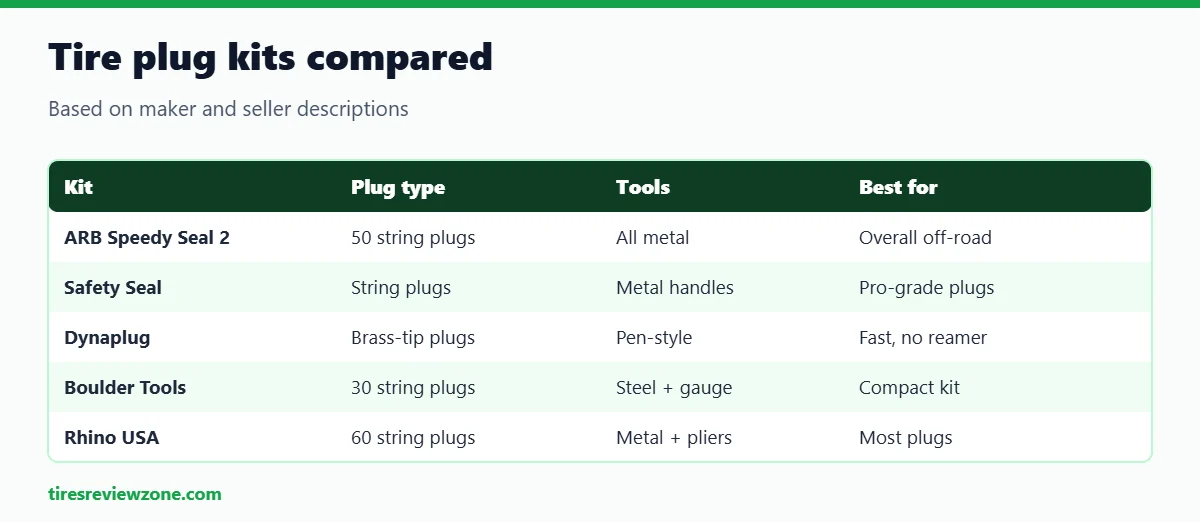
- Best overall for off-road: ARB Speedy Seal Series 2
- Best plugs and pro-grade tools: Safety Seal tire repair kit
- Fastest and easiest to use: Dynaplug
- Best compact kit: Boulder Tools tire repair kit
- Most plugs for the money: Rhino USA 86-piece kit
1. ARB Speedy Seal Series 2
Best overall for off-road trucks. ARB’s Speedy Seal 2 is one of the most popular kits among Jeep, truck and overland owners. Sellers describe it as an all-metal tool kit with about 50 vulcanizing repair cords in a compact, high-visibility case, designed to repair tubeless radial and cross-ply tires without removing the tire from the rim. The kit also includes needle-nose pliers, lubricant and a pencil tire gauge.
Owners generally praise the reamer and the weight of the tools. A few report that the insertion tool can bend if you lean on it too hard, and some recommend adding rubber cement to help plugs slide in on stiff tires.
Pros: sturdy metal tools, plenty of plugs, organised case, trusted off-road brand.
Cons: case is bulkier than soft-pouch kits; costs more than generic kits.
Check the ARB Speedy Seal 2 on Amazon
2. Safety Seal Tire Repair Kit
Best plugs and pro-grade tools. Safety Seal has supplied tire shops and tow trucks for decades. The company describes its kit as an on-the-wheel repair for all tubeless tires, from mowers and ATVs to light trucks and heavy equipment, with no cement needed. Its tools use metal handles, and many owners and former shop technicians say they hold up far better than plastic-handled kits. Even owners of other kits often buy Safety Seal plugs as replacements.
Pros: highly regarded plugs, durable tools, works on many tire types.
Cons: fewer extras than some kits; check which size kit you are buying.
Check Safety Seal kits on Amazon
3. Dynaplug Tire Repair Kit
Fastest and easiest to use. Dynaplug works differently from string plug kits. Each plug has a brass tip and loads into a pen-style tool. You push the tip into the puncture and pull the tool out, leaving the plug in place. The maker says it needs no glues or solvents and can repair a puncture in under a minute without removing the tire. It is very compact, which makes it popular with motorcyclists and drivers who want a kit in the glove box.
Pros: very quick, compact, clean to use.
Cons: fewer plugs per kit, plugs cost more than string plugs, and larger holes may need more than one plug.
4. Boulder Tools Tire Repair Kit
Best compact kit. Outdoor Life named Boulder Tools its best compact tire repair kit, noting that it fits full-size tools into a small case. Listings describe 30 self-vulcanizing plugs, steel tools, a tire pressure gauge, spare valve cores and caps, and lubricant. It suits trucks and SUVs where space behind the seat is limited.
Pros: small, full-size steel tools, gauge included.
Cons: fewer plugs than larger kits.
Check the Boulder Tools kit on Amazon
5. Rhino USA 86-Piece Tire Plug Kit
Most plugs for the money. If you want a large stock of plugs for several vehicles or a long trip, Rhino USA’s 86-piece kit is a common choice. Listings describe around 60 plugs, a metal reamer and insertion tool, pliers, a gauge and valve parts in a high-visibility case.
Pros: lots of plugs and spares, metal tools, bright case is easy to find.
Cons: larger case; tool quality is good but not as heavy as the premium brands.
Check the Rhino USA kit on Amazon
When Can You Plug a Tire?
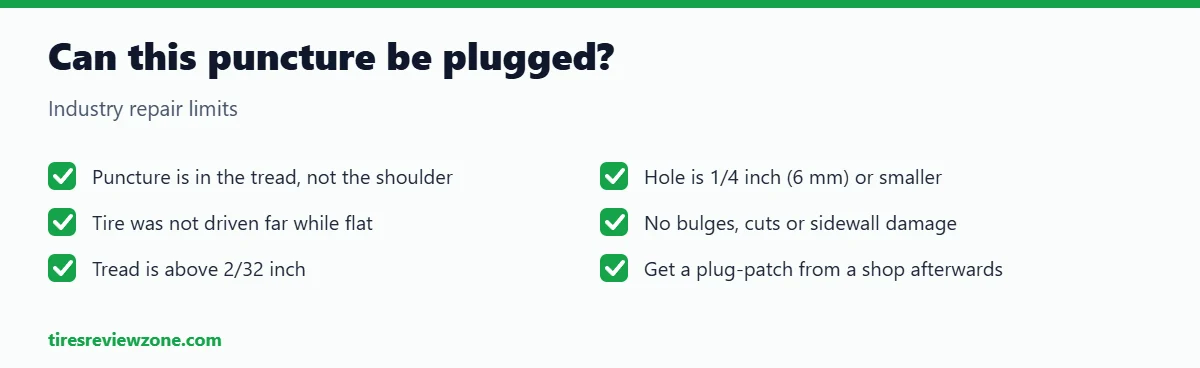
A plug is only appropriate when the puncture is in the tread area, is no larger than 1/4 inch, and the tire has not been driven far while flat. Driving on a flat damages the sidewall from the inside, and that damage is not visible from outside. If you see bulges, cuts, cords or damage near the shoulder, put on the spare instead. Our guide to whether a tire with a nail can be patched covers this in more detail.
How to Plug a Truck Tire
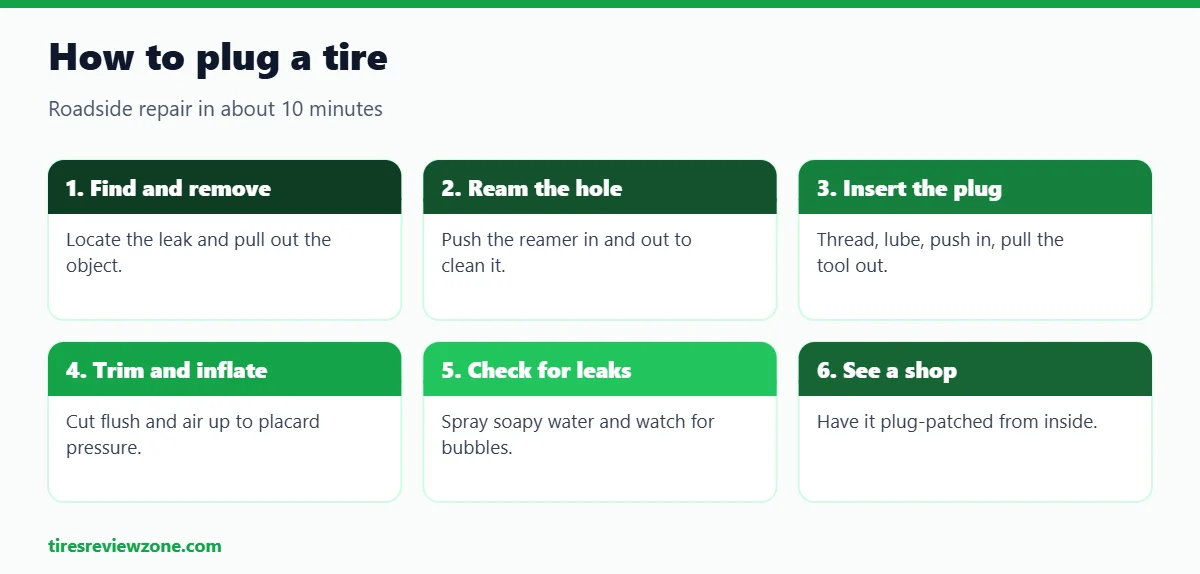
- Find the leak: look for a nail or screw, or spray soapy water and watch for bubbles. Mark the spot.
- Remove the object: pull it out with pliers. Air will escape, so work quickly.
- Ream the hole: push the reamer straight into the hole and work it in and out several times to clean and roughen the channel. On stiff light truck tires this takes real effort, which is why metal T-handles matter.
- Load the plug: thread a plug through the eye of the insertion tool so it is centred, and coat it with lubricant or cement.
- Insert: push the tool into the hole until about a third of the plug remains outside, then pull the tool straight out without twisting.
- Trim and inflate: cut the plug ends close to the tread and inflate to the pressure on your door placard.
- Check for leaks: spray soapy water over the plug. If bubbles appear, try again with a new plug.
For a broader walkthrough, see our five-step guide to using a tire repair kit. If the damage is too large to plug, here is how to change a tire safely.
What to Look For in a Tire Plug Kit
- Metal T-handles: plastic handles can crack under the force needed for truck tires.
- Quality plugs: self-vulcanizing string plugs that seal well and stay soft in storage.
- Lubricant or cement: makes insertion much easier.
- Extras: pliers, a knife or blade for trimming, valve cores, and a pressure gauge.
- Case: a sturdy case keeps tools together and dry in a truck bed or toolbox.
Pair Your Kit With a Compressor
A plug kit is only half the job: you also need to put air back in. Many truck owners keep a 12V compressor next to the plug kit. See our guide to the best portable air compressors for truck tires for options that clamp to the battery and fill truck tires quickly.
Plug Kit vs Tire Sealant vs Spare Tire
Plug kit: fixes a nail or screw hole in the tread in minutes, works on large truck tires, and leaves the tire easy for a shop to repair properly afterwards. It needs a compressor or pump to re-inflate.
Liquid sealant: squirted in through the valve, sealant can stop small leaks without tools. It is quick, but it can be messy for the shop, may not seal larger holes in heavy tires, and some sealants can affect TPMS sensors. It is better suited to emergencies on cars than to repeated use on trucks.
Spare tire: the only real option for sidewall damage, large cuts or a tire that has been driven flat. Many trucks carry a full-size spare under the bed, but check its pressure regularly; it is often the most neglected tire on the vehicle.
Most truck and off-road owners carry both a plug kit and a working spare, since each covers situations the other cannot.
Build a Complete Flat Tire Kit
A plug kit works best as part of a small roadside kit kept in the cab or toolbox:
- Plug kit with metal tools and spare plugs.
- 12V compressor that clamps to the battery.
- Accurate tire gauge, since compressor gauges are often off. See tire gauges.
- Valve core tool and spare cores for slow leaks at the valve.
- Work gloves and a headlamp for night repairs. See headlamps.
- Spray bottle of soapy water to find leaks and check your repair.
- Jack, lug wrench and wheel chocks in case the tire cannot be plugged.
Common Mistakes to Avoid
- Plugging too close to the shoulder: repairs near the edge of the tread or on the sidewall flex too much and can fail.
- Skipping the reamer: a plug pushed into an unprepared hole often leaks or works loose.
- Twisting the insertion tool on the way out: this can pull the plug back out with it.
- Using old, dried plugs: stiff plugs do not seal well. Replace them every few years.
- Treating it as permanent: a plugged tire still needs inspection and a proper repair at a shop.
- Driving fast on a fresh plug: keep speeds moderate until the tire has been properly repaired.
Plugging Tires on Trails and Remote Roads
Off-road, punctures often come from sharp rocks, sticks or debris rather than a neat nail. Before plugging, look closely at the damage. A small round hole in the tread plugs well. A long slice, a gash in the sidewall or a tear from a rock usually needs the spare. On trails, many drivers carry extra plugs because a stubborn hole sometimes takes two plugs side by side to seal well enough to reach camp or the trailhead.
Air down tires before plugging if the tire is still holding some pressure; it makes reaming and inserting easier. After the repair, air back up slowly and watch the plug. If the tire keeps losing air, switch to the spare rather than pushing on.
Frequently Asked Questions
Is it safe to drive on a plugged tire?
A plug can get you to a tire shop, but industry groups do not consider a plug alone a permanent repair. Have the tire dismounted, inspected and repaired with a plug-patch.
Can you plug a sidewall puncture?
No. Sidewall and shoulder damage is not repairable under USTMA guidelines; replace the tire.
How big a hole can you plug?
Industry guidelines limit repairs to punctures no larger than 1/4 inch (6 mm) in the tread area.
Do tire plugs expire?
Plugs can dry out over time. Some makers list a shelf life of several years, so replace old plugs and keep the kit out of extreme heat.
Can I plug a tire without removing it?
Yes. All the kits in this guide are designed for on-the-wheel repairs. You only need to jack up the vehicle if the puncture is hard to reach.
Final Verdict
The ARB Speedy Seal 2 is our top pick for trucks and off-road vehicles thanks to its metal tools and plentiful plugs. Safety Seal offers the most trusted plugs and very durable tools, Dynaplug is the fastest and most compact, Boulder Tools is the best small kit, and Rhino USA gives you the most plugs for the money. Whatever you choose, remember a plug is a roadside fix: get the tire properly repaired soon after.