

Disclosure: Tires Review Zone is reader-supported. As an Amazon Associate I earn from qualifying purchases, at no extra cost to you. Learn more.
Learning how to change a tire is not difficult, but it is one of those jobs where the order of the steps really matters. Do things in the wrong sequence and the wheel spins when you try to undo the nuts, the car shifts on the jack, or the spare works loose a few miles down the road. This guide shows how to change a tire step by step and explains why each one comes where it does, so you understand the method rather than just memorizing it.
Key takeaways: change a tire in this order: secure the car, loosen the lug nuts while the wheel is on the ground, jack at the marked point, swap the wheel, snug the nuts in a star pattern, then lower the car and tighten fully. Re-check the nuts after a few miles and keep compact spares to about 50 mph.
This guide assumes the car is already stopped somewhere safe. If you are on a highway, read our guide on what to do if you get a flat tire on the highway first; on a busy road, calling for help is often the better choice.
Why a step-by-step approach matters
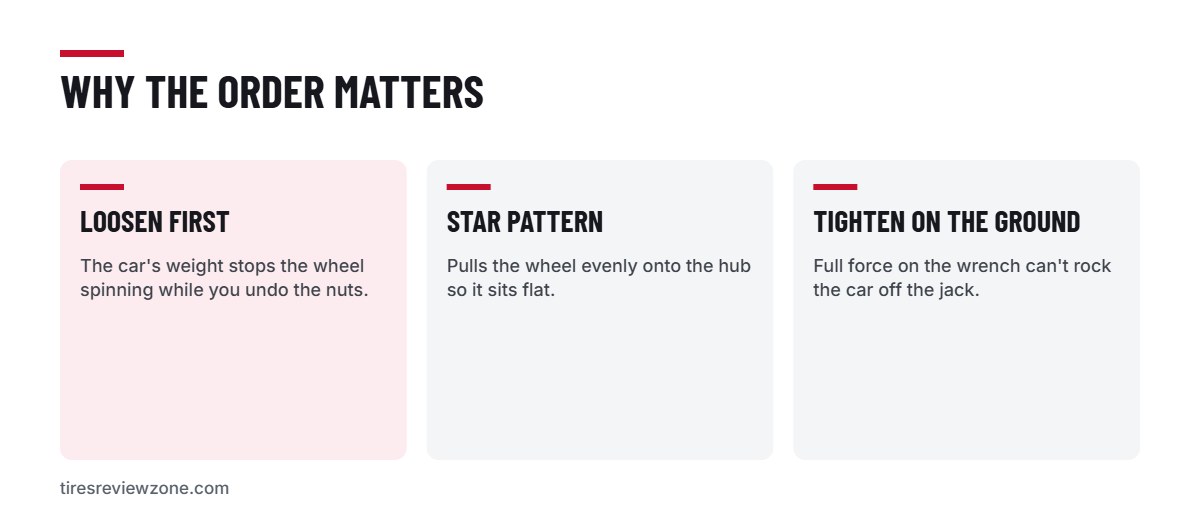
A car weighs well over a ton, and while you change a tire it is balanced on a small jack resting on a single point. Each step in the standard method exists to keep that weight under control:
- Securing the car first stops it rolling off the jack.
- Loosening the nuts before lifting uses the weight of the car to stop the wheel turning.
- Tightening in a star pattern pulls the wheel evenly onto the hub so it sits flat.
- Final tightening on the ground lets you apply full force without rocking the car on the jack.
What you need
| Item | Why |
|---|---|
| Spare tire or temporary spare | Check its pressure regularly; a flat spare is no help |
| Jack | Usually stored with the spare; use only at the marked lifting points |
| Lug wrench | Often stored with the jack; a cross-shaped wrench gives more leverage |
| Wheel lock key | Needed if your car has locking wheel nuts |
| Owner’s manual | Shows jacking points and spare tire limits |
| Wheel chock or a brick | Stops the car rolling |
| Gloves and a flashlight | Wheels are dirty; flats often happen at night |
How to change a tire, step by step
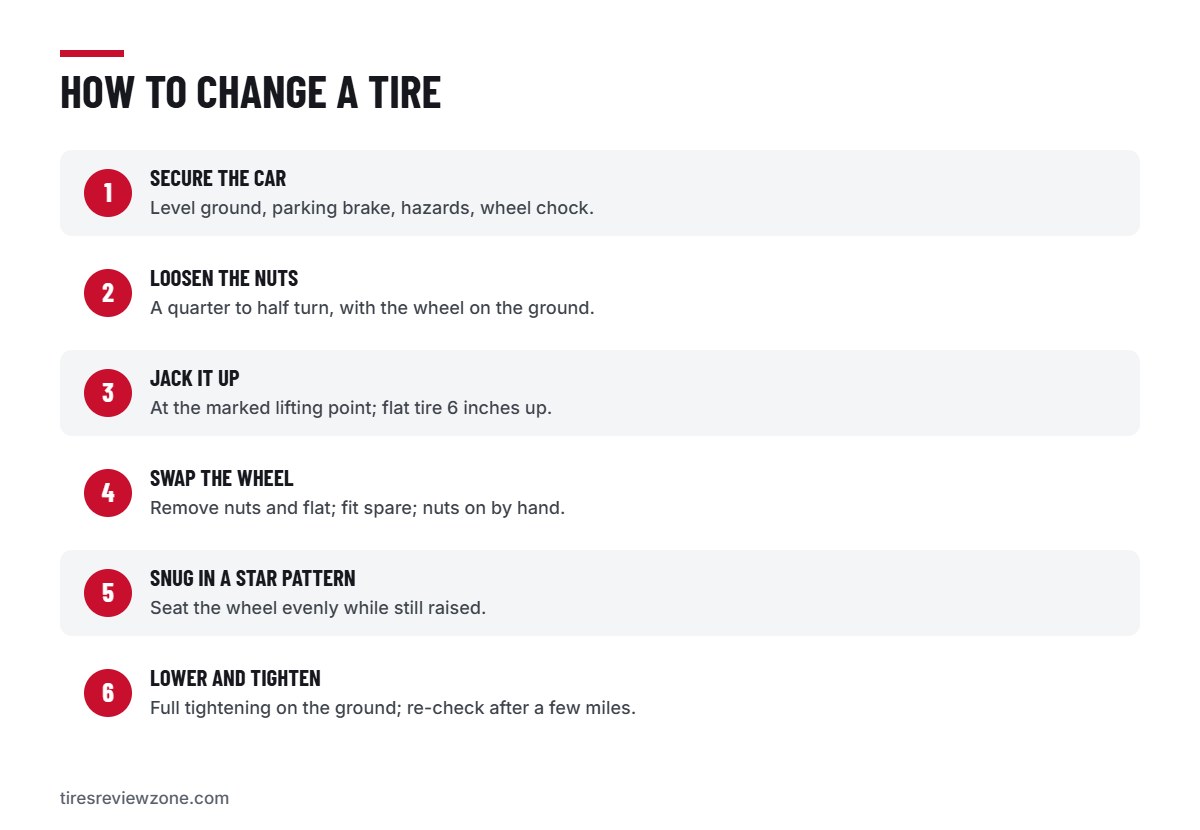
1. Prepare the car
Park on firm, level ground, set the parking brake and put an automatic in park (or a manual in first or reverse). Turn on your hazard lights. Place a wheel chock against the tire diagonally opposite the flat. Why first: a car that can roll is the biggest danger once it is on the jack.
2. Get the spare and tools out
Take out the spare, jack and wrench before you start, and check the spare has air. Why now: discovering a flat spare after the wheel is off leaves you worse off than calling for help at the start.
3. Remove the hubcap and loosen the nuts
Pry off any wheel cover, then turn each lug nut counterclockwise about a quarter to half a turn, without removing them. AAA explains that loosening them first means the car’s weight holds the wheel stable. Why before lifting: with the wheel in the air, it would simply spin.
4. Jack up the car
Place the jack at the reinforced lifting point nearest the flat, shown in your owner’s manual. Raise the car until the flat tire is about 6 inches off the ground. Never put any part of your body under the car. Why the exact point: lifting elsewhere can bend the body or let the car slip off the jack.
5. Remove the nuts and the flat tire
Unscrew the loosened nuts the rest of the way and keep them together, for example in the upturned hubcap. Pull the wheel straight toward you and lay it flat so it cannot roll away.
6. Fit the spare
Line up the holes in the spare with the wheel studs and push it fully onto the hub. Thread each nut on by hand to avoid cross-threading. If the nuts have a tapered end, that end faces the wheel; it centers the wheel on the studs.
7. Snug the nuts in a star pattern
With the car still raised, tighten the nuts with the wrench just enough to seat the wheel, working across the wheel rather than around it: tighten one, then the one roughly opposite. Les Schwab’s guide shows the correct pattern for 4, 5, 6 and 8-lug wheels. Why a star pattern: tightening around in a circle can pull the wheel on at an angle, so it does not sit flat against the hub.
8. Lower the car and tighten fully
Lower the car until the tire carries its weight, remove the jack, then tighten each nut firmly in the same star pattern. If you have a torque wrench, use the figure in your owner’s manual. Why on the ground: heavy force on the wrench while the car is on the jack can rock it off.
9. Pack up and check
Put the flat, jack and tools away, remove the wheel chock and check the spare’s pressure as soon as you can. Many compact spares need a much higher pressure than normal tires, often around 60 psi; the figure is on the spare’s sidewall.
After the change
- Re-check the nuts. Consumer Reports advises driving a few miles and then tightening the lug nuts one more time, because they can settle as the wheel beds in.
- Respect the spare’s limits. Most compact spares are rated for about 50 mph and a limited distance. A full-size spare can be driven normally.
- Fix the flat quickly. A puncture in the tread can often be repaired with a plug-patch from the inside; sidewall damage means a new tire.
- On cars with direct TPMS, the warning light may stay on while the spare is fitted.
Common mistakes
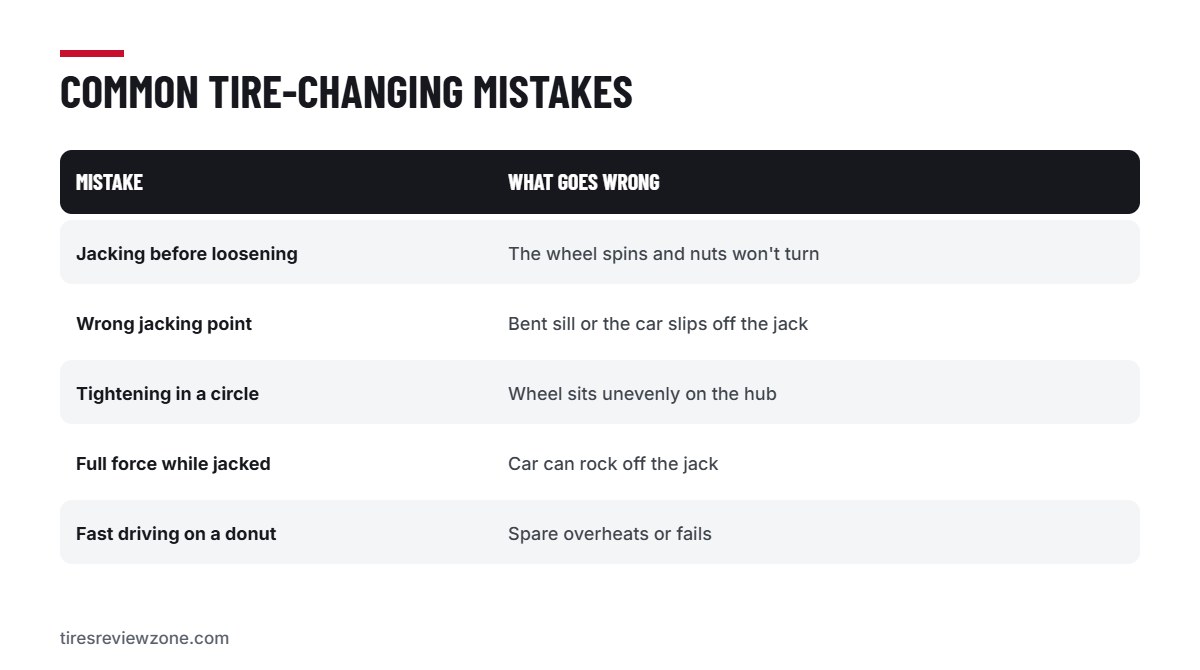
- Jacking the car before loosening the nuts, so the wheel spins.
- Using the wrong jacking point and damaging the body or sill.
- Tightening nuts in a circle instead of a star pattern.
- Fully tightening the nuts while the car is still on the jack.
- Forgetting the wheel lock key, which leaves you unable to remove the wheel.
- Driving fast or far on a compact spare.
If your car has a sealant kit instead of a spare, the method is completely different; see our guide to using a tire repair kit. Once the flat is sorted, you may also want to check whether the new tire should go on the front or back.
Frequently asked questions
Why do you loosen lug nuts before jacking up the car?
Because the car’s weight holds the wheel still. Once the wheel is off the ground it turns freely, making the nuts hard to undo.
What is the star pattern for lug nuts?
Tightening each nut in turn across the wheel, rather than around it, so the wheel is pulled evenly onto the hub.
How long does it take to change a tire?
Around 15 to 30 minutes for most people with the right tools, longer the first time. Practicing at home makes it much quicker.
How fast can I drive on a spare tire?
Most compact spares are limited to about 50 mph. Full-size spares can usually be driven normally. Check the label on the spare or your owner’s manual.
Do I need a torque wrench?
Not for a roadside change, but have the nuts checked with a torque wrench at a shop soon afterward, especially on alloy wheels.